
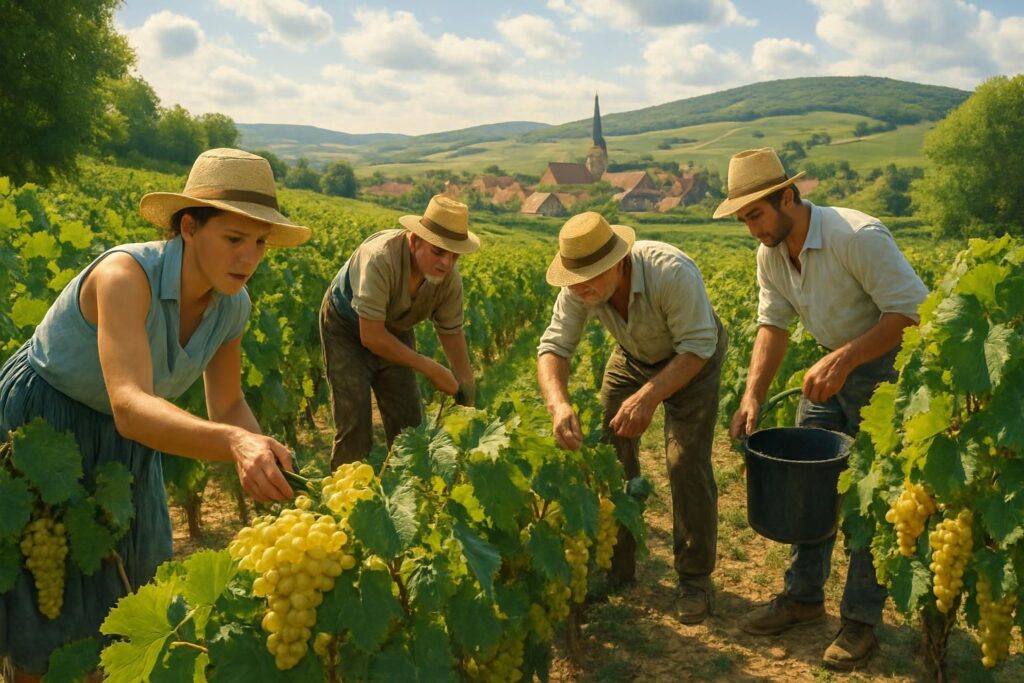
In 2026, Champagne experiences a historic year marked by ultra-early harvests never seen before. The heatwave and successive heat waves accelerate the ripening of grape varieties, forcing the winemakers to react quickly to preserve the quality and typicality of the upcoming vintage. This precocity disrupts agricultural traditions and logistical organization within the estates, while raising numerous human and technical challenges. This unprecedented situation reflects the concrete impacts of climate change on a terroir renowned for its demanding balance between grape maturity and aromatic finesse.
Faced with this challenge, each estate adapts with its own solutions, but all are confronted with the need for increased mobilization from early August. For family estates as well as for the large Houses, the harvest is a race against time. The limited presence of seasonal workers during this summer period generates additional tension, while the quality of the grapes must be ensured despite extreme climatic conditions. This phenomenon requires rethinking the annual management of agricultural calendars but also finding new strategies to anticipate these early harvests in Champagne.
Ultra-early harvests: an unprecedented phenomenon that disrupts the viticultural calendar in Champagne
Traditional harvests in Champagne generally ended between September and early October, depending on the vintages and climatic conditions. Yet, the year 2026 represents a radical break with the past. The first pickings started as early as the beginning of August, officially extending from August 8 to 22 depending on the municipalities and grape varieties – an exceptional calendar never seen in the wine region. Some plots in Aube even began the harvest as early as August 6 thanks to exemptions granted in response to the rapid advancement of ripening.
This precocity is directly linked to persistent and intense heat, a record for several decades, which accelerates the vine’s metabolism. The grapes reach their optimal sugar content earlier, while acidity drops more rapidly, disrupting the usual benchmarks for winemakers. This sudden shift requires constant vigilance in maturity checks to avoid premature harvesting and preserve the aromatic finesse typical of Champagne wines.
The example of the Lamiable house in Tours-sur-Marne perfectly illustrates these upheavals: faced with rapid maturity observed during early sampling, Ophélie Lapie-Lamiable chose to start the harvest five days earlier than planned to maintain the expected quality. This schedule adjustment, experienced as a real logistical challenge, is followed by intense mobilization of the teams, often incomplete due to competition with summer vacations. This situation testifies to the new complexity of an agricultural calendar now dictated by nature, and not by habit or tradition.
Human and organizational challenges of early harvests in Champagne
In the context of ultra-early harvests, one major challenge undoubtedly concerns the management of seasonal staff. In August and September, most potential seasonal workers are on leave, often far from Champagne. The urgent need to assemble competent teams quickly imposes multiple constraints. Inelle Coilot, an 18-year-old seasonal worker for the Lamiable house, recounts how the early harvest forced her to return from the south of France earlier than expected, illustrating the disrupted dynamics of seasonal recruitment.
Many estates must also face the shortage of available accommodations. In the heart of the tourist season, hotels and holiday rentals are fully booked. This situation sometimes forces the estates to deploy alternative solutions, such as housing with producers, resorting to temporary structures, or coordinating carpooling to limit travel.
Charles-Armand de Belenet, general manager of the Bollinger house, emphasizes how critical this rapid mobilization is: “we sounded the alarm to gather all the teams, it was a real achievement.” This statement reflects the tension generated by calendar imperatives and increases the organizational burden on winemakers, who must also ensure the constant quality of the grapes at the time of the harvest.
This human management is sometimes aggravated by increased physical and mental stress in the field. Harvesters often work at dawn to avoid the scorching heat of the day. This sustained pace requires strong professional commitment and significant physical adaptation. The organization of the days must thus incorporate optimized schedules and breaks to preserve the health of the teams while maintaining a fast and efficient harvest, essential to the quality of future vintages.
Quality of grapes and agronomic challenges in a reinforced climatic context
The heart of the success of harvests in Champagne always lies in the quality of the grapes picked. However, the exceptional precocity of 2026 imposes enhanced vigilance over several agronomic parameters. Extreme heat modifies the traditional balances between sugar, acidity, and aromatic compounds. This transformation requires increased control of the vine throughout the season, as well as rigorous anticipation of harvest points.
Winemakers use precise maturity monitoring techniques such as daily sampling, analysis of sugar levels (Baumé degree) and acidity, as well as sensory observation of the berries. This scientific approach improves decision-making and limits risks linked to harvesting too early or too late, thus ensuring the maintenance of Champagne’s typicity, traditionally tied to marked freshness.
The challenge is also agronomic because successive heat waves cause water stress that can affect vine health. A pronounced imbalance in water supply changes berry size and sugar concentration. Some plots become more sensitive to drought, a growing problem at the heart of the Champagne vineyard. This issue is fully explained in analyses such as Champagne and drought: impact on harvests.
In response, winemakers develop agroecological and adaptive practices, such as:
- optimized management of partial irrigation in authorized plots,
- adjustment of shading leaves to regulate photosynthesis and limit cluster exposure,
- use of cover crops to improve water retention in soils,
- the use of resistant grape varieties when planting new vines,
- rigorous selection of priority plots to maximize quality.
These agronomic innovations are direct responses to the consequences of the climate, reinforcing the strategic importance of early harvests for the overall management of Champagne terroirs and the vineyard’s sustainability.
Economic and territorial perspectives linked to ultra-early harvests in Champagne
The impact of premature harvests goes beyond the agricultural framework. The Champagne industry is strongly challenged by this change which affects the entire production and marketing chain. Precocity modifies cellar processing schedules, bottling, and even marketing strategies related to the launch of new vintages.
The Houses and producers must quickly adapt to these changes, often accelerating technical processes and reinforcing staff versatility. This organizational flexibility comes with significant economic pressure, notably from additional costs related to welcoming and managing seasonal teams at an unusual time, as well as the potential risk to the final quality of production.
For the region, these early harvests represent a territorial challenge. The municipality of Tours-sur-Marne clearly illustrates this dynamic, where winemakers must closely cooperate with local stakeholders to meet accommodation and logistical needs. Partnerships between winemakers, local authorities, and accommodation providers are emerging to manage the tension created by this early birth of the harvest.
In the long term, this climatic evolution forces the sector to rethink its economic model and incorporate environmental realities into its development projects. Innovative techniques, diversification of grape varieties, and digital transformation are now among the priority axes to strengthen the resilience of such an emblematic sector.
The video above illustrates the speed of execution and team mobilization during ultra-early harvests, thus exposing the constraints and know-how faced by Champagne winemakers.
Innovation and adaptation: how Champagne winemakers respond to the challenge of ultra-early harvests
To overcome difficulties related to climatic instability, Champagne actors adopt an innovative and collaborative approach. The introduction of digital agronomic monitoring tools allows modeling of grape ripening, precise adjustment of harvest dates, and optimization of resource use. These technologies also facilitate internal communication among teams for better coordination of vineyard interventions.
Furthermore, some estates experiment with splitting the harvest, treating more advanced plots earlier, while keeping other areas for later harvests, in order to preserve aromatic diversity and overall balance in blends. This flexibility comes with increased quality requirements, essential to maintaining Champagne’s international reputation.
This evolving model also relies on continuous training of harvesters and strengthening agronomic knowledge among younger generations. The transmission of traditional know-how, enriched by technological innovations, becomes the key to overcoming climatic uncertainties.
The consolidated efforts make it possible to face this new agricultural model. Every actor, from the family estate to the largest Houses, works for a Champagne faithful to its history, capable of adapting to contemporary environmental challenges. These developments fit into a sustainable dynamic where quality and authenticity remain priorities.
This second video highlights modern winemaking methods adapted to early harvests, emphasizing the link between technical innovation and maintaining the quality demanded in a world-famous terroir.
- Historically advanced dates of harvests in Champagne, unprecedented before 2026.
- Complex management of seasonal staff during peak summer vacation periods.
- Agronomic adaptations to preserve quality and combat the effects of drought.
- Economic impacts on the wine sector and local logistics.
- Use of technological innovations to improve harvest precision and winemaking.
In short, ultra-early harvests mark a new era for Champagne, where climate forces winemakers to rethink their practices while preserving the quality that has made their cuvées world-renowned.
Why are harvests increasingly early in Champagne?
Repeated heatwaves and global warming accelerate the ripening of grape varieties, forcing harvesters to pick earlier to preserve grape quality.
What are the main logistical challenges linked to ultra-early harvests?
Rapid mobilization of seasonal workers during the summer period and lack of available accommodations are major obstacles that Champagne estates must manage.
How do winemakers ensure quality despite the precocity of the harvests?
They use precise analyses and rigorous monitoring of maturity parameters to decide the optimal time for harvest and deploy innovative agronomic practices to manage water stress.
What economic impact do early harvests have on the Champagne sector?
These harvests generate additional costs related to logistics and personnel organization, as well as adaptation of production and marketing schedules.
What innovations are implemented to cope with early harvests?
Winemakers adopt digital tools to optimize ripeness tracking, split harvests across several periods, and strengthen team training and know-how.