
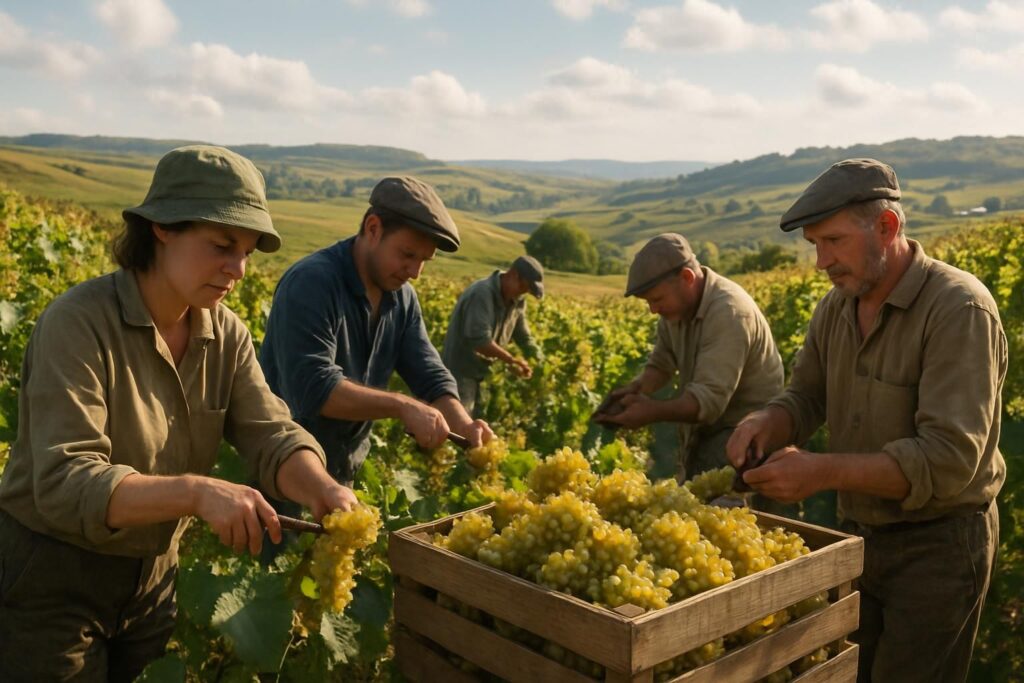
The 2026 harvests in Champagne represent an unprecedented turning point for viticulture in this emblematic region. The arrival of exceptionally early harvests, caused by a climate marked by intense heatwaves and persistent drought, disrupts the habits and strategies of winemakers. This record earliness, observed from August 6 to 22 depending on the communes and grape varieties, has not only accelerated the timeline of operations but also imposed a drastic reorganization, both for wine estates and for seasonal teams. The latter, strained by this abrupt advancement, had to adjust their availability, sometimes at the expense of their summer vacations.
This situation, unprecedented in recent memory, illustrates the tangible and growing impact of climate change on Champagne viticulture. In the heart of the Marne, at the Lamiable champagne house estate, the harvest began as early as August 17, five days before the initially planned date, under the direction of Ophélie Lapie-Lamiable. The organizational storm accompanying this new timing shows how mastering grape quality has become a meticulous balancing act in the face of climatic uncertainties.
Climatic factors behind the early harvests in Champagne
The exceptional earliness of the 2026 harvests in Champagne cannot be separated from the climatic evolution observed in recent years. The combination of an exceptionally warm spring and early summer, coupled with a significant rainfall deficit, accelerated the ripening of grape varieties. Several heatwave episodes favored rapid cluster growth, which advanced the traditional harvest calendar by about a week, an unprecedented phenomenon.
In this region where grape quality largely determines the character and finesse of champagne, this weather situation demands a rapid and rigorous adaptation. Prolonged drought periods have also altered vine physiology, sometimes limiting available water and concentrating sugars in the grapes. This concentration plays a crucial role at harvest time, as it directly influences the future organoleptic qualities of the wine.
Champagne producers must also cope with the logistical consequences generated by this climatic context. The earliness of the harvests requires anticipating the mobilization of teams and infrastructures. The difficulty of recruiting and housing seasonal workers in the height of summer, amplified by the overlap with summer vacations, further complicates harvest management. Nevertheless, the mobilization remains strong, as the harvest is the ultimate phase where the work of an entire year is expressed.
For a deeper look into this climatic topic, a thorough analysis of the impacts of drought on the harvests in Champagne sheds light on the current challenges facing the sector. It notably highlights the close links between climate, yield, and grape quality.
Harvest organization and logistics: challenges related to an anticipated harvest
Early harvests in Champagne require a complete reorganization of schedules and human resources. For many producers, this acceleration has caused unprecedented situations: recalling teams on vacation, express recruitment, and adapting material means. This flexibility has become a sine qua non condition to guarantee the success of the harvest.
A striking illustration of this dynamic is provided by the Bollinger champagne house. Its general manager, Charles-Armand de Belenet, mentions the “performance” achieved to gather harvesters on time, despite the summer break. This exceptional mobilization allowed the harvest to start as early as August 13, demonstrating the adaptability of Champagne structures in the face of a disrupted situation.
Moreover, the harvest organization must also take into account the management of extreme temperatures. To preserve the quality of the grapes, picking mainly takes place during the coolest hours of the day, often in the morning and late afternoon. This time management imposes an intense pace on the teams and requires increased vigilance regarding the quality of the fruit. The need for rapid and effective coordination between estate managers and harvesters thus becomes imperative.
The constraints related to housing seasonal workers in the heart of summer constitute another major obstacle. Many hotels and guesthouses in the region are already occupied by vacationers, forcing winegrowers to find alternative solutions. The earliness of the harvests in Champagne thus creates a double tension, both organizational and human.
To discover the detailed dates of the harvests in Champagne, as well as local specificities, the following link offers a reliable and updated source: official Champagne harvest calendar.
Impact on grape quality and viticultural adaptations to earliness
The accelerated ripening of grapes caused by exceptional climatic conditions in Champagne raises crucial questions regarding the quality of the harvests. Champagne grape varieties, notably pinot noir, chardonnay, and pinot meunier, are particularly sensitive to temperature changes and water stress. This year, the rapid maturation requires growers to be especially vigilant to harvest at the optimal moment.
An overly early harvest risks compromising the balance between sugar, acidity, and aromas, thus affecting the style and finesse of the final product. Conversely, waiting too long exposes the grapes to alterations related to overripeness, such as acidity loss or dehydration. This delicate balance demands enhanced field presence, with regular sampling and rigorous analyses before each harvest decision.
Some estates, such as the one led by Ophélie Lapie-Lamiable in Tours-sur-Marne, have chosen to start the harvest earlier, as soon as physiological maturity is confirmed. This strategic choice aims to guarantee optimal quality despite the pressure from climatic conditions. This professional gesture reflects the adaptability required by current viticulture.
Cultural practices are also evolving to accompany these changes. Adjustments in pruning, foliage management, and irrigation help better control vine vigor and grape quality. These combined efforts contribute to maintaining a level of excellence recognized worldwide.
To deepen these technical and grape quality dimensions, it is advised to consult the analysis offered by Champagne experts on the relationship between drought and harvests, a vital point to understand current viticultural challenges in the region.
Economic and human consequences of early harvests in wine estates
The shift in the traditional harvest calendar in Champagne has direct repercussions on the human and economic organization of the operations. Growers must combine rapid team mobilization with managing an already pressured market. This anticipation increases pressure on human resources, especially due to the need to employ seasonal workers often still on vacation.
The case of Inelle Coilot, an 18-year-old seasonal worker at the family estate Lamiable, clearly illustrates this reality: “Many were on vacation and did not expect such an early harvest. I myself had to come back much earlier.” This testimony reflects the tension prevailing in the affected sectors. This advancement in harvest shortens the rest periods of many workers, a constraint difficult to manage long term.
On the economic level, these changes involve additional investments to adapt harvesting tools and storage infrastructures. The synchronization of different actors – transporters, presses, vats – must be rethought, with more intense flows over concentrated periods. Despite these challenges, guaranteeing consistent quality remains the priority of the estates, to preserve Champagne’s reputation on international markets.
Beyond individual operations, the Comité Champagne plays an essential role in supporting this transformation. David Chatillon, co-president of the organization, recalls that while harvest organizational difficulties occur almost every year, adaptability remains key to success: “We have no choice, we manage. The harvest for a winemaker is one week and the fruit of a year of work.” This philosophy highlights the importance given to quality despite climatic and logistical constraints.
Future prospects: how Champagne viticulture adapts to this unprecedented context
The record early harvest in Champagne constitutes a strong signal of the transformations the sector must undergo in the face of climate change. To ensure the sustainability and quality of production, growers and Champagne houses are turning to innovative and sustainable solutions. This unprecedented context requires rethinking both cultural practices and the very organization of harvests.
Among promising future pathways, the introduction of grape varieties more resistant to heat and drought is the subject of many experiments. These efforts aim to maintain an aromatic profile aligned with market expectations, while ensuring better adaptation to climatic changes. Furthermore, precision viticulture, supported by sensor technologies and real-time analyses, allows for finer monitoring of the microclimate and vine vigor.
The development of collaborative networks between estates to share human and material resources also offers pragmatic solutions to face activity peaks linked to early harvests. These collective approaches aim to optimize seasonal worker employment and strengthen the resilience of the Champagne sector.
Finally, growing awareness of environmental issues pushes actors to adopt more soil and biodiversity-friendly practices. These actions help limit the impact of extreme warming on viticulture and enhance the image of an innovative and responsible Champagne. To follow the latest news on these transformations, the site champagne.news offers precise and updated analyses.
Why are harvests in Champagne so early in 2026?
Strong heatwaves, persistent drought, and an exceptionally warm spring have accelerated the ripening of grapes, advancing the harvest calendar by several days to several weeks depending on the region.
What are the consequences of these early harvests for growers?
Growers must adapt quickly by mobilizing their teams earlier, managing logistics in a tightened schedule, and closely monitoring grape quality to ensure excellence in Champagne.
How is grape quality affected by early harvests?
An overly early harvest can unsettle the balance between sugar and acidity levels in the grapes. Winemakers therefore carry out regular analyses to determine optimal timing to preserve the aromatic characteristics of Champagne.
What adjustments are made in estates facing these unprecedented conditions?
Estates modify their practices, notably in foliage management, irrigation, and pruning, while exploring more resistant grape varieties, and adopting precision viticulture technologies.
What solutions exist for housing harvesters in the heart of summer?
Growers must find alternatives as tourist accommodations are often fully booked in August, which represents an additional challenge for organizing early harvests.