
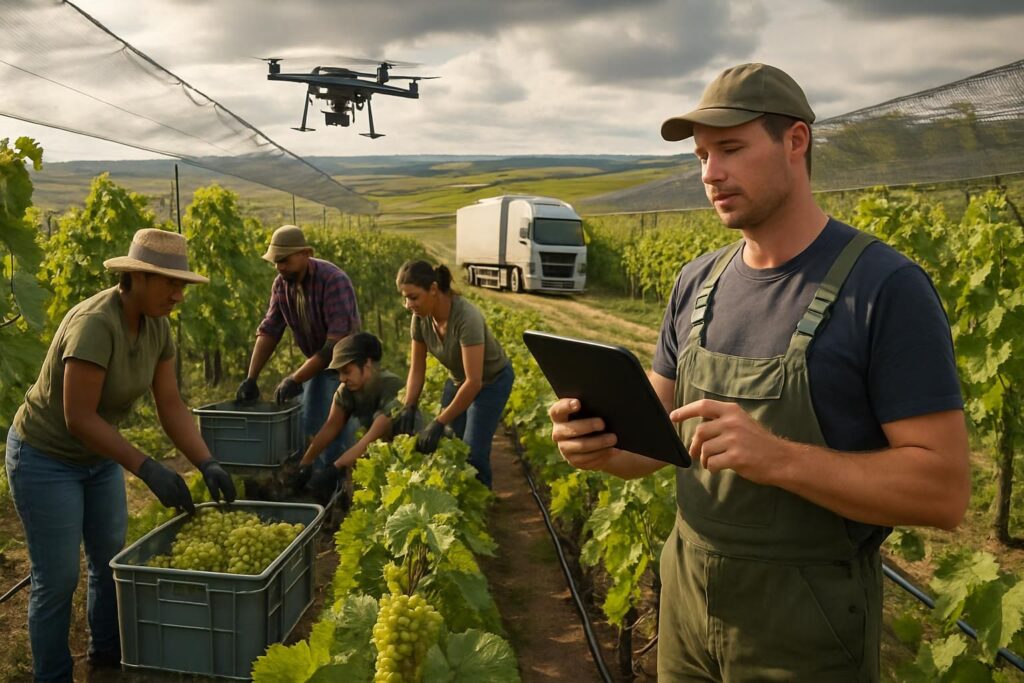
The 2026 harvest in Champagne is taking place in an especially sensitive agricultural and economic context, marked by an unprecedented climate challenge. After a historically hot June, the vine shows a one-week advance, indicating an early harvest with crucial stakes both for viticulture and for Champagne’s global commercial strategy. The Champagne Committee, during its annual press briefing in Épernay on July 16, presented a realistic assessment, emphasizing the need to adapt practices in response to global warming. This anticipation echoes a sector that must reconcile grape quality, environmental sustainability, and the conquest of international markets, in a context where global competition is intensifying and climate hazards directly affect volumes and yields available for export.
These early harvests result from a spring and early summer marked by record temperatures and persistent drought, conditions that already influence the cluster structure, their size, and aromatic profile. This critical period requires Champagne winegrowers to implement new sustainable viticulture strategies to preserve the qualitative potential of their grapes while optimizing yields. Moreover, the commercial situation pushes the sector to anticipate Champagne supply in view of fluctuating international demand, between a return to more measured consumption and the rising power of competitors such as Prosecco or Cava. The dynamic of the 2026 harvest thus illustrates a dual challenge: maintaining Champagne’s long-term reputation for excellence and the indispensable adaptation in the face of challenges induced by climate change.
Anticipating an early harvest and its impacts on Champagne viticulture in 2026
The technical monitoring conducted by the Champagne Committee reveals that the vine shows a significant advance of about one week compared to previous years. This precocity, long dreamed of by some professionals to benefit from favorable climatic conditions, now becomes a major uncertainty factor. Recurrent heat waves, combined with a severe water deficit – about 50% less than normal precipitation – exert significant pressure on the vines. Berry growth was slightly slowed in some more exposed zones, with sometimes visible signs of desiccation. However, the overall sanitary condition remains satisfactory, thanks to a lower prevalence of powdery mildew, partly inhibited by the extreme climatic conditions.
The first pruning cuts are anticipated as early as mid-August, which places the 2026 vintage among the earliest ever recorded. This timing disrupts traditional winemaking schedules and demands increased rigor in vineyard management. Farmers must adapt their practices, notably regarding rational irrigation and protection against heat stress, to maintain grape quality despite these constraints. Mastering these parameters is essential, considering that the finesse and aromatic complexity of Champagne rely on well-controlled cluster maturity.
Anticipating the calendar also affects the logistical organization of harvests and the availability of seasonal teams. In this context, the Champagne sector needs innovative solutions to combine efficiency with respect for biological cycles. Technological initiatives such as sensors acting in real time on soil water status or decision-support applications are developing to optimize this adaptation. These tools are now indispensable to meet the demands of sustainable viticulture while preserving Champagne’s competitiveness.
Commercial challenges of the 2026 harvest facing climatic and economic challenges
Champagne, which exports nearly 60% of its production, finds itself at a delicate economic crossroads. The progressive reduction of yields, which has dropped by 26% in twelve years, reflects climatic constraints accentuated by spring frosts and the scarcity of precipitation. This decline in available volume directly influences supply management on the most strategic international markets: the United Kingdom, United States, Japan, and Germany.
Even a moderate yield variation – on the order of 10% – can cause sensitive fluctuations in exported volumes, impacting both producer prices and the expansion capacity of Champagne houses. Setting the marketable yield is therefore a delicate exercise, combining arbitration between quantitative availability and qualitative ambitions. For the 2023 campaign, this cap was set at 11,400 kg per hectare. In this context, the results of the 2026 harvest will be closely scrutinized to adjust this reference and ensure a favorable balance between quality and quantity.
Paradoxically, the 2026 vintage seems to benefit from a favorable sanitary profile, with the heat limiting the progression of fungal diseases, which is a valuable asset for grape quality. This could mitigate the effects of water stress felt in some areas, without degrading the aromatic potential of the clusters. Commercial pressure is all the greater as the worldwide Champagne consumption slightly declined in 2025, coming down from a historic post-pandemic peak. The sector must now deal with more measured demand and a global market in reconfiguration, marked by the rising power of foreign sparkling wines such as Prosecco, Cava, and crémants outside of France.
Facing this situation, the sector is focusing both on qualitative excellence and commercial creativity to maintain its position. The stakes are high: to preserve Champagne’s attractiveness in major export markets while ensuring economically viable yields. Tight coordination between producers, merchants, and distributors is therefore essential to succeed in the conquest of markets amid intensified competition.
Agricultural adaptation and innovation: key tools to meet the climate challenge in Champagne
In the face of the impacts of global warming, the Champagne sector is working to integrate innovation and research into its cultural practices. Protecting the vines against drought and optimizing grape ripening now rely on advanced techniques in sustainable viticulture, combining respect for the environment and economic performance.
Cultural practices are evolving toward precise water management, notably through localized irrigation systems and soil conservation methods to avoid excessive evaporation. This results not only in better resistance of the vines to heat waves but also in optimizing sugar and aroma concentration in the berries, key elements for producing exceptional Champagne.
Moreover, innovations are not limited to agronomy. They include the use of drones to monitor the sanitary status of plots, as well as the application of predictive models based on artificial intelligence to anticipate risks and adapt cultural interventions in real time. These tools offer an undeniable strategic advantage against increasing climatic hazards.
These adaptations are essential to meet the demands of Champagne houses and consumers, who are increasingly sensitive to environmentally friendly approaches. They also allow anticipation of upcoming regulatory criteria around organic farming and sustainable certifications, essential for commercial valorization on foreign markets.
Actors are also attentive to social dynamics, such as discussions on the collective agreement for Champagne workers, which affect the sustainability of work in the vineyards. The sector thus engages in a global approach where agricultural innovation accompanies a more balanced economic and societal model.
The resilience of the Champagne vineyard facing extreme climatic hazards in 2026
Spring 2026 left a strong mark on the vineyards with three consecutive frost episodes between March and early April, causing a loss of around 40% of productive surface. This phenomenon was a real ordeal for winegrowers, forced to adapt quickly to limit consequences on quantity and quality of the harvest. Frost, combined with persistent drought, increased water stress and reduced the vigor of certain vines, especially affecting young plantations and the most vulnerable terroirs.
The resilience capacity demonstrated by Champagne relies on reinforced cultural practices and increased responsiveness of professionals. Techniques such as protective anti-frost sprinkling, mulching to retain soil moisture, or rigorous selection of plots to be harvested first are integrated into management strategies. These measures help preserve the integrity of the remaining grapes and mitigate economic impact.
The vineyard also benefits from cooperative work driven by unions and interprofessional structures. This solidarity facilitates information sharing, technical support, and pooling of resources to face crises together. For example, in connection with recent news regarding unions in Champagne and initiatives aiming to defend winegrowers’ interests, collective structuring is a fundamental lever.
Despite these challenges, early analyses indicate that the 2026 harvest could preserve remarkable quality, supported by a vigilant and agile vineyard. Maintaining balanced production will allow Champagne to meet its quality requirements while strengthening its international positioning.
Strategies to ensure the conquest of global markets despite climatic challenges
In a global market where competition is intensifying, the Champagne sector must combine innovation, sustainability, and excellence to maintain its dominance in the premium sparkling wine segments. The climate challenge requires production to integrate both qualitative criteria and environmental considerations, related to water resources, soil management, and carbon footprint.
To ensure the conquest of markets, Champagne houses also rely on adaptive marketing campaigns and valorization of the most prestigious terroirs, combined with thoughtful expansion in geographic areas with high potential. Mastering the harvest calendar, coupled with increased yield monitoring, is a key element to offer international buyers consistency in the product’s organoleptic characteristics.
Aware of this issue, the sector maintains ongoing dialogue with major importers and distributors. Coordination with groups like LVMH or Vranken-Pommery Monopole allows anticipation of market fluctuations and adaptation of supply according to obtained volumes. The question of balance between price and volume plays a crucial role in this strategy, notably in light of recent consumer trends observed at Leclerc and other major retailers.
In conclusion, the year 2026 reveals that the success of the harvest in a context of global warming results from a multifactorial adaptation capacity. Champagne professionals are thus engaged in a strategic dynamic combining technical rigor, agricultural innovation, and commercial ambition to preserve the excellence and attractiveness of this iconic wine on the world stage.
- Anticipating the harvest to adapt agricultural interventions
- Use of digital tools for vineyard monitoring and water management
- Development of sustainable viticulture practices to limit environmental impact
- Strengthening interprofessional cooperation to manage climate crises
- Targeted commercial strategies to meet international market requirements
Why are the harvests earlier in Champagne in 2026?
The precocity of the 2026 harvests is mainly explained by an exceptionally hot spring and early summer, with a significant precipitation deficit. These conditions accelerated the growth and maturation of the grapes, thus advancing the harvest calendar by about one week.
What are the main climate challenges faced by the Champagne vineyard?
The vineyard must contend with extreme events such as prolonged heat waves, severe drought periods, and successive spring frosts. These phenomena harm vine vigor and harvest quality, requiring constant adaptations of agricultural practices.
How is Champagne adapting to guarantee grape quality despite global warming?
The sector integrates agricultural innovations such as localized irrigation, the use of drones for sanitary monitoring, and predictive analysis based on artificial intelligence. These tools facilitate fine and sustainable vineyard management, preserving grape quality despite difficult climatic conditions.
What impact will the 2026 harvests have on Champagne’s export strategy?
The harvest will have a direct influence on volumes available for export and thus on international market shares. A successful harvest, combining quantity and quality, is essential to maintain competitiveness in the face of global competition and to support prices amid fluctuating demand.
What collective measures are in place to deal with climate hazards?
Unions and interprofessional structures play a key role in supporting winegrowers, notably through information sharing, pooling resources, and negotiating adapted collective agreements. These measures strengthen the sector’s resilience in the face of climate change challenges.