
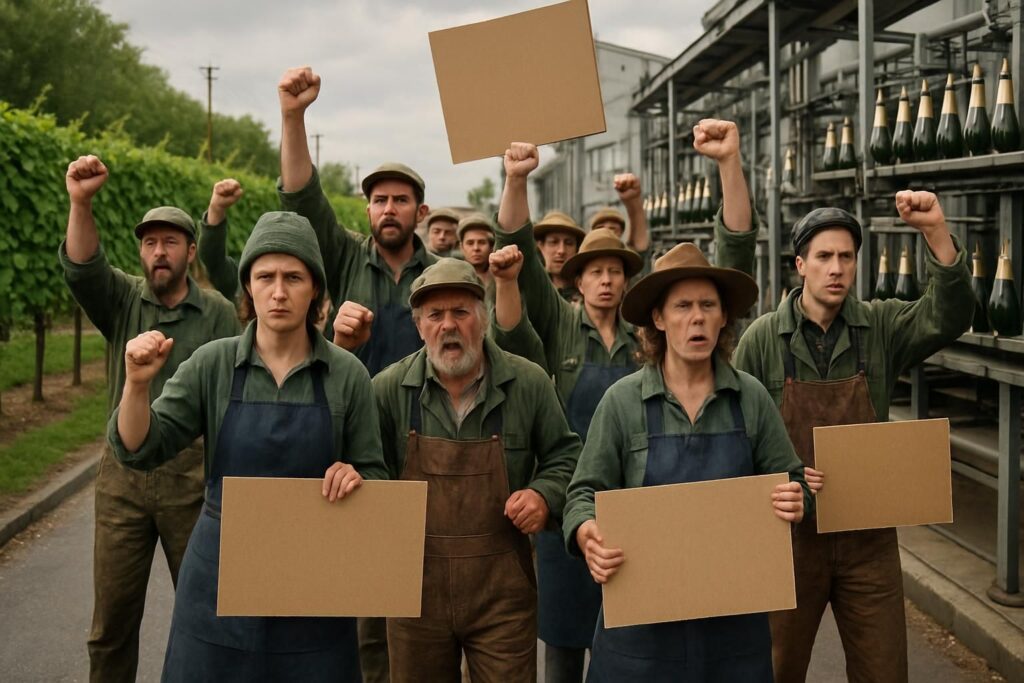
The champagne sector is once again the scene of a major union mobilization that raises questions as much about social issues as about the preservation of collective freedoms. In response to the reappearance of tensions linked to the partial denunciation of a salary agreement, the inter-union coalition, notably composed of CGT, CFDT, and FO, has called for a strike scheduled for July 9 and 10. This action is not limited to salary demands but is part of a broader fight to defend the fundamental right to demonstrate, a right perceived as threatened by certain recent decisions within the major champagne houses, particularly in the subsidiaries of the LVMH group.
In the middle of the summer season, as the grape harvest approaches, several hundred employees have already mobilized to demonstrate their determination. This momentum reflects a strong desire to make the workers’ voices heard, whether on economic or social issues, in a sector known for its prestige but also weakened by challenges of recognition and working conditions.
A union fight to preserve the right to demonstrate in the champagne sector
The mobilization of champagne unions against the risk of deterioration of the right to demonstrate originates from several alerts issued by workers and their representatives. For several weeks, unions have been denouncing the removal or questioning of rights considered acquired, notably the payment of a participation bonus deemed essential. This context has triggered an unprecedented protest movement, joining the traditional demands of employees around wages and working conditions.
Unions emphasize that the protection of the right to demonstrate is a fundamental pillar of workers’ rights. The fear that this right could be neutralized under the pretext of economic or strategic constraints in a field as prestigious as champagne has led to widespread mobilization. Indeed, eliminating the possibility to protest would weaken employees’ ability to defend their interests in a sector where the balance between haute gastronomy and wage precariousness can often be delicate.
This struggle goes beyond mere financial issues and is rooted in a deeper collective consciousness: that of worker solidarity and respect for commitments made by employers. In this regard, the inter-union coalition plays a central role by bringing together several representative organizations, such as CGT, CFDT, and FO, allowing effective coordination of actions including strikes, demonstrations, and negotiations. This union unity reflects a determination to defend both concrete goals such as wage increases and fundamental principles related to public freedoms.
Wage demands at the heart of social tensions in the champagne sector
The unions’ demands in the champagne sector are particularly focused on wage increases in line with real inflation and the rise of the minimum wage. The partial denunciation of a salary agreement, a recent event, has crystallized tensions and highlighted the widening gap between employees’ incomes and the cost of living. The issue of the removal of a participation bonus previously paid regularly also played a decisive triggering role.
The major houses, especially those belonging to the LVMH group, are directly affected, with employees mobilized at several key sites such as Moët & Chandon or Veuve Clicquot. They responded en masse to the strike call with the objective not only of obtaining a wage increase but also of having their efforts recognized in an economic context often judged difficult and marked by international competition.
This situation is all the more paradoxical as champagne, synonymous with luxury and French success, faces wage precariousness sometimes little known in this world. Unions denounce a model where the product’s renown does not always translate into equivalent social recognition. They highlight the need to preserve this sector while ensuring employees a fair working environment and decent income.
- Wage increases based on inflation and the minimum wage ;
- Maintaining participation bonuses deemed crucial for purchasing power ;
- Securing workers’ rights in a changing sector ;
- Strengthening solidarity among employees facing economic pressures ;
- Respect for the right to demonstrate as a fundamental element of social dialogue.
These demands define a clear framework around which the mobilization was structured and illustrate the close link between defending purchasing power and collective freedoms. For more information on the current negotiation issues in the sector, details can be found on the ongoing negotiations between unions and employers.
The strike movement as a means to defend the right to demonstrate: challenges and perspectives
The strike is a powerful lever for champagne unions to put pressure on management and guarantee the preservation of the right to demonstrate. This right, sometimes questioned in certain companies, is at the heart of debates as it embodies the possibility for employees to express themselves freely and challenge measures perceived as unjust.
This strike action is all the more significant as it takes place in a sector with high visibility, involving major houses emblematic of French heritage. The convergence of union actions in this symbolic context amplifies the scope of demands and lends national, even international resonance to the protests.
The consequences of this mobilization are multiple. The strike impacts production and related services, prompting negotiations at several levels. Unions leverage this effect to try to obtain solid guarantees on maintaining fundamental rights, including freedom of expression and active employee participation in decision-making processes.
Beyond immediate demands, it is a struggle for the recognition of a professional identity, notably in an industry that strongly values its brand image. The ability to organize demonstrations or engage in protests without repression is a key indicator of social democracy within the champagne sector. To this end, the upcoming mobilization is a milestone towards finding a balance between economic demands and respect for workers’ rights.
Socio-economic impacts of the strike in the champagne sector and actors’ responses
The onset of the strike in the champagne sector generates immediate repercussions on the functioning of companies and the image of the sector. In the short term, the suspension of work at sites like Moët Hennessy Champagne Services (MHCS) disrupts the production chain, while international demand remains strong. This tension illustrates the paradox of a sector known for its prestige but experiencing internal dysfunctions linked to social conflicts.
Management of major houses, as well as groups such as LVMH, are encouraged to return to the negotiating table. The agreement signed in 2026 for a minimum participation bonus of 3,300 euros, obtained recently after a similar mobilization, remains a precedent showing that strikes can lead to tangible progress. Maintaining this type of social benefit has thus become a crucial issue, not only for employees but also for the reputation of the sector as a whole.
Economically, the strike can also affect consumer perception, distribution, and marketing. Facing these challenges, champagne houses implement strategies to limit the impact, but solidarity among workers remains an essential barrier against any repression. Similar movements have been observed previously, notably at Cromology, another agro-industrial company in the sector, where the lifting of certain strikes was the result of reinforced dialogue, as reported in recent articles: lifting of the strike at Cromology.
Ultimately, this new phase of protest unfolds in a complex economic context, marked by a difficult year for the champagne sector, particularly in terms of sales conditions and prices of top crus, where defending employees’ rights becomes a condition for the very sustainability of the sector.
Perspectives and challenges for preserving workers’ rights in the champagne industry
Given the current situation, champagne unions face a major challenge: preserving a balance between the social recognition of employees and the economic viability of the houses. The ability to maintain the right to demonstrate is a key element, as it guarantees a space for social dialogue essential for anticipating and resolving conflicts.
The issues are multiple, ranging from wage recognition to the protection of social gains, but also adapting working conditions in the face of luxury market evolutions. Cooperation among the various actors, whether unions, company management, or public authorities, will be decisive to ensure a favorable and lasting crisis exit.
Social governance models in the champagne sector will need to evolve to more broadly integrate workers’ voices into strategic decisions. This involves a renewed commitment to solidarity and mutual respect, essential elements for building effective and transparent negotiation mechanisms. The current mobilization through strikes and demonstrations reflects a collective awareness of the stakes and inspires increased vigilance on the defense of public liberties within this prestigious sector.
Here are some action paths envisaged by unions to face upcoming challenges:
- Strengthening representative bodies for better communication between employees and management ;
- Supporting protest actions to maintain social pressure ;
- Training and information on union and collective rights ;
- Developing dialogue platforms to anticipate conflicts ;
- Promoting inter-company solidarity for greater unity in the sector.
The success of these initiatives largely depends on the ability to preserve the right to demonstrate and ensure a peaceful social climate, guaranteeing both economic sustainability and respect for workers’ rights throughout the sector. For a concrete overview of mobilizations in the Champagne-Ardenne region, a useful resource is available with the latest news on the access to the Chalons gallery and social movements.
What are the main reasons for the strike in the champagne sector?
The main reasons include a wage increase in line with inflation, maintaining participation bonuses, as well as defending the right to demonstrate, which is perceived as threatened by certain recent measures in the champagne houses.
Why is the right to demonstrate crucial for champagne employees?
This right allows workers to express themselves collectively and exert necessary pressure to defend their interests. Its preservation is essential to guarantee balanced social dialogue and the recognition of fundamental rights within companies in the sector.
What impact can the strike have on the champagne sector?
The strike affects production, may disrupt marketing, and mobilize public opinion. It also serves to strengthen solidarity among employees and to put pressure on management to obtain social progress and guarantee fundamental rights.
What actions are planned by the unions for the future?
Unions plan to strengthen representative bodies, support protest actions, offer more training on union rights, develop social dialogue, and promote inter-company solidarity for a more united sector.
How can one stay informed about ongoing negotiations in the champagne sector?
It is possible to consult specialized sources that follow social news in the sector, such as detailed information on ongoing union negotiations.