
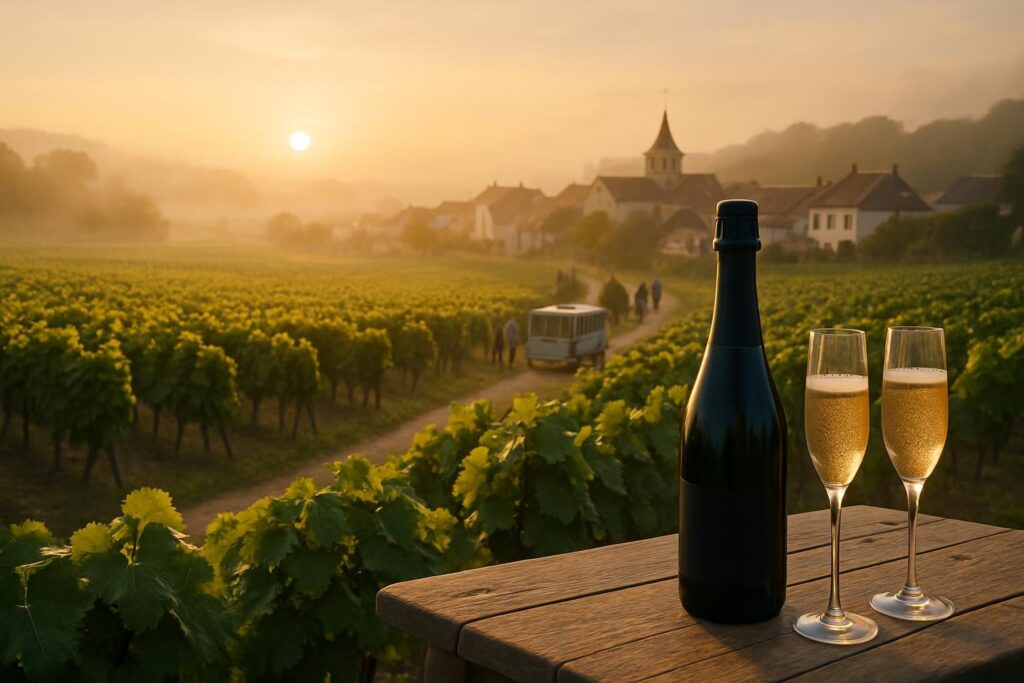
The Aube department in Champagne asserts itself in 2026 as a territory where the emblematic sparkling wine goes beyond mere production. With a quarter of the Champagne bottles sold worldwide coming from its vineyards, the Aube is reinventing its image by harmoniously blending terroir, heritage, and experiential tourism. Far from being merely an export hub, this region unveils a rich viticultural scenography, opening its doors to visitors eager for authenticity and discovery. The Côte des Bar vineyard, with its Champagne Tourist Route, offers a 220-kilometer journey linking Bar-sur-Seine to Bar-sur-Aube via Les Riceys, the only commune boasting three appellations. This approach now places the bottle within a broader framework, that of a wine tourism destination bearing innovations and unique experiences, far beyond simple tasting.
Wine tourism is establishing itself in the Aube as an essential lever of attractiveness. The local dynamic notably relies on unmissable events such as the Route du Champagne en Fête, a summer event that attracts up to 40,000 visitors each year across about twenty cellars. These visitors, often far removed from traditional export commercial circuits, participate in a true immersion in Champagne know-how. This success reflects a foundational shift: the perspective on Champagne moves from economic calculation to festive celebration, while relying on quality labels such as Vignobles & Découvertes, which promote both landscapes and hospitality.
The reinvention of the Aube vineyard: a marriage between tradition and modernity
On the Côte des Bar, the beet crisis of recent years has affected the profitability of farms, with declining yields and rising costs. Yet, far from giving up, local players have chosen an innovative path to enhance their production. The reinvention of the vineyard involves a global approach integrating culture, hospitality, and discovery. Rather than being limited to production and export, producers have since developed offerings that make Champagne a true tourist product.
The initiatives are multiple: personalized reception in about thirty cellars labeled Vignobles & Découvertes, guided tours where visitors directly discuss with winemakers, and immersion in the traditional winemaking process. This direct contact offers a human dimension, often absent from purely commercial circuits. The terroir thus becomes the setting of a complete experience around wine, where each plot tells its story and contributes to the authenticity of the tasting.
A flagship example is the commune of Les Riceys, a unique territory benefiting from three different appellations, illustrating the diversity and richness of the vineyard. This particularity offers a unique aromatic and stylistic palette that delights both amateurs and beginners. To reinforce this dynamic, the Champagne Tourist Route has been set up to promote quality tourism.
Finally, modernization is not limited to communication or tourist infrastructure. It also invests in the local economic ecosystem: the organization of idea contests such as the one launched by Aube en Champagne Attractivité prepares 2026 with innovative projects adapted to visitors’ new expectations. This desire to evolve the territory demonstrates a strong adaptability in the face of contemporary challenges.
Wine tourism asserting itself as a driver of attractiveness
The development of wine tourism mainly relies on the enhancement of landscapes and the storytelling of Champagne’s history. The inscription of the vineyard landscapes on the UNESCO World Heritage list has strengthened the place of the Aube as an unmissable destination. It is no longer only about selling a bottle but about offering an immersive experience combining medieval history, bygone fairs, and contemporary know-how.
Each summer, the Route du Champagne en Fête invites visitors to tour the vineyard villages, discover cellars in a festive and friendly atmosphere, and participate in a collective celebration. This popular event has succeeded in uniting a diverse clientele, ranging from knowledgeable amateurs to curious tourists wishing to understand the subtleties of sparkling wine. With attendance reaching up to 40,000 people, this event gives a collective dimension to local heritage while boosting the rural economy.
Wine tourism in the Aube is not limited to tasting or cellar visits: it also integrates local gastronomy, cultural circuits, and discovery of other attractions in the department. This holistic approach invites visitors to extend their stay, thus enhancing indirect economic benefits and the region’s reputation.
For project leaders and entrepreneurs, the territory is also a fertile ground for innovation, with initiatives integrating digital technology, augmented reality, or even unprecedented sensory experiences. These innovations allow for creating original and personalized storytelling around Champagne, contributing to global attractiveness and better visitor loyalty.
The export challenge: turning discovery into commercial momentum
While wine tourism is a powerful lever of enhancement, it must not overshadow one of the traditional pillars of the Aube vineyard: export. Indeed, the Aube produces about 25% of Champagne bottles sold worldwide, a remarkable figure despite difficulties linked to declining beet yields. This significant weight testifies to the international visibility enjoyed by the region and opens up conquest prospects in demanding markets for quality and innovation.
The strategy adopted by the Champagne houses of the Aube now relies more on the complementarity between tourism and export. Tourism creates a memorable experience, an attachment to the Champagne brand which can be transformed into a purchasing driver internationally. Thus, visitor feedback, notably during tours, events, and tastings, fuels increased commercial momentum, facilitating access to new outlets.
In this logic, some Houses integrate more targeted communication on foreign markets, highlighting the history, authenticity, and experiential nature of the wine. It also involves adopting practices that meet new requirements for sustainability, traceability, and innovation. Moreover, specialized articles on the rise of wine tourism in Champagne or the challenges of liquidating rare Champagnes attest to the complexity and opportunities in the sector.
The goal is clear: to make the tourist showcase a lever of growth favoring export, and vice versa. The growing notoriety of the Aube vineyard in tourism thus contributes to the recognition of wines on international markets and to the loyalty of a demanding clientele.
New wine tourism experiences renewing the discovery of Champagne in the Aube
The evolution of Champagne consumption invites a rethink of the economic model of the cellars. The contemporary visitor no longer comes only for a simple tasting but seeks a complete experience mixing discovery, activities, know-how, and gastronomy. The Aube responds to these expectations by multiplying innovative reception formulas and diversifying wine tourism routes. Among the many ideas developed, some stand out particularly:
- Sensory and technological visits: integration of virtual and augmented reality to better understand the work of the winemaker and the particularities of the terroir.
- Gastronomy workshops and food-Champagne pairings: showcasing local products linked to Champagne, creating a symbiosis between wine and cuisine.
- Participatory experiences: grape harvest, bottle labeling, or even personalized cuvée creation sessions to involve the visitor.
- Themed walks and hikes: vineyard discovery on foot, by bike, or by small train, combining physical activity and environmental awareness.
- Cultural and artistic events: concerts, exhibitions, and shows integrated into the visit routes to enrich the cultural dimension of the terroir.
This range of offerings contributes to building a relaxed Champagne destination, where authenticity rhymes with modernity. The slogan “the 52 awakenings of the Aube” illustrates this ambitious strategy aimed at highlighting a diversity of experiences week after week. This model places discovery at the heart of attractiveness, making Champagne a source of shared emotions and pleasure.
Reception and tradition at the heart of the Champagne tourism experience in the Aube
Hospitality in the Aube goes beyond simple tourism hospitality; it is rooted in a deeply established tradition where human contact and exchange are valued. The territory gathers more than fifty cellars open to the public, where visitors can freely converse with passionate winemakers. This direct link is a major characteristic that differentiates the Aube from other producing regions.
The region also relies on a rich historical and cultural heritage, incorporating elements such as medieval fairs, religious buildings, and picturesque villages. This storytelling associates the living vineyard landscapes with cultural discovery, allowing a comprehensive approach that appeals to a wide audience. The tourist offer is thus diverse, alternating between oenological excursions, friendly tastings, museum visits, and heritage circuits.
Moreover, the Champagne Houses of the region regularly organize unifying events throughout the year, strengthening the sense of belonging to a community while attracting visitors. These events are opportunities to taste the multiple facets of Champagne and understand its role in local culture. This tradition of hospitality, combined with tourist innovations, guarantees an authentic and memorable experience.
Finally, the Aube leverages its reputation to attract not only French tourists but also an international audience curious about authentic French terroirs. The potential is considerable, as the region now positions itself as a major pillar of French wine tourism innovation. This approach is accompanied by a strong desire to build an image both as a destination around Champagne and as a globally appreciated export product.
What are the major tourist assets of the Aube in Champagne?
The Aube combines an exceptional vineyard, rich with a unique history and ancestral know-how, with a complete tourist offer mixing tasting, cultural visits, and festive events around Champagne.
How does the beet crisis impact Champagne production in the Aube?
The crisis leads to a drop in yields and an increase in costs, pushing producers to reinvent their model by placing more value on tourism and the customer experience.
What wine tourism innovations can be found in the Aube?
The Aube offers sensory visits using virtual reality, food and Champagne pairing workshops, participatory experiences, and cultural events integrated into the discovery route.
What role does tourism play in the Champagne export strategy in the Aube?
Tourism turns discovery into attachment to the Champagne brand, facilitating opening up to export by creating a loyal and aware international clientele.
How does the Aube maintain its authenticity in welcoming visitors?
Thanks to more than fifty cellars where exchanges and friendliness are prioritized, the Aube cultivates a human and warm welcome, founded on a rooted tradition and rich heritage.