
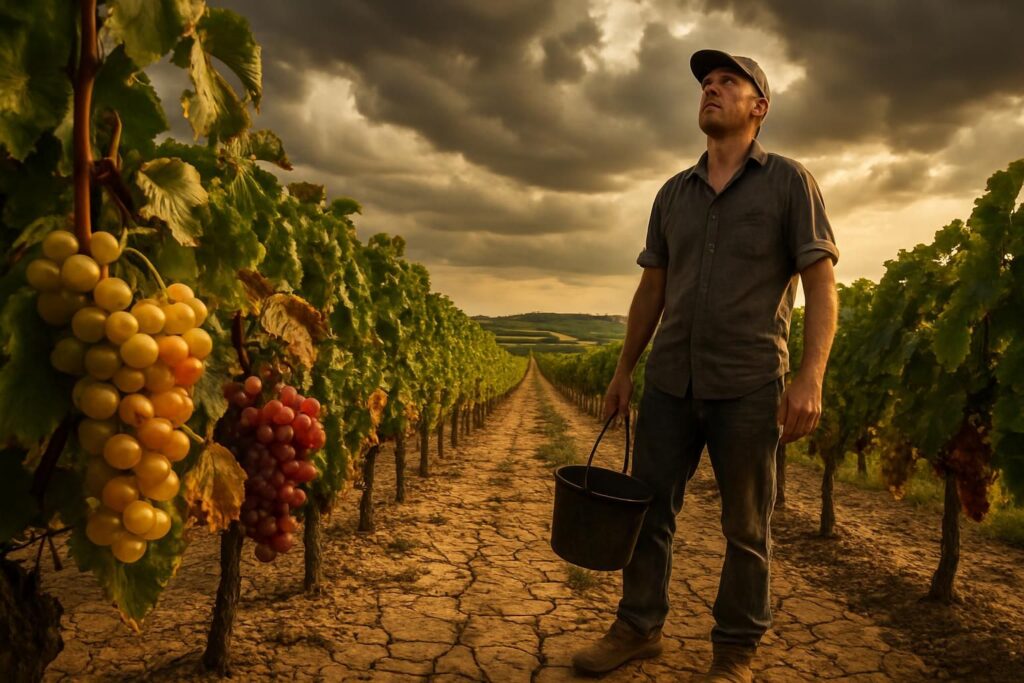
In Champagne, the weather for the month of August holds particular importance this year. Faced with intense and prolonged drought, this emblematic wine-growing region is confronting unprecedented challenges that shake the traditional rhythms of the harvest. The early harvests, now a tangible reality, call on all actors in the sector, from winemakers to oenologists, highlighting both the changes induced by global warming and the new strategies to adopt in order to preserve the quality of the grapes. This exceptional situation reflects a profound shift in the management of Champagne terroirs, with crucial issues concerning yield, quality, but also the protection of workers involved during the summer season.
While the Champagne vineyard was once known for its cool and humid climate, conducive to late ripening favoring the acidity and finesse of the bubbles, the situation has evolved considerably. Now, scorching and dry summers dictate the growth of the vine, pushing for a complete reorganization of the harvest calendars. In 2026, the harvests are shaping up to be the earliest of the decade, an anticipation that does not fail to raise strong concerns regarding the volumes harvested and the preservation of the characteristic aromas of this prestigious region.
Early harvests in Champagne: a phenomenon disrupting traditional cycles
Early harvests are no longer an exception in Champagne, but a structural trend embedded in an unprecedented climatic context. Since the early 2000s, summer heatwaves have multiplied, weakening vineyards and deeply altering ripening rhythms. In 2026, they are announced as early as mid-August, with initial harvests planned around August 15 to 22, nearly a month ahead of historical norms established by previous generations.
This earliness, notably illustrated by Maison Drappier — whose family has known the Champagne vine for decades — expresses a forced adaptation to these extreme conditions. After the death of André Drappier in 2025, the heirs face a climate that no longer has the same mildness nor homogeneity as before. As Hugo Drappier expresses it, the new generation of oenologists now considers these vintages “as less exceptional,” as heat and drought become constants. This phenomenon marks the end of an era when rain, rather than drought, used to dictate the viticultural agenda.
For Sophie Cossy, a winemaker established on the Montagne de Reims, the break is tangible and significant. Whereas her father regularly finished the harvest in October, she now must arbitrate between severe water stress and clusters in a slow final ripening phase. “The vines go on pause,” she explains, highlighting the impact of water shortage on photosynthesis and berry closure. This situation means the traditional calendar no longer matches the realities immediately visible in the field, and anticipating the harvest becomes essential.
This change also translates into a strong disruption for the teams mobilized during the harvest. Each year, more than 120,000 people are involved in the picking, a huge collective effort that must now include improved safety measures against heatwaves. The “Together for the Champagne Harvest” initiative warns of risks linked to heatwaves, imposing a strict organization with water points, shaded zones, and frequent rotations to protect the health of pickers. Vigilance has become imperative, illustrating how decisive the intense drought and August weather can be.
Intense drought: a major challenge for the balance and quality of the grapes
The drought that prevails in Champagne this year disrupts the water balance of the soils and reflects on the fate of the 2026 vintage. Charged with recalling the fragility of the vineyard in the face of heatwaves, the Comité Champagne emphasizes the need to adopt adapted cultural practices and close monitoring of groundwater tables. These latter, vital for the vineyard’s resilience, show worrying levels, confirming the urgency of actions to limit the water stress that hampers the vine.
This water stress results in a slowdown of photosynthesis, an essential phenomenon for the synthesis of sugars and aromas in the grape. The vine tends to suspend its development, mobilizing its resources for survival, to the detriment of fruit ripening. Paradoxically, this situation can delay the harvest date despite the thermal amplitude, creating tension for viticulturists who must juggle between earliness and optimal fruit quality.
Jean-Marc Charpentier, an experienced professional from the Marne valley, also mentions the impact of drought on yields. After years where quantity often prevailed, 2026 promises to be “probably very limited in volume.” Collective memory recalls 2003, a year marked by an early harvest under a heatwave, which resulted in an abundant but qualitatively questionable harvest, due to bitterness from still under-ripe berries. This year, the stakes are different: the extreme drought calls for increased vigilance to avoid these pitfalls and ensure an excellent cuvée.
To overcome these difficulties, some Champagne houses are exploiting technology and agronomic innovations, combining precise measuring tools with ancestral methods respectful of the terroir. We thus see a multiplication of sustainable vineyard techniques, ranging from cover cropping between rows to fine irrigation management where it is permitted. At the same time, botanical studies are conducted to select more resistant grape varieties and clones, a challenge that fits into the vineyard’s sustainability in the face of announced climate changes.
Learn more about groundwater management in Champagne provides additional insight into this essential issue. These efforts are committed to balancing economy and ecology, with the goal of ensuring the vineyard’s survival in the short and long term despite climatic hazards.
Quality and volume of the harvest: a difficult balance to achieve under August heat
The 2026 vintage promises to be marked by a paradox: while quantity risks being limited, quality tends to improve. This trend reflects a new reality for Champagne, especially with a climate now strongly influenced by oceanic and continental factors, which favors better concentration of sugars and aromas in the grape. This evolution is conducive to more elegant and harmonious champagnes, capable of competing with the greatest cuvées despite a difficult context.
Hugo Drappier furthermore emphasizes the Champagne vineyard’s ability to benefit from these climatic conditions. The ancestral technique of champagnisation, combined with adjusted dosage, helps mitigate the hazards linked to ripening, thus giving winemakers a significant margin of maneuver. Indeed, over the past two decades, poor vintages have become rarer and the general trend is a steady improvement in quality, despite episodes of extreme heat.
However, this year more than ever, “the August weather will be decisive.” Everything will indeed depend on managing water stress in the coming weeks. “We will have to pray that the vine does not suffer,” comments Jean-Marc Charpentier, illustrating the apprehension of professionals. In this context, vigilance is essential to protect the harvest and ensure winemakers receive an excellent raw material.
Economic consequences must also be considered. Fewer grapes harvested imply a drop in production, which can influence price dynamics and the availability of champagnes. The impact on the global market, where Champagne holds a leading position, is therefore closely monitored by houses and merchants. Volume fluctuations underscore how crucial the August climate is for the entire sector.
Adaptation of viticultural practices: strategies facing drought and heat
Champagne winemakers are redoubling their ingenuity to face this unprecedented climatic situation. For several years, the transition towards more sustainable and reasoned practices has been underway, accelerated by increasingly intense droughts and heatwaves.
Among the adaptations implemented, cover cropping between vine rows is gaining ground. This technique, consisting of planting vegetative covers between vines, helps maintain soil freshness, reduce erosion, and improve local biodiversity. It also promotes water retention, a valuable asset facing the intense drought currently affecting the Champagne vineyard.
At the same time, harvest working hours management is modernizing. Under the aegis of the Comité Champagne, guidelines emphasize team protection, especially during heatwaves. Frequent rotations are organized, accompanied by breaks in shaded areas and permanent access to hydration. These measures aim to ensure the safety and health of pickers under extreme conditions.
Finally, agronomic and technological research plays a key role. The improvement of localized irrigation devices in authorized plots helps limit plant stress, while real-time vine monitoring tools allow anticipating needs and adjusting interventions. These innovations accompany a growing awareness that Champagne’s future depends on fine and adaptive vineyard management.
Among inspiring initiatives, we can mention the efforts of some estates to integrate the botanical dimension at the heart of their practices. The exposure to plants indeed helps improve vine resilience while enriching terroirs with beneficial microorganisms.
Growing concern about the safety and well-being of harvesters
The earliness of the harvest intensifies tensions not only on the agronomic level but also on the human level. Each year, relying on more than 120,000 people for the picking under a heat-marked climate poses organizational and preventive challenges.
The increasingly frequent heatwaves require enhanced vigilance. The Comité Champagne, relayed by the General Union of Winemakers, insists that all operations implement good practices to protect the health of workers. The establishment of team rotations, creation of shaded spaces for breaks, as well as distribution of numerous water points are now essential.
Harvester safety has become a central aspect of harvest preparation, in a region where seasonal labor is essential for smooth picking. Training and awareness campaigns have recently intensified to prevent incidents related to extreme heat, a problem that was until now little anticipated in a historically cooler region.
Beyond preventive measures, the general atmosphere is nevertheless tinged with concern. The impact of such crucial August weather extends beyond the harvest: it touches on the very future of the Champagne vine and its ability to maintain its standards of excellence. Addressing this situation demands an unprecedented collective effort, combining ancestral know-how with modern innovation.
To deepen understanding of recent climatic challenges and their impact on Champagne, it is recommended to consult the article dedicated to heat records in Champagne, which analyzes these phenomena in detail.
Why are harvests becoming earlier and earlier in Champagne?
The precocity of harvests in Champagne is mainly linked to climate changes, with warmer and drier summers accelerating grape ripening.
How does drought affect the quality and volume of harvests?
Intense drought sometimes slows down ripening by stressing the vine, which can reduce yields while improving the aromatic concentration of the grapes.
What measures are taken to protect harvesters against the heatwave?
Wine organizations recommend staff rotations, regular breaks in the shade, and permanent access to water points to ensure the safety and health of workers.
Is the 2026 vintage expected to be a good vintage despite the drought?
Experts believe that overall quality can be high thanks to better concentration of sugars and aromas, but everything will depend on the August weather.
What technical innovations help manage water stress in the vineyard?
Techniques like cover cropping, localized irrigation, and real-time vine monitoring help better manage drought and optimize yields.