
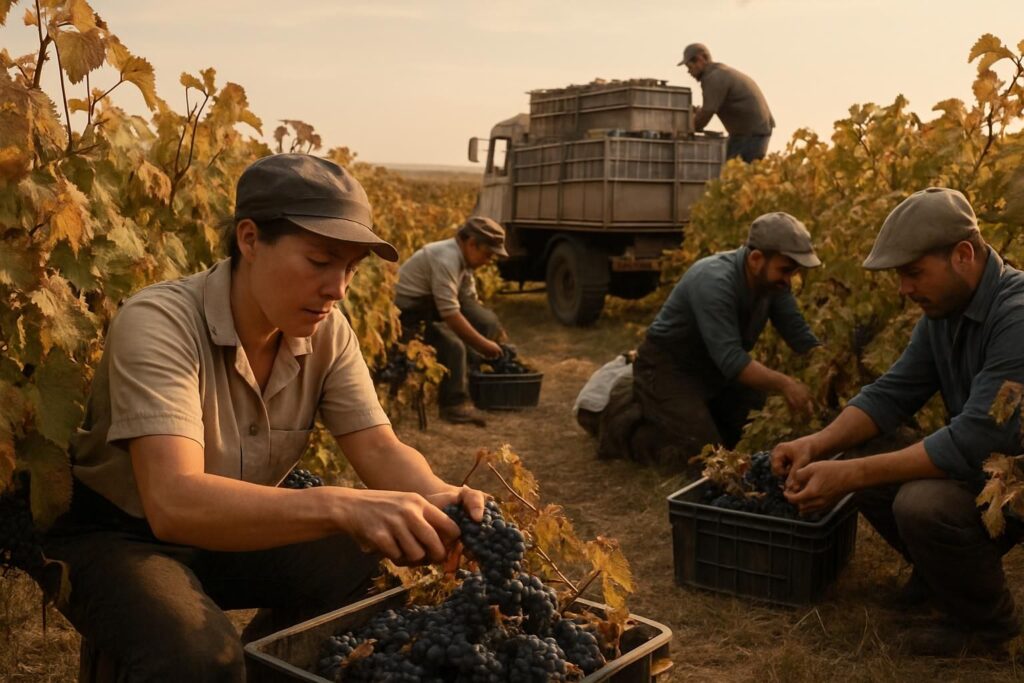
The Champagne vineyard, the beating heart of the global champagne production, faces an exceptional challenge in 2026. A persistent drought has been settling in since mid-May, severely affecting the most sensitive grape varieties and delaying the usual harvest pace. At the same time, the sector must confront unprecedented economic pressure, marked by the need to regulate overly large stocks and adapt to a worldwide demand less dynamic than after the euphoric pandemic period. This dual sanitary and financial constraint pushes growers and trading houses to rethink harvest management, from choosing harvest dates to controlling the marketable yield, set this year at a reduced threshold of 8,800 kilograms per hectare. This delicate balance between qualitative preservation and economic viability illustrates the extreme tensions endured by a sector subject to the whims of climate and market demands.
In this tense context, the harvest, traditionally synonymous with celebration and abundance, becomes an exercise in rigorous management and anticipation of climate hazards. The spring frost combined with an unprecedented June heatwave and a prolonged lack of rain since May jeopardize the optimal ripening of the grapes. The harvest is expected to be early, with notably reduced cluster masses and a ripening shift of nearly ten days compared to the previous season. According to experts from the Comité Champagne, this advancement, now considered the norm, requires extreme vigilance regarding fruit quality and the ability of farms to maintain a profitable balance despite restricted volumes.
Marketable yield in Champagne: towards drastic regulation to control stocks
The marketable yield for the 2026 harvest has been officially fixed at 8,800 kilograms per hectare, a decision made during the interprofessional meeting on July 22 in Épernay. This measure, aimed at regulating the production surpluses accumulated in recent years, is based on a clear trend: a progressive reduction of quotas since 2022, when the ceiling peaked at 12,000 kg/ha, compared to only 9,000 kg/ha in 2025. This constant decrease underscores the desire of Champagne vineyard stakeholders to gradually reduce stocks, whose current volume amounts to nearly 4.8 years of sales, while the objective is to bring this ratio down to four years.
The pressure linked to this regulation directly impacts production and the profitability of farms. Indeed, a gradual destocking of around ten million bottles is planned, a value negotiated between independent growers and trading houses. The interprofessional committee favors a measured strategy to allow operators to manage this context without weakening the financial health of the sector.
The global champagne market, though growing modestly, is not immune to turbulences. Exports show a slight increase of 1.2% with 107.1 million bottles shipped by the end of June, mainly driven by foreign markets. However, the domestic French demand remains sluggish, hindered by geopolitical tensions and American customs duties disrupting access to certain key areas. This delicate balance between produced volumes and distribution capacities illustrates the crucial challenges facing Champagne.
To deepen this aspect, reading the complete analysis of the 2026 harvests in Champagne offers an enriched perspective on stock management.
Persistent drought: an aggravating factor for the quality and quantity of the harvest
2026 stands out due to an unprecedented exposure to climatic hazards, notably a prolonged drought established since mid-May, with no significant rain interruption for several months. This situation combined with a spring frost marks a severe halt in grape growth, with the average weight dropping from 130 to about 80 grams per cluster according to field observations. This water stress limits not only the size of the clusters but also their ability to develop the complex aromas expected in a great vintage.
The earliness of ripening accelerates while the balance between sugar and acidity deteriorates. Regions such as La Côte des Bar started harvesting as early as August 10, with historical exceptions granted, like Montgueux where picking began on August 6. These unprecedented advances underline how quickly the vineyard tries to preserve the freshness of the grapes before the extreme heat, notably peaks above 40°C recorded in June, further deteriorates quality.
The calendar evolves accordingly: the start of the harvest has been set for August 12, ahead of the initial date of the 15th, a strong signal from the Comité Champagne in response to the climate emergency. This adjustment aims to minimize the loss of freshness and limit the deleterious effects of thermal stress, notably to protect the natural acidity so essential in producing classic champagnes.
In this context, each grape variety must be considered carefully: Chardonnay, traditionally early and sensitive to drought, shows very rapid but unbalanced ripening, while Pinot Noir resists better though with a lower fruit load. Growers now adopt refined cultural strategies, adapted to extreme conditions, including minimal irrigation techniques and more severe vine pruning.
To better understand these challenges, consulting a detailed report on drought and its impacts on Champagne harvests is essential.
Historic earliness of the harvests: a phenomenon that has become the new norm
Harvest earliness has never been as marked as in 2026, where the calendar ranges between August 8 and 22 depending on geographic zones and concerned grape varieties. This phenomenon, notably observed in the vineyards of Riceys and Glannes, profoundly modifies traditional habits. This advancement of eight to ten days compared to 2025, a vintage already considered exceptional, affects not only the harvest planning but also the champagne production process, where organoleptic balance is paramount.
La Côte des Blancs, known for the finesse of its chardonnays, delays picking as much as possible between August 16 and 22 to preserve acidity, a key element of freshness on the palate. In Reims and Épernay, harvests begin respectively on August 15 and 17, in line with local conditions and to protect the integrity of the grapes.
Beyond the calendar, this earliness reflects a profound climate shift in the region, placing the Champagne vineyard on alert regarding upcoming changes. Technical director Sébastien Debuisson estimates that this accelerated pace could become the norm for the next fifty years, raising the question of the necessary adaptation of viticultural practices and commercial management in a sector where tradition is a strong identity marker.
Moreover, these observations and adjustments underscore the importance for producers to closely follow official recommendations, such as the official Champagne harvest calendar, which serves as a precious reference in periods of climate uncertainty.
Stock management and economic issues: fragile balance between limited production and market expectations
Pressure on stock management represents a challenge as vital as the harvest itself. Faced with excess volumes, the vineyard must continue its regulation effort by maintaining production compatible with actual demand, to preserve the value of the Champagne brand. This reduction in the yield ceiling must both promote cautious destocking and ensure the economic sustainability of farms, notably family-sized ones, visibly weakened by rising costs linked to environmental transition.
At the same time, global market fundamentals influence these decisions. The decline in global demand after post-pandemic purchasing peaks adds to obstacles caused by geopolitical tensions and customs duties, especially in the United States. These constraints amplify the economic tensions for trading houses, responsible for bearing the financial weight of stocks accumulated during previous campaigns. It is a delicate balance to maintain to avoid both overproduction and erosion of profit margins.
Small producers, supported by the Federation of Independent Champagne Growers, indicate that the breakeven point is now around 10,000 kg/ha, a level above this year’s quota, pushing some to dip into their reserves or reconsider their economic models.
This context highlights the importance of fine, strategic, and concerted management among all sector players, a subject thoroughly covered by the analyses of Champagne’s economic news in this turbulent period.
Contemporary viticultural practices facing climatic and commercial challenges
The 2026 harvest highlights the need to adapt viticultural practices to fit the new climate reality while responding to economic imperatives. The use of more sustainable methods, notably limiting irrigation, increasing canopy management, and adjusting planting densities, are among the implemented responses.
The choices of harvest dates and modalities are now integrated into a global strategy combining advanced meteorological monitoring tools and precise evaluations of grape maturity. This scientific approach, combined with fine knowledge of the terroir, allows better control of the tension between quality and quantity.
Growers also experiment with new oenological techniques to counterbalance the effects of unbalanced ripeness, notably through adjusted blends or the use of complementary grape varieties. This meticulous work helps preserve the unique aromatic identity of champagne, a guarantee of excellence and authenticity.
Here are some key practices adopted in 2026 to ensure production sustainability in this complex context:
- Yield reduction through severe pruning to concentrate grape quality.
- Staggering harvests according to grape varieties and geographic zones.
- Targeted water stress management using soil cover techniques to conserve moisture.
- Increasing use of digital tools for precise vine growth monitoring.
- Strengthened collaboration between growers, houses, and institutions to coordinate destocking strategies.
This collective upskilling is essential to face future climatic hazards while maintaining a high-end positioning on the international market.
Why is the marketable yield decreasing in Champagne?
The reduction of the marketable yield, fixed at 8,800 kg/ha, aims to regulate the excessively high stocks accumulated in recent years and rebalance supply with fluctuating global demand.
What impact does drought have on the Champagne harvest?
Prolonged drought reduces the size of grape clusters and accelerates ripening, causing an earlier harvest and sometimes imbalance between sugar and acidity, complicating the management of grape quality.
How do growers adapt to early harvests?
They stagger harvesting according to grape varieties, use canopy management techniques, and closely monitor grape maturity using advanced digital and meteorological tools.
What is the role of destocking in Champagne’s economic management?
Destocking helps reduce the surplus of bottles in reserve, stabilize prices, and ensure the financial viability of farms in the face of market fluctuations.
Which Champagne regions began the earliest harvests?
Montgueux opened harvesting as early as August 6 with an exceptional exemption, while La Côte des Bar started picking from August 10, illustrating the unprecedented nature of the earliness.