
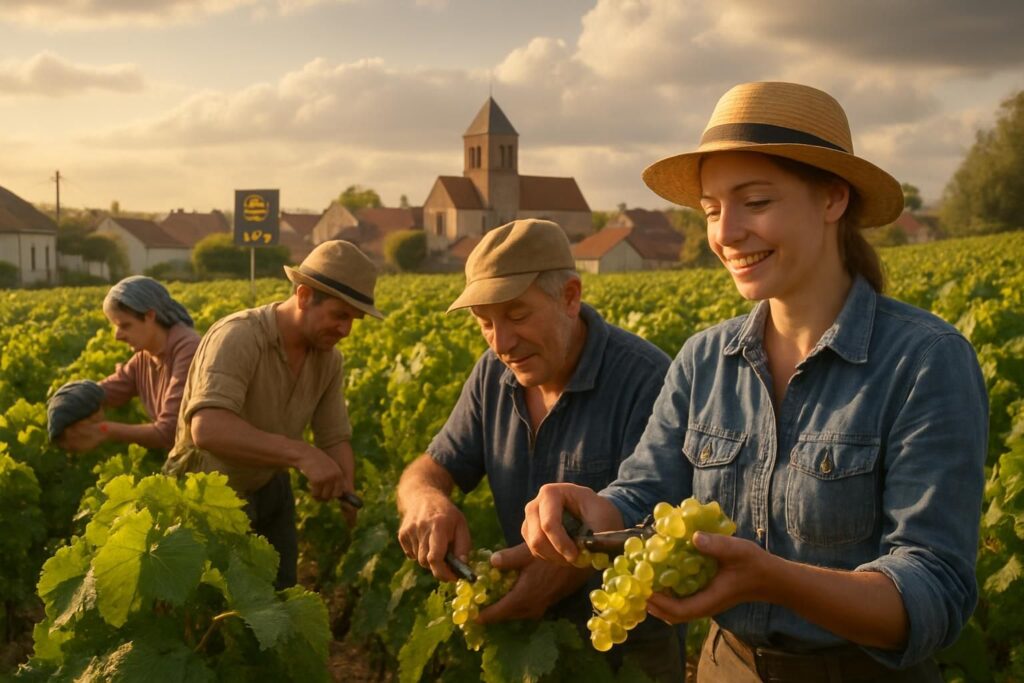
For several years, Champagne has been witnessing a notable transformation in the viticultural calendar, with an increasingly early start to the harvest. Harvesting beginning as early as mid-August is quickly becoming the norm, disconcerting some winemakers accustomed to later dates. This extreme anticipation of the harvest is fueled by unprecedented climatic phenomena, whose effects profoundly disrupt the natural ripening rhythm of the grapes. The players in the terroir must now adapt to this evolution to preserve the quality of the grape and the excellence of Champagne, a global symbol of expertise and finesse.
This surprising precocity is not the result of a simple meteorological whim but fits into a broader dynamic linked to global warming and the extreme climatic episodes that have occurred over several seasons. Beyond the technical and logistical challenges, it questions the sustainability of traditional viticultural methods in the face of environmental variations, and encourages rethinking harvest criteria in regions with a strong identity like Champagne. Leaving behind the image of a vineyard frozen in its customs, Champagne viticulture is now adapting under the pressure of climate and quality requirements, illustrating a battle between tradition and modernity.
A climatic acceleration at the heart of the start of the harvest in Champagne as early as mid-August
The phenomenon of a harvest starting as early as mid-August in the Champagne region is no longer an exception but a growing trend. Since 2020, early harvests have succeeded one another year after year, with sometimes even earlier dates, such as in 2026 when the first bunches were picked as early as August 12 in certain plots. This evolution is mainly explained by a hotter and drier summer, which viticulturists must monitor very closely.
Episodes of intense heat, with temperatures sometimes reaching nearly 40°C as early as June, have accelerated photosynthesis and grape ripening. This rapid accumulation of sun and heat leads to an increased concentration of sugars, thus modifying the usual balance of the berries. At the same time, drought limits water availability, imposing hydric stress on the vines which further concentrates the aromatic components of the fruits but can also reduce yields if these conditions persist.
This situation is amplified by unusual climatic hazards, such as a late frost episode in March that weakened certain areas. This mix of environmental factors contrasts with a past where harvests typically began at the end of August or even early September, offering a longer and more gradual ripening period. The lasting impact of climate change therefore reshapes the profile of harvests in Champagne, requiring constant adaptation.
For producers, it is now a matter of readjusting their calendar references: “At the time, August 15 marked the start of vacations, today, it is the heart of the harvest,” recalls Alexandre Gobillard, a long-time figure in the vineyard. This acceleration has significant logistical consequences, both in terms of personnel and equipment, reflecting a profound upheaval in the daily life of winegrowers and seasonal workers.
The surprising reasons explaining this anticipated start of harvests in Champagne
Beyond global warming, several factors converge to explain this start of the harvest as early as mid-August, once inconceivable in a region known for its wines where freshness is essential. Here are the key points shaping this evolution:
- Persistent heat and heatwave episodes : For about twenty years, with a sharp acceleration after 2003, summers in Champagne have been marked by extreme temperatures and prolonged heatwaves. This has led to faster grape ripening.
- Widespread drought : The scarcity of precipitation reduces the soil water reserves, further concentrating sugars in the berries, which can destabilize the classic balance of the wine.
- Adaptation of viticulture : Faced with this new reality, winemakers now favor grape varieties and vine management techniques that preserve freshness and acidity despite the early ripening.
- Search for quality and balance : The earlier harvest is also a quest to avoid excessive ripeness, which could produce overly heavy aromas, distorting the delicate signature typical of Champagne.
- Economic and organizational pressure : Starting early allows better distribution of seasonal labor and avoids intense activity peaks that impact harvesting and vinification logistics.
These elements combine so that harvest dates, traditionally fixed, become a major adjustment factor in Champagne viticulture. An illustration of this phenomenon can be seen in Hautvillers or Tours-sur-Marne, where some producers note that they will have to get used to this new norm that disrupts historical benchmarks.
As Ophélie Lapie-Lamiable, manager of Champagne Lamiable, points out, the year 2003 marked a memorable turning point when harvests began early at the end of August, “since then, this calendar advances a little more every year.” It thus becomes essential to rethink old calendars and traditional methods to best support this change.
The impact of the early harvest on the quality of the grape and Champagne
A harvest starting as early as mid-August naturally raises the question of the maturity of the grapes and the ability to produce a Champagne faithful to its terroir and its quality requirements. The precise timing of the harvest is crucial to record the perfect balance between sugars, acidity, and aromas, guaranteeing the finesse of the final wine.
When the harvest is advanced by several weeks, viticulturists face a double risk. On the one hand, too rapid maturation can cause a “peak” of sugars, accompanied by a drop in acidity, essential for the liveliness and freshness of Champagne. On the other hand, hydric stress imposes a severe choice on the best bunches to harvest, because excessive dehydration can alter organoleptic characteristics.
However, this precocity can also present a qualitative advantage: harvesting before temperatures decline at the end of the season limits the degradation of fresh and floral aromas. Furthermore, grapes less exposed to autumnal moisture reduce the risk of diseases such as botrytis.
Moreover, the intensification of technical control around the harvest moment is now imperative. Thanks to regular monitoring of sugar, acidity, but also phenolic compounds, estates can determine the optimal harvesting time for each plot, thus guaranteeing a meticulous balance and the typicity of the Champagne terroir despite the precocity.
This technical and qualitative evolution clearly illustrates the need to combine tradition and innovation in viticulture. Producers must continually adjust their strategies to maintain a high level of requirement, determining the success of future vintages in an unprecedented climatic context.
Logistical and human challenges underlying this early harvesting in Champagne
Beyond agronomic issues, the anticipated start of harvests raises major organizational challenges. Traditionally, Champagne mobilizes a considerable seasonal workforce, with hundreds or even thousands of pickers intervening simultaneously. Moving these cohorts in early August, during the heart of summer, requires precise and adaptable logistics.
This organization is all the more complex as advanced harvests often lead to a shorter break between team rest periods and harvesting, limiting preparation and supervision time. Professionals must simultaneously manage pickers’ schedules and the availability of harvesting equipment, as well as transport and accommodation.
Finally, the sometimes overwhelming heat of early harvest days impacts workers’ health and performance. It is necessary to ensure appropriate working conditions: provision of water, regular breaks, protection against heat strokes. Moreover, for estates that still rely on manual harvesting, this human constraint is all the more significant.
On a broader level, this precocity threatens the transmission of traditional know-how, as it disorients the elders who come to train the newcomers. Successful management now relies on increased anticipation and rigorous planning, based on close coordination between vintners, technicians, and seasonal teams.
Faced with these realities, the sector reflects a paradox: while Champagne maintains its prestige and historic terroir, it must constantly evolve to integrate new climatic constraints. This adaptation is one of the major challenges to preserve this prestigious appellation and guarantee the future of Champagne harvests.
Future perspectives: how Champagne viticulture adapts to global warming?
In the face of an increasingly demanding climatic context, winemakers are nurturing innovative strategies to ensure the sustainability of early harvests in Champagne. Several avenues are emerging:
- Adaptation of grape varieties : The introduction or selection of varieties better suited to heat and drought is gaining ground, with constant vigilance to preserve the typicity of the terroir.
- Targeted mechanization and digitalization : To meet growing logistical needs, the use of cutting-edge technologies and connected tools allows better monitoring of ripening and optimizing the harvest.
- Sustainable vine management : Improvement of agronomic practices to limit hydric stress, such as soil management, targeted irrigation, and protection against thermal excesses.
- Training and awareness : Field teams are trained on new constraints, developing collective awareness on the challenges of warming and increased vigilance on grape maturity.
- Rethinking calendars : The traditional harvest calendar is being reconsidered, with more flexibility, adapting to seasonal variations rather than sticking to fixed dates.
This proactive transition is already reflected in the fields, where many estates are experimenting with these solutions to preserve the exceptional quality of their early harvests. While some see this precocity as a threat, others view it as an innovation opportunity, enabling better control of the vegetative cycle despite turbulent climate.
Future vintages will depend closely on the sector’s ability to combine tradition and modernity, ensuring the finesse and purity of Champagnes. This water and thermal mutation is undoubtedly one of the most significant viticultural challenges of recent decades.
Why do harvests now start as early as mid-August in Champagne?
The precocity of the harvest mainly results from global warming, which accelerates the ripening of the grapes through hotter summers and increased drought, pushing the harvests to begin earlier to preserve the quality of the grape.
What are the main challenges linked to such an early harvest?
Early harvests complicate logistical and human management, especially concerning labor, organization, and require more rigorous monitoring of the grapes’ maturity to avoid compromising the finesse of Champagne.
How do winegrowers adapt to these new climatic conditions?
They experiment with grape varieties more resistant to heat, adopt sustainable agronomic practices, integrate technology to monitor ripening, and adjust their harvest calendars to maintain quality.
Does the precocity of the harvest affect the final quality of Champagne?
While it presents risks related to the sugar-acidity balance, good technical control helps preserve the freshness and aromatic signature of Champagne, notably avoiding overly ripe harvests.
Is this trend expected to continue?
Yes. This precocity is part of a lasting trend, imposed by climate change. It forces the Champagne sector to rethink its methods, practices, and calendar for the coming decades.