
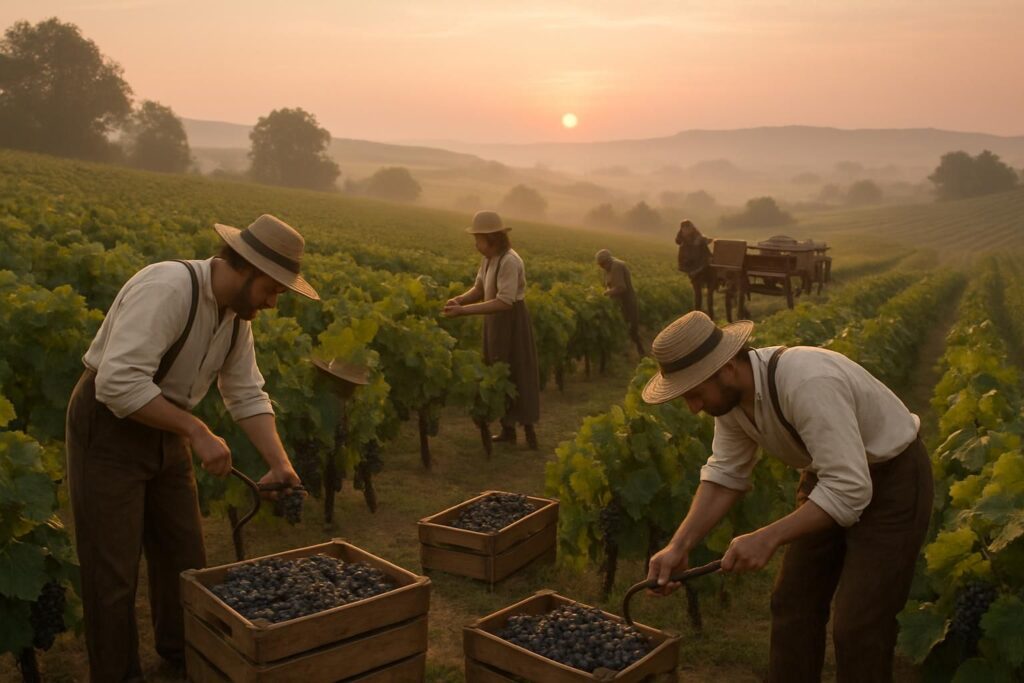
At the beginning of August, the Champagne region is witnessing an unprecedented event: the grape harvest has exceptionally started early, marking a historic milestone for this outstanding terroir. This phenomenon reflects a summer marked by record temperatures and intense water stress, causing an accelerated ripening of the grapes. The vineyard, the beating heart of Champagne production, thus sees its millennia-old traditions disrupted by unprecedented climatic conditions. The premature appearance of the harvest opens a crucial debate among professionals, between the challenge of preserving the impeccable quality of the grapes and the uncertainties linked to the weather hazards of the coming season.
This early start does not only reflect a climatic singularity but also a remarkable adaptability capacity of the sector, encouraged by winemakers like Vincent Finot, based in the Aube, who began these first harvests as early as August 6. This approach required an exceptional authorization from the INAO, attesting to the seriousness and rigor with which the regulations now govern Champagne winemaking in the face of climate challenges. This evolution also raises the question of the impact of these early harvests on the final character of the champagnes, with promises of distinctive vintages at stake. A dynamic to be closely observed, at the crossroads of traditions, know-how, and the consideration of current environmental realities.
A historic start to the harvest in Champagne: climatic factors and impact on the yield
The date of August 6 will remain engraved in the annals of the Champagne vineyard as the earliest recorded first day of harvest. This phenomenon is largely attributed to the exceptional weather conditions that marked the summer: successive heatwaves combined with prolonged drought have accelerated the ripening of grapes at an unprecedented pace. The rapid transition of grapes from green to golden in just a few days pushed winemakers to anticipate the harvest to preserve fruit quality despite the risks associated with such unusual precocity.
In this exceptional region, traditional grape varieties such as Chardonnay, Pinot Noir, and Meunier have reached a stage of maturity usually observed later in the season. Vincent Finot, a local reference from Montgueux, indicated that this rapid development required a special authorization request to the INAO, emphasizing the exceptional nature of the situation. The decision to harvest so early is a first in this vineyard, going against historical and regulatory practices.
The acceleration of the vegetative cycle causes technical challenges for winemakers, notably in managing the plants’ water supply and controlling grape temperature at harvest time. This unprecedented context forces the adaptation of traditional winemaking methods to ensure optimal quality. Professionals anticipate that these early harvests will influence the organoleptic characteristics of the upcoming wines. They also echo broader issues related to the impact of drought on the harvest throughout the Champagne vineyard.
The strategic role of the INAO in the evolution of Champagne viticultural practices
The National Institute of Origin and Quality (INAO) plays a central role in monitoring and regulating harvests in Champagne. Faced with this extreme precocity episode, the INAO had to adapt its rules and grant exemptions to winegrowers like Vincent Finot, who noted abnormally advanced grape maturity. This regulatory flexibility illustrates the delicate balance between preserving the appellation’s specifications and considering climatic realities.
Traditionally, the official harvest ban, symbolizing authorized picking, is set mid or late August. In 2026, this threshold was moved forward from August 15 to August 12 to adapt to the accelerated ripening of the grape. Upstream, the complexity of this decision highlights the need for a close observation of the vineyard, notably through regular maturity and berry health status surveys. The Ministry of Agriculture also acknowledged the “very high uncertainty” surrounding 2026 harvest projections by postponing estimates to September to better incorporate observations from the first harvests.
The use of punctual exemptions, so far rare, could become a more frequent practice in the context of intensified climate change. Dialogue between winegrowers and control bodies is more crucial than ever to maintain Champagne’s excellence while respecting regulations. This close collaboration also illustrates a shift towards more agile viticultural regulation management, capable of responding to nature’s challenges without compromising the identity of the Champagne vineyard.
The diversity of Champagne terroirs facing early harvests and quality challenges
The consequences of intense heat and drought episodes are not homogeneous across the entire Champagne vineyard. While the Aube begins its harvest as early as the beginning of August, other areas such as the Marne or the Côte des Blancs are still awaiting the ideal moment. This diversity in the harvest schedule reveals marked differences in the development of grapes and varieties.
For example, young plots in Montgueux were the first to deliver their bunches because of their increased sensitivity to climatic hazards. In contrast, communes such as Germaine or Orbais, known for their specific terroirs, plan their harvest for early September, ensuring an optimal balance between maturity, acidity, and aromatic concentration. These disparities in harvest dates confirm the need for precise management for each plot, reinforcing the complexity of winemaking operations.
Quality challenges are evident. A harvest too early could limit the development of aromatic compounds, while a delay could lead to overripeness or excessive water stress. In this regard, winemakers and oenologists rely on innovative practices and detailed monitoring to preserve the sensory quality of the grapes, essential to the international reputation of champagnes.
- Regular monitoring of maturity through sampling and laboratory analyses;
- Adapting harvest windows according to plots and varieties;
- Optimized management of irrigation and soils according to retention capacity;
- Winemaking techniques adapted to the profiles of early-harvested grapes;
- Incorporation of climatic data into annual cultural strategies.
This differentiated approach guarantees rigorous control of winemaking and the style of future wines, while remaining rooted in Champagne tradition.
Adaptation of Champagne winegrowers: innovative practices and respect for traditions
Champagne winegrowers must reconcile a long tradition with unprecedented environmental constraints. The necessity to adapt cultural techniques and vineyard management has become an unavoidable reality. Early harvests force revisions of calendars and customized interventions.
Among the measures adopted are modifications of pruning dates, more rigorous yield management, and soil work that favors freshness and water retention capacity. Producers also use digital tools to model growth and anticipate maturity. This digitalization helps reduce risks of misinterpreting the vegetative cycle.
This evolution includes reflection on the selection of grape varieties and clones more resistant to heat and water stress, while maintaining the quintessence of aromatic profiles. This delicate balance between innovation and respect for tradition is at the heart of strategies deployed by Champagne houses, such as Château Roederer, which combines exigency and adaptability.
The 2026 harvests will thus constitute a full-scale test for the Champagne sector, highlighting its adaptability in the face of climate change challenges. They also demonstrate that the richness of the Champagne terroir, its diversity, and its collective management are major assets to guarantee the future of these exceptional wines.
Perspectives and challenges of the early harvest for the Champagne vintage
The phenomenon of early harvests raises reflections on the qualitative and economic stakes of the viticultural campaign. While precocity testifies to an alert reaction to extreme conditions, it also raises the question of the stability of the Champagne profiles over time. A further step is taken in the ability to control the harvest without compromising the finesse and complexity that characterize these wines.
Several factors will be decisive for the outcome of this campaign:
- Respect for optimal harvest periods according to terroirs to preserve acidity and aromas;
- Adaptation of winemaking techniques to the specific characteristics of the grapes;
- Management of climatic uncertainties, notably upcoming rainfall;
- Mobilization of Champagne employees’ skills, respecting conventions and tradition;
- Regular monitoring of quality indicators throughout the production chain.
This rigorous approach is supported by close collaboration between producers, institutions, and oenology researchers. The vineyard continues to embody a dynamic of innovation respectful of historical fundamentals. Facing this horizon, enthusiasts and professionals can expect to discover a 2026 vintage full of promise, despite capricious weather.
{“@context”:”https://schema.org”,”@type”:”FAQPage”,”mainEntity”:[{“@type”:”Question”,”name”:”Pourquoi les vendanges ont-elles commencu00e9 si tu00f4t en Champagne cette annu00e9e ?”,”acceptedAnswer”:{“@type”:”Answer”,”text”:”Les tempu00e9ratures exceptionnelles et la su00e9cheresse prolongu00e9e ont accu00e9lu00e9ru00e9 la maturation du raisin, incitant les viticulteurs u00e0 ru00e9colter plus tu00f4t pour pru00e9server la qualitu00e9.”}},{“@type”:”Question”,”name”:”Quel ru00f4le joue lu2019INAO dans lu2019autorisation des vendanges ?”,”acceptedAnswer”:{“@type”:”Answer”,”text”:”Lu2019INAO ru00e9gule le calendrier officiel des vendanges et peut accorder des du00e9rogations pour des ru00e9coltes anticipu00e9es afin du2019adapter la ru00e9glementation aux ru00e9alitu00e9s climatiques.”}},{“@type”:”Question”,”name”:”Comment les vignerons gu00e8rent-ils les diffu00e9rences entre terroirs face aux vendanges pru00e9coces ?”,”acceptedAnswer”:{“@type”:”Answer”,”text”:”Ils adaptent les dates de ru00e9colte et les pratiques culturales en fonction de la maturitu00e9 spu00e9cifique des raisins et des caractu00e9ristiques pu00e9doclimatiques propres u00e0 chaque parcelle.”}},{“@type”:”Question”,”name”:”Quels sont les principaux du00e9fis pour la vinification avec des vendanges si pru00e9coces ?”,”acceptedAnswer”:{“@type”:”Answer”,”text”:”Les du00e9fis incluent le maintien de lu2019u00e9quilibre aciditu00e9/aru00f4mes et lu2019ajustement des processus de fermentation et du2019u00e9levage pour pru00e9server la qualitu00e9 du champagne.”}},{“@type”:”Question”,”name”:”La pru00e9cocitu00e9 des vendanges annonce-t-elle un changement durable pour la Champagne ?”,”acceptedAnswer”:{“@type”:”Answer”,”text”:”Il est probable que les vendanges pru00e9coces deviennent plus fru00e9quentes, nu00e9cessitant des adaptations continues des pratiques et une ru00e9u00e9vation des calendriers traditionnels.”}}]}Why did the harvest start so early in Champagne this year?
Exceptional temperatures and prolonged drought accelerated grape ripening, prompting winegrowers to harvest earlier to preserve quality.
What role does the INAO play in authorizing the harvest?
The INAO regulates the official harvest calendar and can grant exemptions for early harvests to adapt regulations to climatic realities.
How do winemakers manage differences between terroirs in the face of early harvests?
They adapt harvest dates and cultural practices according to the specific maturity of grapes and the pedoclimatic characteristics of each plot.
What are the main challenges for winemaking with such early harvests?
Challenges include maintaining the balance of acidity/aromas and adjusting fermentation and aging processes to preserve champagne quality.
Does the precocity of the harvest herald a lasting change for Champagne?
It is likely that early harvests will become more frequent, requiring continuous adaptation of practices and reevaluation of traditional calendars.