
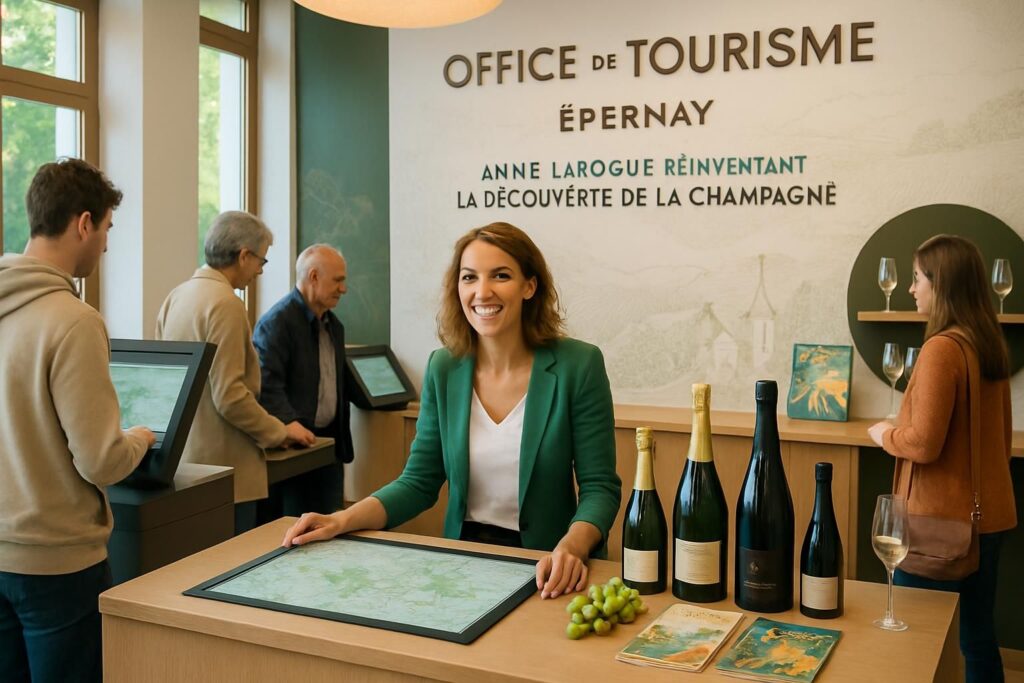
At the heart of the Champagne region, Épernay has long established itself as an essential stop for champagne lovers and those curious about the wine heritage. In 2026, this destination enhances its appeal thanks to a bold cultural initiative led by Anne Laroque, an artist renowned for her works blending visual poetry and sensory depth. Her project “Être (s) de Champagne” at the Épernay tourist office revolutionizes the classic approach to discovering the territory, inviting visitors and locals to immerse themselves in a universe where memory, life, and local culture subtly intertwine. This exhibition proposes a new form of tourism, enriched by an artistic reflection that transcends mere visits to vineyards or cellars. By offering an innovative perspective on Champagne heritage, Anne Laroque transforms every detour into a sensitive walk at the heart of a tangible landscape but also of an intimate atmosphere, capable of awakening emotions. Through this approach, the Épernay tourist office positions itself not only as a tourism information center but also as a space for cultural experimentation serving the influence of Champagne. This initiative perfectly illustrates the region’s ability to combine tradition and modernity in a context where the discovery of the vineyard is enhanced by an original immersive and sensory experience.
Anne Laroque’s artistic approach to enhance tourism in Champagne
Through “Être (s) de Champagne,” Anne Laroque offers a journey where art dialogues with the wine heritage in unprecedented forms. Far from traditional presentations, her work combines photography, photographic scripts, and poetic universes that evoke both dream and collective memory around Champagne. As a result, the visit to the tourist office becomes an experience where each artwork tells an intimate story resonating with the natural and cultural richness of the region.
This artistic approach acts as a revealer of the Champagne soul. Anne Laroque strives to capture the invisible links between human beings and the landscapes they inhabit. Visitors are thus invited to slow down, to look anew at a region often associated with celebration and consumption. In this context, tourism in Champagne deeply reinvents itself, stepping beyond simple descriptive visits to establish a contemplative dialogue between the visitor and their environment.
Another notable aspect lies in how the exhibition fits into the sensory memory of the place. By staging frescos and poetic images, Anne Laroque makes the walls of the tourist office vibrate, offering a route that stimulates all the senses. This renewal of local tourism addresses the expectations of a clientele seeking authentic experiences where heritage becomes a vector of emotions. This new way of presenting Champagne thus opens innovative paths to make the region known by blending culture, art, and tasting.
How this exhibition transforms the traditional experience of discovering the Champagne vineyard
Typically, discovering Champagne revolves around classic cellar visits and tastings at prestigious houses. Yet, thanks to Anne Laroque’s initiative, the general public can now enjoy an enriched visit where the artistic dimension reflects a living terroir. The exhibition fits perfectly within a tourist route that values multisensory experiences and invites a form of slow tourism where time stretches to better penetrate the local cultural richness.
In this context, the visit to the Épernay tourist office becomes more than just a necessary stop: it turns into a moment of contemplation, emotion, and reflection. Anne Laroque’s visual poetry sparks a rediscovery of the Champagne landscape, highlighting the uniqueness of each terroir while awakening the gaze to the diversity of the vineyard and its intimate connections with the people who shape it. This approach notably makes it possible to go beyond mere clichés and encourages a tourism that is more respectful and aware of the environmental and human dynamics of Champagne.
It is essential to note that the exhibition fits into a broader context of enhancing tourism in Champagne where many actors are committed to renewing services. For example, one can mention hiking routes through the vineyards of Blanzac, or thematic trails offered in the Épernay region and its surroundings. Thus, the discovery of Champagne diversifies and gains depth, balancing tasting experiences and cultural immersion. This development demonstrates a strong trend: visitors are now searching for stays where heritage, nature, and local culture harmoniously interact.
The visit to Épernay is therefore energized by this innovative adaptation. The public, seeking authenticity, is led to renew their perception of Champagne, not only as a region producing prestigious wines but also as a living place imbued with history and artistic sensitivity.
The cultural and touristic stakes of the “Être (s) de Champagne” exhibition for Épernay and its region
Beyond its immediate impact on visitors, Anne Laroque’s project holds significant meaning for the region and its tourist development. The exhibition acts as a catalyst to reposition Épernay as a cultural center of Champagne, stimulating renewed interest among tourists as well as economic and institutional actors. This synergy between art and tourism promotes better valorization of regional heritage while strengthening local identity around a contemporary artistic expression.
It also aims to respond to increased demand for enriching, sensitive, and sustainable experiences. Tourism in Champagne is no longer limited to traditional activities; the cultural dimension has now become a fundamental pillar to attract a diverse and demanding clientele. This new positioning generates positive economic benefits not only for wine establishments but also for all local tourism-related shops and services.
Anne Laroque’s presence in this context also illustrates a fruitful dialogue between artistic modernity and historical heritage. The works unveiled at the tourist office illustrate the intangible wealth of this territory, revealing the interconnection between nature, local culture, and the Champagne identity. By linking contemporary art with the terroir’s specificities, this exhibition raises visitors’ awareness of the importance of preserving a fragile and precious heritage while wine tourism experiences constant growth.
This perspective fits within the overall dynamic of tourism in Champagne, where the search for authenticity, the promotion of Champagne houses, and environmental respect contribute to a positive transformation. To deepen this trend, detailed analysis can be consulted, for example, on the little-known principality of Champagne and its unprecedented potential.
New forms of discovery and animation offered by Anne Laroque at the Épernay tourist office
To make the visit more interactive and memorable, Anne Laroque does not limit herself to a simple static exhibition. Several participatory devices are put in place, allowing visitors to engage in a personal dialogue with the artworks and especially with the Champagne universe. This interactive dimension enriches the understanding of the vineyard and fosters a deeper immersion in local culture.
Among the proposed initiatives, there are:
- Creative workshops around photography and writing, inspired by the Champagne landscapes and the sensations they evoke.
- Themed guided tours where art meets vineyard science, exploring links between terroir, biodiversity, and artistic expression.
- Audiovisual projections mixing archive images and contemporary creations to tell a living story of Champagne.
- Poetic animations on occasion, conducive to festive and sensory discovery, in harmony with the spirit of the region.
These initiatives are set in an evolving tourism context where differentiation through experience becomes crucial. The public is invited to take the time to feel, marvel, and understand Champagne beyond its mere oenological fame. Such innovations testify to Épernay’s determination to position itself as a quality cultural tourism destination, fully integrating heritage, art, and contemporary practices.
Thanks to this project, the discovery of Champagne at the Épernay tourist office asserts itself as an original experience, off the beaten path, revealing the complexity and beauty of the Champagne vineyard through Anne Laroque’s singular perspective.
What are the highlights of Anne Laroque’s exhibition in Épernay?
The exhibition blends contemporary art and Champagne heritage to offer an immersive, sensory, and poetic experience that transforms the traditional discovery of the vineyard.
How does this exhibition renew tourism in Champagne?
It proposes a cultural approach where the visitor is invited to slow down and immerse themselves in a sensitive universe linking the terroir to art, thus promoting more sustainable and authentic tourism.
How does the tourist office integrate this artistic dimension into its activities?
The office offers workshops, guided tours, and animations around the exhibition, creating an interactive route that enriches heritage knowledge and stimulates sensory experience.
What links can deepen knowledge about tourism and Champagne heritage?
To learn more, it is useful to consult specialized articles such as those on the best addresses for tourism in Champagne or the little-known principality of Champagne.