
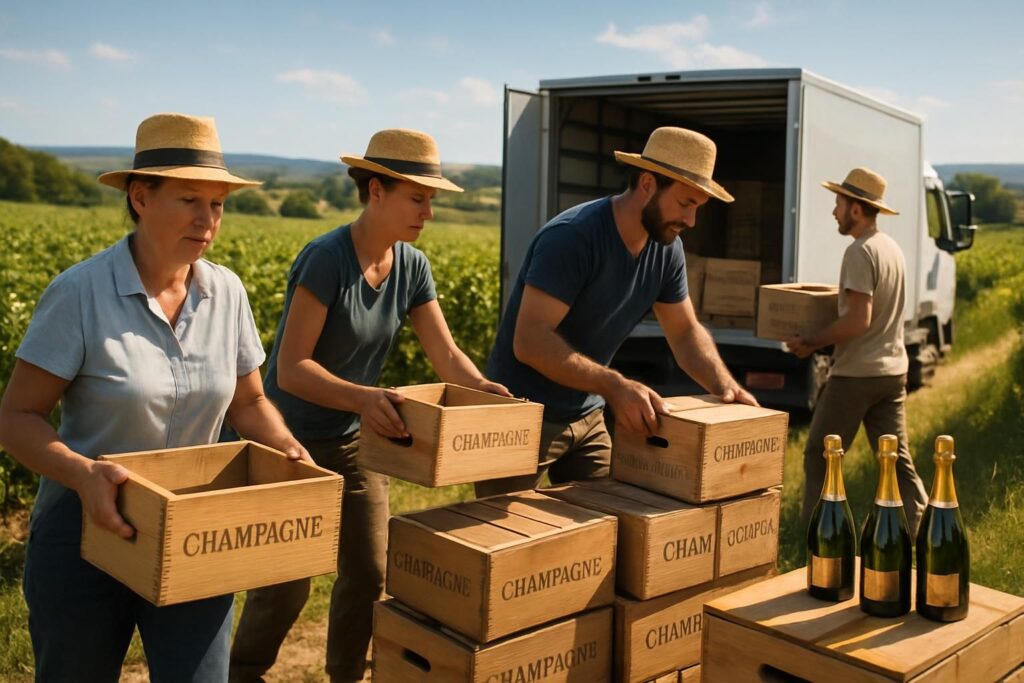
Champagne shipments showed a notable restart in August, marking an important turning point after several months of uncertainties in the markets. This momentum originates from several combined factors: a promising harvest, significant improvements in logistics and transportation, as well as a recovery in trade, especially in exports. Despite the persistent challenges encountered in the first half of the year, notably the repercussions of climatic conditions and global economic turbulence, the Champagne sector thus displays tangible signs of growth. This encouraging development takes place in a context marked by strong international demand and renewed commercial strategies, contributing to strengthening the resilience of the Champagne vineyard and affirming its crucial weight on the global fine wine market.
Shipments carried out during the month of August resulted in a significant volume of bottles sold, marking a rebound that partly compensates for the slight decline observed at the beginning of the year. This resurgence in activity also benefited from improved transportation conditions, with logistical solutions adapted to reduce delays and optimize merchandise flows. At the same time, operators leveraged the richness and diversity of Champagne appellations, as well as enhanced communication, to revitalize the interest of distributors and consumers in key markets. This restart thus heralds a more dynamic end of the year, based on solid foundations for the sustainability and international outreach of Champagne.
Key Factors in the Restart of Champagne Shipments in August
The resurgence in shipments observed during August rests on several essential factors that made it possible to reverse a declining trend seen earlier in the year. First of all, the exceptional quality of the 2026 harvest, renowned for its maturity and impeccable sanitary condition, greatly contributed to strengthening the confidence of producers and distributors. This agronomic excellence stabilizes supply and reassures buyers regarding the consistent quality of the product.
In parallel, the increased mastery of logistical issues played a major role. After two years marked by disruptions in transport circuits, Champagne houses are now implementing optimization strategies, integrating innovative solutions and reinforced partnerships with specialized service providers. The reduction of delivery times and the increased reliability of transports favor a better responsiveness to demand, a key element to recover from months of stagnation.
Another influential aspect lies in the refined management of volumes and quotas imposed for the Champagne sector, a topic hotly debated in recent years. Fine-tuned management of production and shipments optimizes the balance between supply and demand, avoiding overstocking which can weigh on prices. For example, adjustments made regarding the grape quota, recently revised, have helped orient production according to market signals, thereby contributing to fluid trade.
Finally, the dynamics of international markets, notably in the United States – the leading export outlet – also support this recovery. The restart of commercial flows, combined with targeted promotional campaigns, has allowed regaining market shares. These initiatives demonstrate a stated willingness to conquer new segments, particularly among younger generations more sensitive to innovations and the diversity of champagnes offered.
- Exceptional quality of the 2026 harvest ensuring consistency and enhanced attractiveness.
- Logistical optimization for faster and more reliable transportation.
- Adjusted quota management to balance supply with global demand.
- Commercial expansion on exports, particularly towards the United States.
The Impact of Logistical and Transport Challenges on Champagne Shipments
The Champagne sector is particularly sensitive to logistics chain uncertainties, as the fragility of bottles and the need for controlled handling require rigor and expertise. In 2026, the recovery of shipments heavily relied on an overhaul of transport systems and better coordination between producers, merchants, and carriers.
The main logistical challenges lie in volume management and delivery security, which notably require protection against shocks and temperature variations. New technological solutions now allow real-time tracking and risk anticipation, reducing losses and improving end customer satisfaction. Furthermore, process digitalization facilitates flow coordination and better transport sizing.
Market globalization also demands constant adaptation to the specific constraints of each region. Maritime transport, for example, remains a key element in exporting to distant zones, but must cope with unforeseen events such as port delays or container shortages. In response, the Champagne sector invests in solid logistical partnerships and diversifies its routes to avoid any disruption.
Some operators have also explored alternatives such as rail transport, faster and more ecological for European deliveries, combined with innovative packaging solutions to preserve bottle quality. These adjustments have contributed to increasing resilience and facilitating shipment growth in a context where demand is more demanding.
Ultimately, the August restart illustrates the sector’s capacity to adapt to 21st-century challenges. The integration of this new logistical approach ensures better responsiveness to commercial dynamics and contributes to maintaining Champagne’s international prominence.
The Key Role of Export Markets and the Growth of Commercial Exchanges
The restart of shipments in August also reflects a significant recovery in international trade, where Champagne maintains a strategic position. Despite a slight decline in the first half of the year, the trend has reversed with sustained growth in export shipments, symbolizing the market’s adaptability and strength.
The United States remains a major outlet, where Champagne wines are perceived as emblematic luxury and celebration products. Recent marketing strategies deployed in this country, notably campaigns targeting a younger, urban clientele, have helped mitigate the impact of global economic fluctuations. The growing importance of Asian markets, notably China and Japan, also illustrates strategic diversification of Champagne’s commercial circuits.
Moreover, customs tariffs and international regulations complicate exchanges, but the sector strives to anticipate these constraints through strengthened regulatory monitoring. Alliances between Champagne houses and local distributors also facilitate market penetration and consolidate the Champagne brand’s presence.
On a quantitative level, there has been an increase of nearly 7.5% in export shipments since the beginning of the year, a growth markedly higher than that recorded on the domestic market. This evolution underscores the crucial importance of a dynamic export policy, which helps offset the slight stagnation of the French market. The ability to diversify commercial approaches and establish durable partnerships thus constitutes one of the essential levers to maintain Champagne’s strong attractiveness.
The American market clearly illustrates this trend, with demand rising, driven by enthusiasm for premium products. More broadly, this international recovery invites a rethinking of the business model and the prioritization of solutions tailored to the specificities of targeted geographic zones.
Effects of 2026 Climatic Conditions on Production and Their Impact on Shipments
The year 2026 was also marked by particularly favorable climatic conditions for Champagne, following challenges encountered in previous years. This improvement directly impacts the quality of harvested grapes, a sine qua non to support the increase in shipments.
The vineyard is in remarkable condition, with good frost risk management that had generated increased vigilance in recent years. Note that flowering and bud development benefited from a temperate and stable climate, thus limiting frost phenomena and other meteorological incidents that could compromise the harvest. These conditions allowed obtaining a satisfying yield and grapes with great aromatic richness, essential to the reputation of Champagne wines.
This situation provides a solid foundation to support shipment growth, with volumes able to meet renewed demand. Moreover, climatic stability helps reduce market fluctuations, offering better predictability for operators and exporters. This consistency is essential for stock management, logistical planning, and commercial decision-making.
However, vigilance remains necessary, as climate change remains a long-term challenge that could influence the vine and its cycles. Sector actors therefore invest in agronomic research and adapt their cultural practices to preserve quality and production. At the same time, issues related to the limitation of grape quotas, recently revised at the regulatory level, are integrated into this overall strategy.
- Stable and favorable climate in 2026 stimulating harvest quality.
- Frost risk prevention ensuring better productivity.
- Adaptation to climate change to guarantee vineyard sustainability.
- Rational quota management to balance production and quality.
Trends and Outlook for Champagne Shipments Toward 2027
Bolstered by this rebound recorded in August, the Champagne sector is heading toward a positive dynamic for the end of the year and the coming months. Prospects indicate a return to growth, both in volume and value, thanks to a combination of strategic initiatives and growing renewed demand.
Commercial innovations notably focus on product diversification, with increased prominence of vintage champagnes and special cuvées, which attract new consumers seeking authenticity and expertise. Furthermore, communication around sustainability and environmentally respectful practices plays a key role in strengthening brand image and appealing to markets sensitive to these aspects.
Additionally, continuous improvement of logistical solutions and process digitalization should optimize supply cycles and make commerce smoother. These advances are all the more essential as international competition intensifies, notably with the arrival of new producers in the sparkling wine segment.
Finally, the sector’s collective willingness to preserve Champagne’s excellence and authenticity is accompanied by increased vigilance regarding volume management to avoid saturation effects. Shipment moderation and quota control thus remain priority areas to ensure sustainable positioning.
To deepen understanding of these trends and better analyze outlooks, the report Champagne Shipments 2026 is an indispensable resource, synthesizing key data and expected growth models.
- Diversification of Champagne ranges with a focus on prestigious cuvées.
- Commitment to sustainability valuing environmental approaches.
- Logistical digitalization for better commercial efficiency.
- Rigorous quota management to support market stability.
What are the main reasons for the restart of Champagne shipments in August 2026?
The exceptional quality of the harvest, logistical improvements, adjusted quota management, as well as the dynamic recovery of export markets are the major factors explaining this restart.
How does logistics impact the performance of Champagne shipments?
Optimized logistics allow for reduced delays, better security of bottles during transport, as well as increased flexibility to meet demand, which overall improves commercial performance.
Which export markets contribute most to the growth of shipments?
The United States remains the main market with sustained growth, followed by Asia, notably China and Japan, where demand for premium champagnes continues to grow.
What influence do the 2026 climatic conditions have on production?
The stable and favorable climate of 2026 allowed for good grape maturity and a high-quality harvest, promoting shipment growth while limiting frost-related risks.
What are the priority areas to ensure the stability of shipments in the long term?
The balance of quotas, diversification of products, environmental commitment, as well as continuous improvement of logistics are essential areas to ensure sustainable market development.