
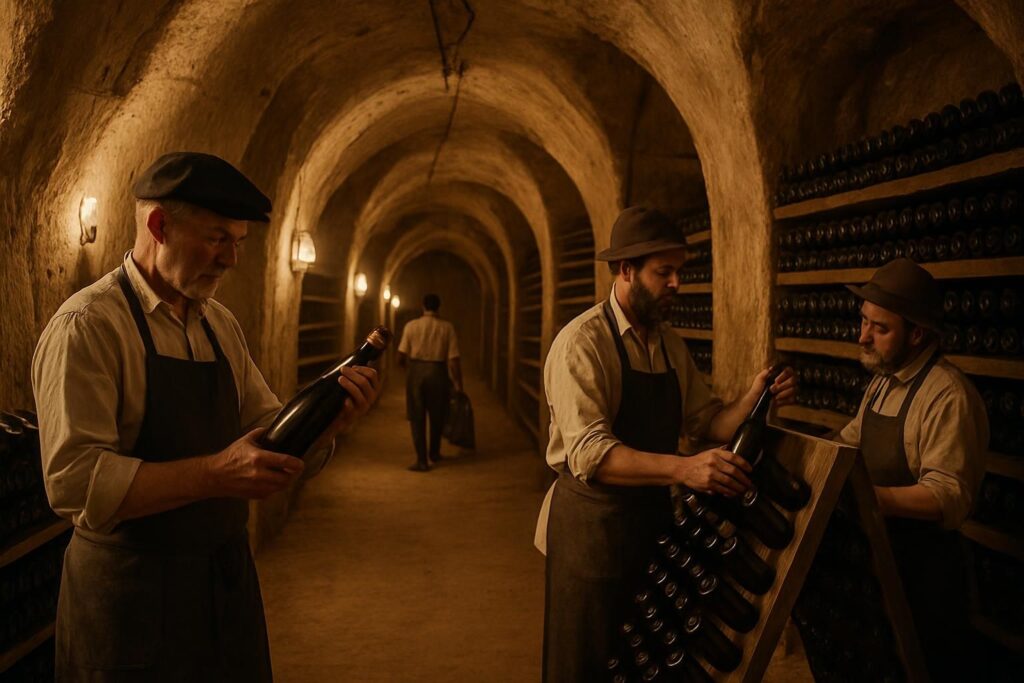
In Reims, the champagne cellars are not mere underground tunnels where sparkling bottles rest. They embody a living memory, both a witness to a rich historical past and a unique know-how in the world. Exploring these troglodytic galleries is to dive into the soul of Champagne, a region where tradition and innovation coexist harmoniously. This prestigious and vital city promotes its heritage through visits that captivate both enthusiasts and the curious, offering a rare immersive experience.
The Reims cellars stretch for kilometers, between paved aisles and delicately sculpted vaults. Every touch of chalk tells centuries of winemaking, meticulous blending, and secrets passed down from generation to generation. Wine tourism is no longer limited to simple tasting but becomes a true sensory and cultural journey. It is a tangible link between the history of the places and the modernity of the facilities, inviting an understanding of how champagne is made, refined, and shines today around the world.
The champagne cellars in Reims: an exceptional underground heritage blending history and know-how
The cellars winding beneath Reims are a treasure of history and technique. Far more than storage spaces, they represent living remains of a viticultural heritage deeply rooted in the region. Their construction on clay-limestone soils has favored ideal preservation, offering constant temperature and humidity conditions essential to the making of champagne.
These galleries, mostly dug into chalk, testify to several centuries of human activity. Some parts even date back to the Gallo-Roman era, a sign of ancient and strategic occupation. With nearly 25 kilometers of galleries, these cellars shelter not only thousands of bottles but also a craft know-how shaped by many prestigious Houses.
During the visits, explanations about the steps of champagne production enlighten the visitors’ understanding. The riddling demonstrations, where bottles are slowly turned to clarify the wine, reveal remarkable precision and patience. Moreover, the symbolism and history of the places unfold, evoking great Champagne figures, technical innovations, and unchanged traditions despite time.
A notable example is the Maison Mumm, whose emblematic cellars extend over several kilometers and preserve an exceptional heritage. Renowned for its know-how and great crus, this House alone embodies the combination of heritage and creativity. Visitors discover there the historic richness of the city of Reims through stone and wine, an open dialogue between past and present.
A unique immersive experience at the heart of the champagne houses of Reims
The visit of the champagne cellars in this city goes beyond a simple walk. It transforms into a true olfactory, visual, and sensory journey that immerses visitors in the world of Champagne viticulture. For several years, the major houses have integrated modern and scenographic devices to enrich this experience. The goal is to plunge the public into the magic of champagne while highlighting the authenticity of the know-how.
Some visits now offer interactive setups combining lights, videos, and sounds. These effects recreate the intimate atmosphere of the cellars while telling the millennium-old story of the region. For example, Maison Thiénot offers a dynamic learning of winemaking techniques, from harvest to disgorging, delivered by passionate guides. These tours target a wide audience, from novices to enthusiasts.
Like the “Le 3” project designed by contemporary architects, the staging of spaces combines historical heritage and artistic creation. Here, the dialogue between contemporary sculptures and ancient vaults immerses visitors in a rich and stimulating universe. The multidisciplinary approach encourages a new perception of champagne and promotes a sensitive reading of the terroirs and the work of the winegrowers.
This innovative setting also allows for commented tastings, where the art of blending and aromatic complexity are explained with precision. Each person can thus discover both the diversity of grape varieties used and the rigor required at every step. This complete sensory immersion showcases the Champagne terroir in all its nuances.
The history of Reims and its inseparable link with champagne
Reims, a major heritage city of Champagne, stands out for its profound historical role in the development of this exceptional wine. Beyond its religious and architectural heritage, it is the beating heart of a region dedicated to champagne. This close link is manifested in the enhancement of its cellars, true witnesses of a know-how transmitted for centuries.
The city enjoys worldwide fame thanks to its major Champagne Houses, which have built their reputation on the quality and consistency of their production. The Reims cellars, because of their extent and state of preservation, embody these solid roots. Every stone breathes the fundamental stages of champagne, from its origin to the international awards obtained over the decades.
Tourism development around the cellars is now a key driver for the region. In 2026, the rise of wine tourism in Reims is framed as a form of cultural tourism, attracting a varied audience eager for knowledge. This dynamic contributes to the valorization of the terroir, through thematic tours and dedicated events that tell the story of champagne.
This historical richness is reinforced by the preservation of precious archives and the transmission of the stories of the men and women who have shaped the region. Thus, between guided tours and educational materials, the cellars become living spaces of discovery, where the past dialogues with the present.
Champagne know-how: a craft tradition dedicated to excellence
The making of champagne in Reims is the result of rigorous know-how, where every step is mastered to guarantee optimal quality. This process, combining artisanal techniques and technological innovations, is carried out with extreme care, where gestures are passed on with precision and passion.
From pressing the grapes to fermentation, each phase requires strict skills. The grape selection, mainly Pinot Noir, Pinot Meunier, and Chardonnay, relies on a deep knowledge of the terroirs. The traditional Champagne method, applied in these cellars, demands a second fermentation in the bottle, meticulous riddling, and controlled disgorging—key steps that shape the finesse and characteristic sparkle of the product.
The cellar master’s role is central in this process. He supervises all operations, examines each batch, decides the blends, and ensures the harmonization of flavors. His mastery guarantees an exceptional product, celebrated worldwide for its gustatory precision and elegance. This art of dosage and blending is a signature hallmark of the Houses based in Reims.
Sustainable development is also part of this quest for excellence. Many Houses invest in environmentally respectful practices, reconciling tradition and ecological innovations to preserve the terroir. This commitment strengthens the quality of champagnes and opens new perspectives for the future.
Wine tourism in Reims: a vector of international influence and unique experiences
Tourism around the champagne cellars in Reims is continuously developing, offering a range of experiences suited to all levels of knowledge. It has become a pillar of the region’s touristic attractiveness, where heritage, know-how, and conviviality blend harmoniously.
Many Houses now offer themed visits, tasting workshops, or even complete stays inviting visitors to deepen their knowledge of champagne culture. The marriage between modernity and tradition is embodied in the proposed routes, which combine technical discoveries, gustatory pleasures, and moments of sharing in often prestigious settings.
To better guide enthusiasts, an updated map of accessible cellars is available, facilitating visit planning. Among the must-sees, some houses such as Bollinger or Le Brun de Neuville stand out for their innovative offerings and warm welcome. These visits, often complemented by exhibitions or cultural events, strengthen the link between wine tourism and heritage promotion.
Moreover, the immersive experience in the cellars is a true vector of international influence. Thanks to these unique routes, Reims consolidates its place as the world capital of champagne and attracts an increasingly diverse audience eager to understand and taste the history contained in every flute. This sensitive tourism today embodies an essential global recognition.
- Discovery of historic cellars for a cultural dive into the heart of Champagne traditions
- Themed guided visits promoting a fine understanding of winemaking techniques
- Commented tastings allowing appreciation of the aromatic palette and blends
- Sensory workshops and blending workshops for active participation in champagne creation
- Cultural and artistic events blending heritage and contemporary creations
Learn more about the champagne cellars of Reims and their innovative wine tourism offer.
Discover how the rise of wine tourism in Champagne transforms visitors’ experience every year.
What are the characteristics of the champagne cellars in Reims?
The cellars of Reims are distinguished by their vast underground network dug into chalk, offering ideal conditions for the aging of champagne and a rich historical heritage dating back several centuries.
How is an immersive experience in the Champagne cellars in Reims conducted?
Immersive experiences combine guided tours, modern scenographies, commented tastings, and sensory animations to immerse visitors in the world of champagne and its history.
What is the role of the cellar master in champagne production?
The cellar master supervises all steps of winemaking, controls quality, performs blends, and ensures the aromatic balance of the champagne.
Why is Reims considered the world capital of champagne?
Thanks to its rich heritage, historic cellars, renowned major Houses, and development of wine tourism, Reims asserts itself as an essential center for champagne production and promotion.
What are the benefits of wine tourism for the Reims region?
Wine tourism promotes the valorization of the terroir, boosts the local economy, promotes Champagne culture, and attracts an international audience.