
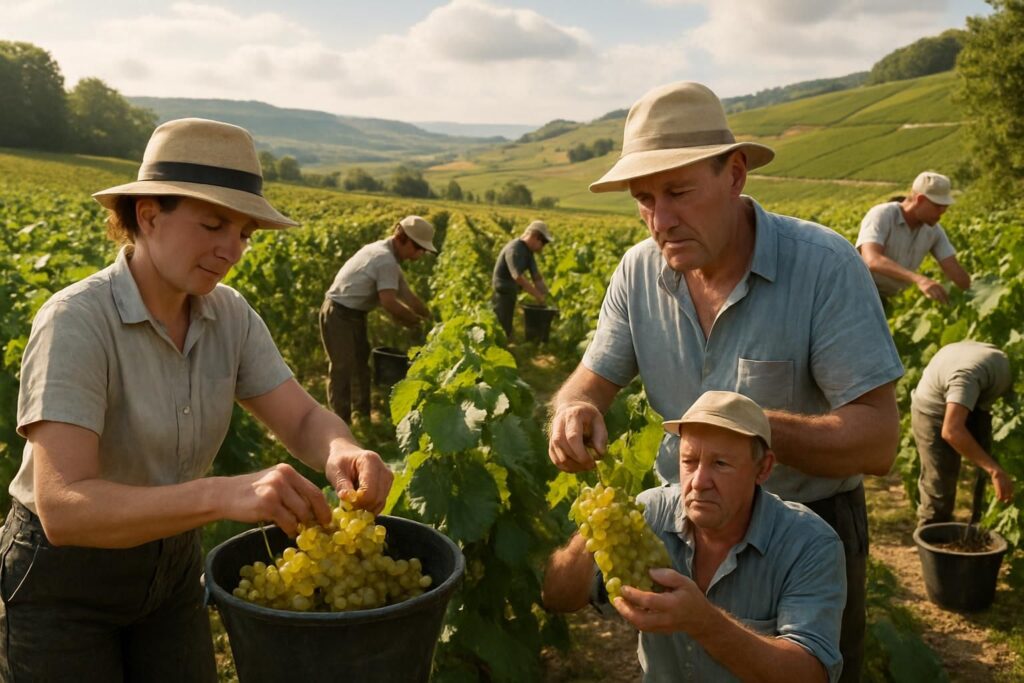
Early harvests in Champagne reveal an unprecedented reality that deeply shakes the wine industry of the region. Never before had the harvests started so early, as early as mid-August, revealing the tangible impact of climate change on grape maturation. This evolution disrupts the age-old habits of winemakers, traditionally accustomed to late-September deadlines. But beyond simply anticipating the dates, it is a profound transformation of the vine’s cycle and the nature of the grape that takes place. Several factors, closely linked to extreme climatic conditions, combine their effects to push winegrowers to adapt their methods and revise their harvest calendar.
In the slopes of Hautvillers, harvesters are busy under an unusual temperature for the season, signaling a major change in Champagne practices. The first pruning shears now date back to early August, whereas traditionally, the harvest began around late September. This historic earliness testifies to an acceleration of grape maturation, favored by successive heatwaves and intense drought. The shift from a harvest naïvely thought of as a seasonal imperative to a harvest adapting to the actual conditions of the terroir illustrates the complexity of a viticulture in transition faced with the climate challenge. This dynamic puts into perspective the very notion of wine quality, in line with pressing viticultural issues.
At both local and regional levels, this “calendar revolution” is noticeable. The reasons for these early harvests are multiple, mixing climate, vine management, and quality requirements. The challenge consists of reconciling profitability and the preservation of the Champagne terroir’s unique identity, which involves questioning traditional practices in a new context. From now on, to understand the phenomenon of early harvests in Champagne, it is essential to decipher the deep climatic causes that led to this harvest as early as mid-August, analyze the consequences for viticulture and the quality of the crus, as well as the adaptation strategies undertaken by the profession.
Climate acceleration: how rising temperatures disrupt the early harvest calendar in Champagne
For several years, the trend has been an intensification of heatwaves and marked drought, which directly affect the vine’s vegetative cycle. The year 2026 stands out due to exceptionally high temperatures in Champagne. Some areas recorded highs approaching 40 °C as early as June, a significant anomaly in this historically temperate region. This early heat triggered accelerated grape ripening, necessitating earlier harvesting to preserve the essential organoleptic qualities of Champagne.
This climate acceleration is a major factor behind the earliness of the harvest. The late March 2026 frost, also exceptional, weakened the buds, partially limiting production but confining the vine to significant hydric and thermal stress. For winegrowers, managing this rapid maturation is a challenge: the right moment must be found when the grape maturity is optimal, neither too sweet nor too acidic, in order to guarantee freshness and delicacy in the final blend.
Alexandre Gobillard, a prominent figure in Champagne, recalls that this pace was unimaginable a few decades ago: previously, harvests beginning at the end of September were the norm. Now, the need to pick from mid-August illustrates the break caused by climate warming. The increased frequency of major heatwaves since 2003, a particularly hot year engraved in the collective memory of winemakers, marks a turning point. The climate, once mild and steady, now results in extreme alternation between spring frost and intense summer heat.
To learn more about the impacts of heat on the Champagne vineyard, it is relevant to consult this detailed article on the historic impact of heatwaves in Champagne.
Technical and viticultural challenges behind the mid-August harvests
Early harvests are not only a response to meteorology: they involve a series of complex technical and viticultural challenges. The shift to a mid-August harvest pushes traditional boundaries and forces the reinvention of vineyard management, especially regarding monitoring of grape maturity. Winegrowers must be extra vigilant to synchronize the right moment to pick and avoid overripening that could compromise the quality of the Champagne.
Several factors come into play:
- Drought management: The notable reduction in precipitation causes hydric stress that concentrates sugars and aromas in the berries, disrupting their natural balance.
- Choice of grape varieties: Some are better suited to hot and dry conditions. Adapting plantings, even introducing new resistant varieties, becomes strategic.
- Harvest organization: The earliness disrupts traditional seasonal labor mobilization, requiring a different planning of logistics under often oppressive heat.
- Increased grape monitoring: Frequent analyses of chemical composition allow defining an optimal date, based not only on sugar content but also acidity and aromatic compounds.
Ophélie Lapie-Lamiable, a winegrower in Tours-sur-Marne, aptly illustrates this evolution: since the 2003 heatwave, harvest dates have inexorably advanced, sometimes to the end of August, now even mid-August. The 2026 test, with its spring frost and scorching heat, risks normalizing an unprecedented harvest period. In the near future, harvesting from August 15 could become a “standard” for Champenois.
This transformation also undermines the longevity of ancestral methods. Manual harvesting, an art guaranteeing quality, is put to a severe test facing climatic and logistical constraints. Operators must invest in training and equipment to maintain qualitative excellence amid these changes, notably by relying on technical innovations.
Consequences of early harvests on Champagne wine quality
Does the earliness of the harvest impact the quality of Champagne wines? This question fuels debates and research within the Champagne wine industry. The challenge for winemakers lies in preserving the identity and finesse that characterize Champagne, amidst rapidly evolving cultural practices.
A harvest carried out as early as mid-August presents several consequences:
- Sugar concentration: Due to drought and high heat, grape sugar content increases, which can influence the potential alcohol degree of the wines, requiring strict fermentation control.
- Acidity maintenance: This is a key element for the final freshness of Champagne. Rapid maturity obliges adjusting the harvest date as closely as possible to avoid harmful acidity loss.
- Aromatic profile: Aromas may evolve differently depending on the earliness of picking, favoring some riper or even exotic bouquets, as opposed to the finer, more delicate classic notes.
- Effect on production: Overall quality does not necessarily suffer from earliness but requires adjustments in the cellar, notably in pressing management and aging.
The first juices of this vintage are already being processed in the cellars, and specialists wonder about their potential to become grands crus, all within the pure Champagne tradition. The adaptation of oenologists and producers is crucial to harness these unprecedented particularities and take advantage of the situation. The high technicality of cellar work must accompany grapes that mature faster, without losing complexity or elegance.
Precise control of these parameters is decisive to ensure that earliness does not lead to quality degradation. Analytical innovations and traditional methods coexist to meet this requirement, inscribing Champagne in a constant excellence approach.
Adaptation and innovation: Champagne industry’s response to early harvests
Faced with this new reality, the Champagne sector has no choice but to adapt by innovating on several fronts. Climate change imposes a profound questioning of established practices, ranging from vineyard management to harvest logistics and production strategies.
Winegrowers direct their efforts toward:
- Selection of resistant grape varieties: In addition to the classic Pinot Noir, Meunier, and Chardonnay, studies evaluate the resistance of new viable varieties in Champagne.
- Adapted cultural practices: Soil work, irrigation management, and pruning techniques help limit hydric and thermal stress to protect grape quality.
- Logistics improvement: To organize the harvest under harsher and earlier conditions, the sector develops solutions to transport and accommodate teams in optimal conditions.
- Oenological innovation: New vinification methods and chemical control in the cellar optimize fermentation and aromatic balance for an enduring result.
Champagne stakeholders also work to raise awareness among consumers and professionals about these transformations, explaining the reasons and benefits of a new approach. This communication is crucial to support the valorization of wines from early harvests. Regular climate data study and the publication of forecasts and harvest dates also contribute to this collective effort. For example, one can consult updated calendars and analyses of harvest openings on this specialized site on harvests in Champagne.
The sector remains confident in its technical and human capacities to meet these challenges, turning a constraint into an opportunity. Anticipation, monitoring, and innovation are the watchwords of viticulture adapted to tomorrow’s world.
Socio-economic impacts of early harvests in Champagne: organization and human stakes
Early harvests do not only disrupt the agricultural calendar. They also transcend the human and economic dimensions of the Champagne sector. This change in rhythm affects the very organization of the harvest, a period traditionally marked by a significant flow of seasonal workers and complex logistics.
The concentration of harvests from mid-August creates several challenges:
- Mobilization of seasonal workers: The earliness requires recruiting and housing teams earlier, often in difficult climatic conditions, necessitating infrastructure adaptation.
- Pressure on operations: For Champagne houses, it means managing a condensed workload, requiring more material and human resources over a short period.
- Training and safety: Rising temperatures entail increased risks linked to intense heat for workers, calling for strengthened vigilance on health and safety.
- Local economy: The anticipated harvest date impacts the regional economy, bringing new rhythms to hospitality, catering, and transportation related to the arrival of seasonal workers.
This context also leads to rethinking the seasonality of vineyard work, with earlier and extended pressure on labor. Champagne must reconcile tradition and modernity by ensuring quality work while taking care of the teams and the conditions in which they operate.
Through these changes, the sector must demonstrate great adaptability, ensuring a delicate balance between technical demands, climatic constraints, and human imperatives. This reality contributes to a broader challenge: maintaining Champagne’s prestigious reputation in an unprecedented environmental context.
Why do harvests now start as early as mid-August in Champagne?
The earliness of harvests in Champagne is mainly due to extreme climatic conditions, notably heatwaves and persistent drought, which accelerate grape maturation.
How does this early harvest affect the quality of Champagne?
The early harvest concentrates sugars and modifies the aromatic profile of the grapes, requiring strict cellar control to guarantee the freshness, acidity, and complexity characteristic of Champagne.
What technical adaptations are implemented to cope with early harvests?
Winegrowers adjust cultural practices, select more resistant grape varieties, innovate in vinification, and reorganize logistics to preserve quality and production identity.
What is the socio-economic impact of early harvests?
The advanced calendar modifies human resource management, requiring earlier recruitment and training of seasonal workers, while ensuring their safety in a context of increased heat.