
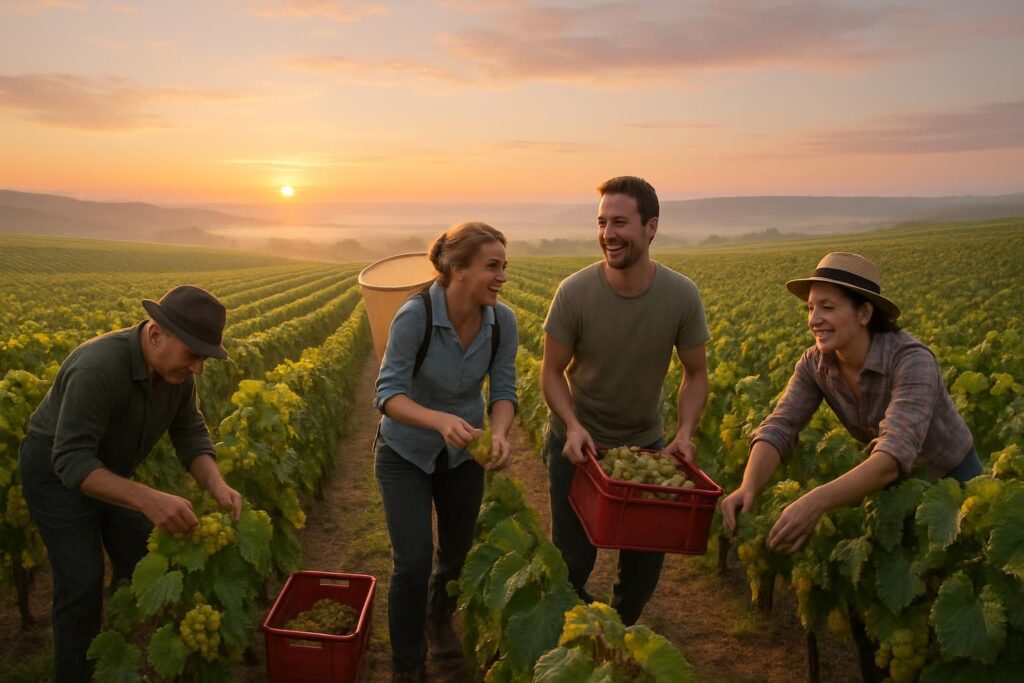
The Champagne vineyard is preparing to begin a harvest whose earliness breaks all historical records. From August 8th, in Montgueux in the Aube, the first harvests will be officially authorized, a start never seen before. This unprecedented anticipation of harvest opening dates highlights not only the direct impact of extreme climatic phenomena but also the necessity for winemakers to adapt their practices in response to accelerated grape ripening. While the heat has settled continuously throughout the year, these calendar advancements reflect a profound and lasting transformation of the Champagne terroir, at the heart of major viticultural and economic challenges.
The Comité Champagne has just published the 2026 harvest “ban,” a true roadmap for winegrowers, whose dates this year extend from August 8th to 22nd depending on the communes and grape varieties. This exceptional shift illustrates increasing pressure from global warming on an emblematic vineyard, nevertheless ensuring a promising quality of the forthcoming vintage. However, winemakers are not safe from harmful effects such as spring frost or drought, which disturb grape loads and require adjustments to harvest quotas and purchases of musts or wines to stabilize production in an uncertain global market.
A record earliness in the history of Champagne harvests: explanation and impacts
Never before has the opening of the harvest in Champagne been as early as in 2026. According to official data announced, Montgueux, a commune located in the Aube and renowned for the quality of its Chardonnays, gave the start as early as August 6th, thanks to an exceptional waiver. This highlights an unprecedented acceleration phenomenon of the grapevine vegetative cycle, strongly correlated to the recurrent heatwaves in recent months.
This phenomenon is not limited to the Aube but affects the entire Champagne appellation: the official dates published for Marne, Aisne, Haute-Marne, and Seine-et-Marne now span a window from August 8th to 22nd, on average two weeks earlier than about twenty years ago. This progressive evolution since the 1980s confirms the tangible impact of climate change on viticulture in Champagne, where grapes ripen in a context of generally higher temperatures.
This anticipation has direct consequences on cultural practices: the harvest must now be organized earlier, which modifies the entire schedule of cellar operations, from vinification to bottling. For example, specific measures are taken to manage yields, with a marketable yield set this year at 8,800 kilos per hectare, down compared to previous years in order to reconcile quality with meteorological constraints. This gradual reduction, aided by limiting the purchase of harvests to an exceptional ceiling of 15% (compared to the usual 5%), aims to balance supply and demand in a volatile international market.
The earliness in the harvest calendar also reveals a greater sensitivity of certain terroirs to climatic disruptions. Montgueux, already known for its early authorizations, offers here a prime example. The vineyard benefits from a specific micro-climate, which accentuates the early maturity of Chardonnay. However, with persistent drought episodes, maturity does not always mean optimal volume, since the lack of water limits the size of the clusters, affecting grape weight and, consequently, the harvested quantity.
The determining role of grape varieties and climate in fixing harvest opening dates
Harvest opening dates in Champagne are not uniform within the appellation. They depend on a complex combination linking the characteristics of different grape varieties, their geographical location within the vineyard, as well as the specific climate of each terroir. In 2026, this interaction was exacerbated due to the cumulative effect of high temperatures and persistent drought.
The main Champagne grape varieties, such as Pinot Noir, Pinot Meunier, and Chardonnay, present different degrees of maturity. Generally, Chardonnays, which are particularly sensitive to heat, rapidly reach maturity in the warmest areas, such as in the Aube, allowing the initiation of the first early harvests.
The climate, for its part, modulates the grape development each year. This year, the succession of heatwave episodes not only advanced the ripening phase but also forced producers to revise their cultural strategies. Several winemakers confirm that exceptional earliness does not always imply deficient quality. On the contrary, faster maturity can offer an interesting aromatic richness, provided there is rigorous control of the harvests to avoid excess sugars that could compromise the balance of the cuvée.
- The earliness of the 2026 harvest highlights the necessary adaptation of the vineyard to global warming.
- The Chardonnay grape variety is often the most advanced, notably in the Aube, triggering the harvests.
- The lack of water causes a reduction in the weight of grape clusters and impacts the quantity harvested.
- High temperatures accelerate the ripening process, which is difficult to precisely anticipate.
- The diversity of terroirs requires a differentiated approach to the harvest calendar.
Faced with these climatic changes, winemakers must also be vigilant regarding impacts on yields and final quality. The 2026 context is a striking illustration of the challenges imposed by managing harvests from the fixing of official opening dates.
Yield management and economic adaptation in response to the earliness of the Champagne harvest
The record earliness of the 2026 harvest is accompanied by rigorous management of quotas and harvested volumes, meeting a dual requirement: preserving the quality of vintages and adapting to persistent economic and climatic hazards. This policy aligns with a desire for reinforced control of marketable volumes, to ensure the sustainability of the vineyard and Champagne’s reputation on the global market.
This year, the marketable yield has been revised downward to 8,800 kilos per hectare, continuing the trend started in 2023. This reduction responds to several factors: massive bud destruction due to spring frost, repeated climatic events, and drought limiting cluster growth. These constraints led the Ministry of Agriculture to exceptionally authorize Champagne producers to resort to external purchases of up to 15% of the volume, a measure intended to offset the natural production decline.
This strategy has a direct impact on the sector: it can both stabilize supply against a still volatile global demand and guarantee a homogeneous quality of the final product. In parallel, this prudent harvest management encourages increased attention to regulation of grape maturity during harvesting, essential in Champagne viticulture to preserve aromatic and gustatory balances of the vintages.
Moreover, these economic adjustments are essential to support the many challenges posed by early harvests. They notably help sustain the sector against risks generated by the increased frequency of extreme climatic events – frost, drought, but also heatwaves – which disrupt the very beginning of the vegetative cycle through to the harvest.
The quota reduction, combined with the temporary increase in purchase possibilities, thus highlights the adaptability required under current conditions, while maintaining a primary objective: producing an exceptional Champagne that continues to charm both connoisseurs and international markets.
The impact of global warming on Champagne harvests and viticultural practices
Global warming manifests in Champagne in a particularly tangible way through the anticipation of harvests. Since the 1980s, this phenomenon observed throughout France has intensified in this emblematic region where harvest calendars have advanced by about two weeks in less than thirty years. Recent crises, culminating in the record earliness of 2026, illustrate the profound upheaval of the traditional vegetative cycle of grape varieties.
This climatic transformation modifies not only the nature of the harvests but also the cultivation and vineyard maintenance methods. Winegrowers must deal with successive episodes of heatwaves, drought, and late frost, increasing risks of water stress, yield reduction, and qualitative degradation of grapes. The Champagne vineyard becomes a true laboratory for the effects of climate on precision agriculture.
The consequences translate into:
- Increased earliness of ripening phases, requiring constant and fine monitoring of grape varieties.
- Significant water stress, which affects the weight and quality of clusters as noted in recent studies (study on drought in Champagne).
- More complex management of frost periods, directly impacting buds and thus the quantity of grapes available each year.
- The necessity for accelerated adaptation of agricultural techniques, through more resilient and innovative cultivation modes.
These challenges spark a global reflection among Champagne houses and winegrowers, seeking a balance between tradition and innovation. Some stakeholders also favor innovative approaches, such as developing climate modeling tools or the selective use of grape varieties better adapted to new temperatures. This dynamic is part of a collective adaptation effort, widely shared in Champagne, as highlighted by the statement from the president of the Grand Est region.
Innovation and perspectives for Champagne viticulture in light of earlier harvests
The unprecedented situation of the 2026 harvest, marked by a widespread early arrival, encourages the Champagne sector to rethink its viticultural approaches. Technical innovation plays a key role in managing the harvest calendar, while ensuring the intrinsic quality of the vintage, a hallmark of Champagne’s worldwide renown.
Several houses and winegrowers, aware of the stakes, invest in technologies allowing precise anticipation of grape maturity: fine analysis of aromatic profiles, remote sensing, and climate modeling. These innovative tools facilitate decision-making to determine the optimal harvest moment, essential in a context of increasingly marked earliness.
Furthermore, diversification of the varietal palette is considered a strategic lever. While Pinot Noir and Chardonnay remain the key grape varieties, increased attention is given to varieties resistant to water stress or better adapted to climatic variations.
Certain initiatives also favor sustainable cultural practices, such as controlled grassing to limit evapotranspiration, or the adoption of biodynamic methods. These approaches aim not only to preserve soil health but also to strengthen the overall resilience of the vineyard.
The harvest calendar, now a sensitive climate indicator, is at the heart of an adaptation system combining tradition, science, and innovation. In this context, the Champagne sector asserts itself as a model of agility, ready to face the multiple challenges imposed by the unprecedented earliness of the 2026 harvests.
Why are the harvests in Champagne so early in 2026?
The record earliness of the 2026 harvests mainly results from successive episodes of heat and drought that accelerated the ripening of grape varieties, notably Chardonnay, leading to an advanced harvest calendar.
What are the economic consequences of this earliness?
Earliness imposes strict yield management, with a reduction in the harvestable grape quota and a temporary increase in purchases of musts or wines to compensate for losses, in order to stabilize production and preserve the quality of Champagne.
How does global warming impact Champagne viticulture?
Global warming alters the grape ripening calendar, increases risks of water stress and frost, and forces winegrowers to adopt more innovative and resilient practices to maintain vineyard quality.
Are there specific practices to manage this earliness?
Yes, the use of advanced technological tools to monitor maturity, diversification of grape varieties, as well as sustainable cultural methods such as grassing and biodynamics, are favored to adapt to the new conditions.
Do early harvests affect the quality of Champagne?
Earliness does not necessarily affect quality. When management is rigorous, it can even reveal enriched aromatic profiles, while remaining attentive to ripening and grape balance.