
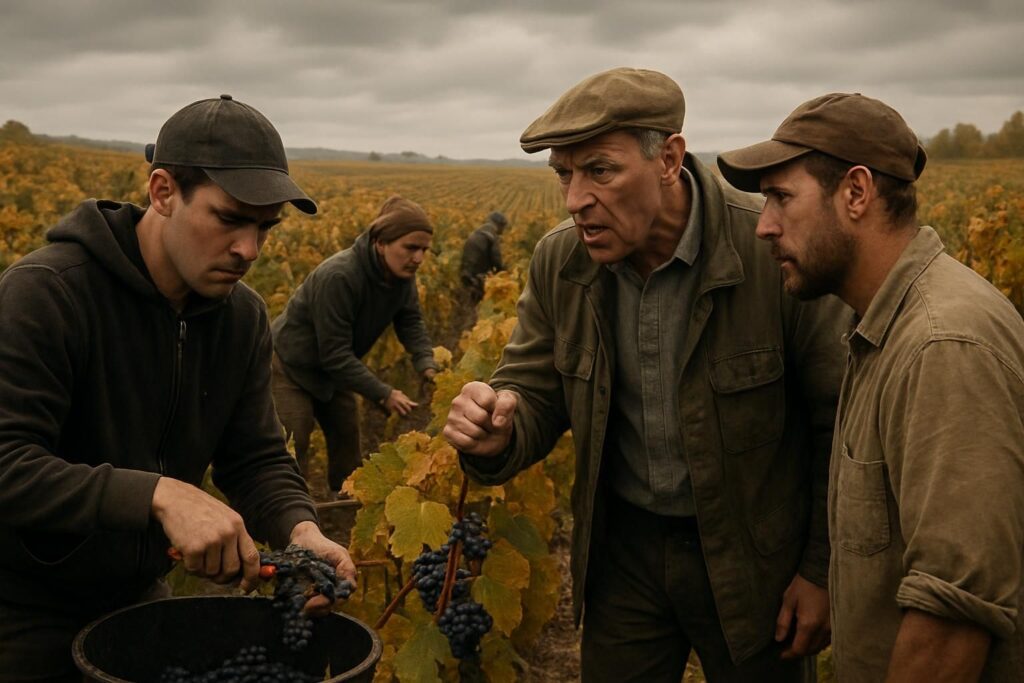
At the heart of the first 2026 harvests in Champagne, the tense atmosphere prevailing in the vineyards echoes a judicial episode with heavy consequences. One year after a major trial revealing the exploitation of grape pickers in the Marne, notably in Épernay, attention now turns to the evolution of working conditions and the challenges facing local winemakers. Between social, climatic, and economic issues, the 2026 harvest is set against a charged backdrop, where every gesture among the vine rows reveals latent tensions and persistent problems of the Champagne terroir.
As the côte des blancs is still adorned with the first golden clusters, the grape pickers face precariousness that does not seem to ease despite promises. This tense social climate also occurs in a context where the climate upsets traditional harvest calendars and tests cultural practices rooted for generations. The winemakers, essential actors in this emblematic sector, must reconcile this social urgency with the rigor necessary for the quality of Champagne, an exceptional product whose international reputation imposes a high standard both for the vine and the related trades.
Social tensions heightened by the 2025 trial in the Champagne harvests
The resounding 2025 trial regarding the alleged exploitation of grape pickers in the Marne has deeply marked mindsets both within the agricultural sphere and in public opinion. This case highlighted sometimes precarious and unfair working conditions, causing a shockwave in a region where the winemaking tradition also relies on respect for the men of the vine. In 2026, although promised improvements seemed planned, the on-the-ground reality remains mixed.
The grape pickers, often seasonal workers or from foreign countries, continue to denounce imposed frantic rhythms, underpaid wages, and insufficient supervision. Despite some enhanced control measures by authorities after the trial, testimonies collected in the Épernay area reveal that winemakers sometimes struggle to reconcile production and respect for human rights. This situation creates a true ongoing tension, where harvest pressure is coupled with a difficult social climate to manage.
In this context, many initiatives are emerging to improve safety and well-being for workers on the ground. Some estates adopt strict ethical charters or collaborate with associations specializing in agricultural workers’ rights. Furthermore, efforts are made to better organize and schedule the harvests, thus avoiding the excessive hours that were central to the criticisms during the trial. Yet, at the dawn of this new harvest, vigilance remains necessary.
A recent survey conducted in several wine-producing communes further confirms that the issue of working conditions is now central in negotiations and exchanges between employers and employees, but social tension also translates into increased pressure on prices and harvest quality, reflecting a persistent dilemma for winemakers. Each year, they must arbitrate between profitability, employee respect, and market demands—a fragile balance revealed in recent Champagne news.
The issue is not limited to social aspects alone. The complexity of relations between small operators, large Champagne houses, and cooperatives deepens the perception of a sometimes fragmented and poorly coordinated sector, also explaining the difficulty in establishing clear and common rules for all. The enhanced monitoring by authorities, supported by media including TF1+, tends to shed light on these crucial issues for Champagne’s future.
The impact of climate on the Champagne harvest: between hazards and winemakers’ adaptations
Champagne is renowned for its unique terroir and microclimates that play a crucial role in the exceptional quality of the grape. Yet, this permanence is now challenged by increased climatic hazards. Extreme weather events, droughts, spring frosts, or heavy rains are multiplying, profoundly destabilizing harvest calendars, and in 2026 even more so than before.
This year’s harvest began with particularly heterogeneous ripening of clusters, demanding constant vigilance from winemakers to optimize the yield. They must adapt their strategies, rigorously selecting parcels and spreading out the passes through the rows to guarantee consistent quality despite the capricious climate. The côte des blancs, famed for its Chardonnay grapes, remains especially sensitive to these meteorological variations.
Agronomic innovations are thus gaining ground in Champagne practices. The increased use of advanced weather forecasting tools, as well as the introduction of soil- and biodiversity-friendly techniques, fit within a collective desire to preserve the vine in the long term. At the same time, the consideration of more resistant grape varieties has become a subject of passionate debate within winemakers’ assemblies, even though it is a delicate evolution in a region attached to its traditions.
In connection with the economic news, grape quality also determines the market value of Champagne. Recent history has shown that poorer quality harvests can durably impact the reputation of crus. This reinforces the need for extreme vigilance during harvest season, where every mistake and every minute counts.
Faced with these challenges, several prestigious châteaux and estates launched agronomic research programs in 2026, partnering with specialized institutes, aimed at better understanding the impact of climate on the vine and identifying sustainable adaptation solutions. The strength of the Champagne vineyard thus depends on the capacity for innovation that marries traditional know-how and modern solutions.
Organization of the Champagne harvest: actors, methods, and logistical challenges
Organizing a harvest campaign in Champagne requires meticulous coordination among various actors. Independent winemakers, cooperatives, and large houses share the task of harvesting fragile clusters within very precise timeframes. The pressure is all the stronger this year as the harvest is expected to be decisive in terms of volume and quality.
The workforce mobilized, often seasonal, notably includes pickers coming from different regions or countries. This diversity demands strict supervision and adapted logistical organization, especially concerning transportation, accommodation, and health safety. The harvest often needs to start at dawn and extend late into the day to take advantage of optimal climatic conditions.
In several estates, pickers report a sustained pace, where physical fatigue sets in quickly. Hygiene and break issues are regularly criticized, exacerbating already existing social tensions. On the other hand, the equipment used is gradually evolving, integrating lighter and less aggressive machines to preserve grape quality as much as possible, but human expertise remains essential.
Here are some major challenges faced during harvest organization:
- Management of unexpected climatic variations and adjustment of schedules.
- Integration of a diverse workforce with short adapted training.
- Compliance with strengthened health standards post-pandemic.
- Maintaining a balance between harvest speed and quality preservation.
- Communication among sector actors for harmonization of practices.
Digitalization is also expanding rapidly, with the appearance of mobile applications enabling real-time monitoring of tons harvested, team pace, and weather conditions. This use of new technologies facilitates the work but does not in any way eliminate the physical and demanding nature of work on the ground.
To deepen the understanding of societal issues’ impact on Champagne viticultural organization, some articles like Champagne and gastronomy: a respectful alliance of actors offer an interesting cross perspective.
The role of winemakers facing current environmental and social challenges in Champagne
Champagne winemakers stand at the crossroads of a dual responsibility: to preserve a terroir listed as a world heritage site while adapting their practices to contemporary ecological and social demands. In 2026, the balance between tradition and innovation is more necessary than ever.
At the heart of debates is the sustainable management of vineyards. Organic and biodynamic farming methods are developing, favoring soil and plant health without compromising the final quality of Champagne. This transition, sometimes delicate, requires investments and thorough training, but it responds to a growing consumer demand for products with reduced impact.
On the social dimension, the winemaker is now also a responsible manager, attentive to the well-being of their stable and seasonal teams. They must not only comply with legal standards but also cultivate a peaceful work climate, a key factor for quality and sustainability. Partnerships with local organizations and social support initiatives are increasingly frequent.
Economic dynamism depends on a regained unity in the sector, a need for visibility and reinforced solidarity. In this regard, the role of regional institutions and networks such as that relayed by TF1+ is crucial to promote Champagne expertise while maintaining a critical eye on the shadowy areas.
To grasp recent approaches and their impact on the region, it is recommended to consult specialized resources such as the eco-performance initiatives of Champagne winemakers. These examples show that the Champagne sector advances pragmatically in the face of its challenges, inviting all stakeholders, from the most remote lands to urban centers like Épernay, to work towards a sustainable future.
Economic perspectives and market developments for Champagne in a tense context
The 2026 harvest in Champagne takes place in an economic context where global demand—albeit robust—is confronted with several structural challenges. Price fluctuations, amplified by rising production costs and geopolitical uncertainties, directly affect the profitability of Champagne operations.
Moreover, wine quality is a major competitive stake. Any defect in the harvest can have long-term consequences on brand image, with a notable impact on export markets, the main growth driver. The necessity to maintain Champagne’s reputation against aggressive international competitors encourages producers to invest more in quality, but managing this remains complicated during periods of social and environmental tension.
Development prospects mainly concern commercial innovation, with the rise of short circuits, online sales, and immersive wine tourism experiences. These trends are also a lever to strengthen the link between consumers and producers, a valuable strategy in this changing context. For example, the emergence of new addresses in Chalons-en-Champagne testifies to this effort to invigorate the region and attract an audience eager for authenticity and local discoveries.
In summary, winemakers stand at a crossroads between preserving traditions and adapting to market changes. The tension observed during these harvests reminds us that Champagne’s future, a symbol of excellence, will depend as much on grape quality as on respect for human and environmental conditions.
Find more information on current trends and innovations in the sector on the specialized site new addresses in Chalons-en-Champagne, which highlights regional dynamics.
What are the main causes of tensions during the Champagne harvests?
Tensions mainly result from difficult working conditions for grape pickers, sometimes complex organization between the different sector actors, and seasonal pressure amplified by economic and climatic challenges.
How does the climate influence the quality of the Champagne harvest?
Climatic variations, such as frosts, droughts, and unexpected rains, modify grape ripening and can affect the final quality of Champagne. Winemakers adapt their methods to preserve quality despite these hazards.
What measures were taken after the 2025 trial concerning the exploitation of grape pickers?
Enhanced controls, ethical charters, and associative initiatives have been implemented to improve working conditions and reduce abuses toward seasonal workers in the Champagne sector.
How do Champagne winemakers reconcile traditions and innovations?
They move towards more sustainable agricultural practices by combining ancestral know-how and new techniques, while integrating better social and environmental practices in managing their operations.
What are the major economic challenges for Champagne in 2026?
These include cost control, harvest quality, international competitiveness, and the development of new distribution channels to meet modern consumers’ expectations.