
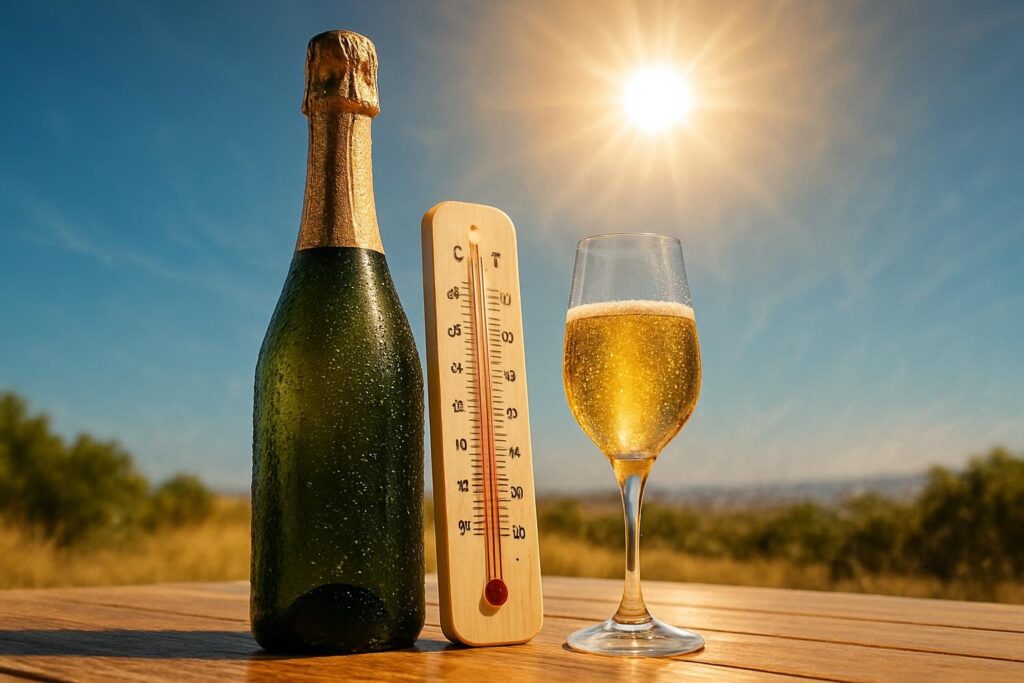
The recent succession of heatwaves in Champagne reflects a profound change in climatic conditions that now influence the viticulture of this iconic region. Each increasingly scorching summer alters the ripening of the grapes, accelerating their development and increasing their sugar content, which inevitably impacts the final alcohol level in the wine. This phenomenon challenges traditional winemaking practices and the very definition of champagne profiles, hitherto based on a subtle balance between refreshing acidity and aromatic finesse. Early harvests in August, declining yields, and exceptional alcohol degrees, sometimes exceeding regulatory limits, illustrate an unavoidable reality for industry professionals.
Faced with these upheavals, the profession has requested exemptions to market champagnes with unprecedented alcohol levels, frequently exceeding 13%, even reaching 14 or 15%. This context demands deep reflection on vineyard management, grape variety adaptation, and winemaking techniques, while sparking debates on preserving the unique character of Champagne bubbles. At the same time, the exceptional quality of some grapes offers unprecedented potential despite climatic challenges. Through analyzing the direct impacts of heatwave episodes on the vine, winemaking, and the organoleptic characteristics of champagne, it will be essential to grasp the scale of this climatic revolution.
How heatwaves alter grape ripening in Champagne
Prolonged heatwave episodes in Champagne significantly modify the physiology of the grape, disrupting the traditional vegetative cycle typically associated with this cool terroir. During these heat surges, the vine responds by accelerating sugar synthesis in the berry, an adaptation to thermal stress observable from early summer. This phenomenon is intensified by a marked decrease in natural acidity, a crucial element for the freshness and balance of the wines produced.
The direct consequence manifests in the chemical composition of the grape juice, where the concentration of glucose and fructose increases, raising the alcoholic potential of the future wine. In 2026, this situation led to exceptionally early harvests, sometimes as soon as August 6th, when the winemaker observes that the clusters have reached an unusual maturity level for this period. The phenomenon not only affects traditional grape varieties such as Pinot Noir, Chardonnay, or Meunier but also questions their long-term viability facing a progressively Mediterranean climate in this northern region.
To illustrate this evolution, it is enough to compare the yields obtained on the same plots between 2025 and 2026. While the previous year offered about 10,000 kilos of grapes per hectare, the 2026 harvest only reached 7,000 kilos, with berries more concentrated in sugar. This phenomenon inevitably impacts both quality and quantity of wine produced, posing a paradox between aromatic richness and reduced volume. Winemakers’ responses now include strategies such as vine shading, soil structure modification, or selecting rootstocks more resistant to dehydration.
Precise understanding of these mechanisms is essential. Indeed, the combination of increased sugar accumulation with low acidity pushes for renewing harvesting practices and rethinking the viticultural calendar. Early harvests facilitate maturity management but also raise questions about the build-up of structure and aromatic typicity of future champagnes. The goal will therefore be to reconcile the inevitable rise in alcohol levels with the preservation of the emblematic Champagne style.
Technical and regulatory adaptations to rising alcohol levels in champagne
The sharp increase in alcohol content due to the sugar concentration in grapes forces the Champagne industry to adopt unprecedented measures. In 2026, for the first time, the Comité Champagne obtained an exceptional exemption from the National Institute of Origin and Quality (INAO), allowing the marketing of champagnes displaying alcohol levels up to 15%, beyond the usual 13% limit. Although concerning a minority of producers, this change reveals a new reality for the entire vineyard.
In response to this rise in alcohol level, several technical options are explored by Champagne houses and winemakers. Firstly, the traditional blending of several vintages remains a preferred tool to moderate the alcoholic intensity of an exceptionally ripe vintage. This system allows incorporating fresher and more acidic wines from cooler years to rebalance batches and ensure the product’s coherence. However, this method is only viable to a certain extent if future harvests maintain high alcohol levels.
Moreover, genetic adaptation becomes a serious avenue. Selecting or introducing grape varieties more resistant to heat or less sensitive to over-ripening could preserve Champenois typicity. Several studies also encourage researching rootstocks adapted to new climatic constraints, capable of limiting sugar concentration while maintaining vine vigor.
Another lever lies in vineyard planning. Installing shading nets on certain plots, modifying row orientation, or enhancing irrigation are solutions considered by growers to reduce hydric and thermal stress. These measures, although costly, help limit the direct impact of heatwaves on the rapid maturity of grapes.
Finally, the regulation, long rigid, seems to be progressively adapting to this new reality. French and international consumption remains sensitive to champagne quality, and the profession seeks a balance between innovation and respect for traditions. The recourse to a punctual exemption may herald more lasting relaxation, opening the way to champagnes claiming a modified identity, infused with the realities of global warming.
Organoleptic consequences of warming on champagne’s taste and structure
Climate change influences not only yields and alcohol levels but also disrupts the aromatic palette and texture of champagne. Accelerated grape ripening, with high sugar content and reduced acidity, alters the chemical composition of the must, impacting winemaking and the final perception of the sparkling wine.
Typically, Champagne cellars strive to preserve the delicate balance between freshness, acid tension, and aromatic liveliness, which confer champagne its unique identity. However, heatwaves modify this balance by reducing malic and tartaric acidities, responsible for the lively and refreshing character. In parallel, aromas evolve toward riper, sometimes jammy or even slightly alcoholic notes, associated with higher alcohol levels.
This evolution poses a major challenge for oenologists. Winemaking must be reconsidered to control alcoholic fermentation, anticipate the intensification of alcohol perception in the mouth, and adjust dosage so as not to mask finesse. Techniques such as must cooling, selection of specific yeasts, or enzymatic control become essential levers in the quest for a renewed balance.
On the sensory level, tasters note a fuller texture and a warmer sensation, contrasting with classic champagnes. While some enthusiasts may appreciate this increased richness, others regret a loss of freshness and lightness, hallmarks of the traditional Champagne style.
Through this transformation, Champagne wine is reinventing itself, disrupted by constraints imposed by climate. The question then arises: how to preserve a globally recognized typicity while integrating the realities of a rapidly changing nature? The coming years will be decisive for the qualitative adaptation of these exceptional wines.
Innovative strategies to protect the vine and control alcohol levels
Faced with this observation, Champagne growers adopt various strategies to counter the increasing effect of heatwaves on alcohol levels in their products. While maintaining quality, it becomes imperative to master the vine from planting to pressing, including managing environmental factors. These approaches cover agronomic, oenological, and technological dimensions, sometimes complementary.
Among agronomic solutions, partial shading of vines using nets or natural elements helps limit cluster overheating. Reasoned irrigation, though still limited by regulations in Champagne, is gaining ground in the most affected areas. Additionally, soil management to preserve moisture and optimize biodiversity is increasingly valued. These practices aim to reduce hydric stress and excessive photosynthesis, thus moderating sugar accumulation in the berry.
At the same time, varietal choice is shifting towards grape varieties better suited to new climatic trends. Studies on heat-resistant rootstocks and later-ripening clones are encouraged to preserve Champagne’s genetic diversity. Climate change thus calls for rethinking the vineyard, anticipating a Mediterranean climate progressively shifting the boundaries of wine-growing soils.
In the cellar, fermentation control techniques have evolved: use of less alcoholic yeasts, temperature-controlled fermentation, or targeted micro-oxygenation contribute to regulating the final profile of champagnes. The exemption obtained in 2026 allowing greater tolerance of alcohol degrees encourages a progressive regulatory adaptation, providing some leeway to producers faced with heatwave phenomena.
An overview list of the main strategies deployed:
- Installation of shading nets to limit the direct impact of sunlight on grapes.
- Rigorous irrigation management to limit hydric stress.
- Selection of rootstocks and clones resistant to heat to stabilize ripening.
- Optimization of harvest dates to pick at the optimal moment without excess sugar.
- Adapted winemaking techniques to modulate alcohol levels and preserve aromas.
This evolution reflects a true revolution in Champagne viticulture, foreshadowed by recent studies on ultra-early harvests and confirmed by results observed in various plots affected by heat. These adjustments testify to the agility and innovative capacity of the region to assert itself in a rapidly changing world.
These combined approaches can reconcile tradition and change, within a sustainable perspective, ensuring Champagne’s longevity in the face of climate challenges.
Economic stakes and the future of Champagne in a changing climate
The successive heatwave episodes not only disrupt the vine’s vegetative cycle and winemaking but also have direct repercussions on the Champagne industry’s economy. Today, it must integrate additional costs linked to warming management: investment in protection equipment, cultural modifications, legal exemptions, and adaptation of production processes.
By 2026, the vintage showed yields significantly below expectations, with an average of 7,000 kilos per hectare versus 10,000 kilos in 2025, translating into a global reduction in champagne volume produced. This scarcity, combined with increased alcohol levels, leads to market tension and a probable price rise, already noticeable in several commercial segments.
The economic stakes are coupled with deep reflection on preserving champagne’s global reputation. The exceptional quality of grapes, mentioned by the Comité Champagne as a major positive point, could become a differentiating lever if the industry manages to adjust swiftly. However, the risk is real that style and profile divergences appear among champagnes produced, due to new ripening modalities imposed by a changing climate.
The Champagne vineyard also faces territorial adaptation questions. The northward progression of Mediterranean climates in France implies a gradual redefinition of the most suitable vine-growing areas. Some historic plots might see their potential diminish over the long term, to the benefit of zones previously less exploited. These methodological and geographical changes are already documented in publications like studies on harvests and drought in Champagne.
Facing these developments, the profession relies on research and cooperation among stakeholders to guarantee a faithful champagne, even if it must now coexist with new constraints. Champagne’s future lies in this capacity for innovation, adaptation, and constant reinvention.
Why does the alcohol content of champagne increase with heatwaves?
High temperatures accelerate grape ripening by increasing sugar concentration, resulting in a higher alcohol content during fermentation.
What are the impacts of warming on champagne’s taste?
Warming reduces the grape’s natural acidity, modifies aromas toward riper notes, and imparts a warmer mouthfeel, thus affecting champagne’s characteristic freshness.
How can winemakers limit the rise in alcohol content in champagne?
By adopting practices such as vine shading, irrigation management, selecting adapted rootstocks, and adjusting harvest dates as precisely as possible.
Will the exemption for champagnes over 13% alcohol be permanent?
This exemption obtained in 2026 could become the norm, reflecting the need to adapt regulations to climatic realities, but remains subject to ongoing evolution of winemaking practices.