
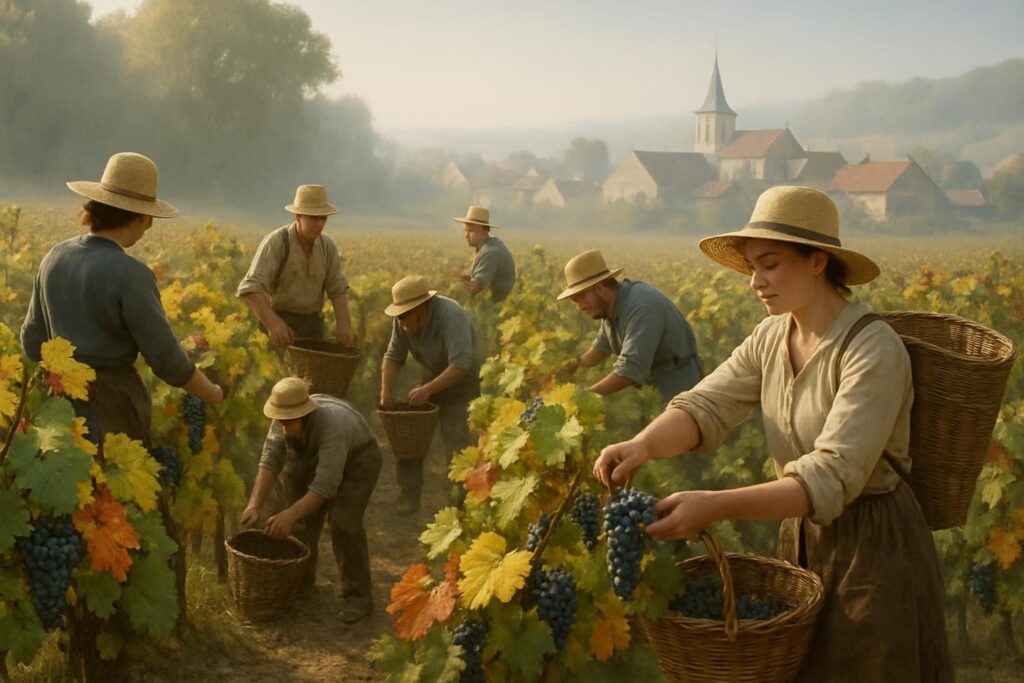
The grape harvests in Champagne for the year 2026 promise to be marked by exceptional earliness, a direct consequence of unusual climatic conditions that have accelerated the ripening of the grapes. The Comité Champagne published this Wednesday the official start dates for the harvests, thus marking a crucial appointment for all the players in Champagne viticulture. This anticipation reflects environmental factors that have continuously influenced the development of the vine, requiring careful assessment at every stage of the vegetative cycle. With a vintage shaped by heatwave episodes and prolonged drought, the viticultural campaign is facing unprecedented challenges, pushing winemakers to adapt their practices to preserve the quality of the grape varieties and optimize the harvest.
This year, the harvest therefore starts earlier than ever, with some areas even beginning picking in the first days of August. The speed at which the clusters reached the minimal potential alcohol level for harvesting testifies to the impact of the intense heat accumulated since the beginning of summer. This advanced schedule is not only a matter of dates but a clear indicator of the growing tensions between terroir requirements and climate evolution. In this context, Champagne producers navigate between respecting appellations, grape health imperatives, and the expectations of a market eager for the region’s characteristic finesse.
Early harvest dates: an unprecedented phenomenon in Champagne
The early publication of the 2026 Champagne harvest dates surprised many observers, as the displayed earliness exceeds the standards observed over the past four decades. The Comité Champagne has officially moved the start of the harvests to August 12, compared to an initially planned date around August 15. This decision results from precise measurements by the Matu network, which rigorously monitors grape maturation since early August. Results showed that in certain municipalities, notably in the Sézannais and Aube areas, the grapes had already reached a sufficiently high maturity threshold to justify an immediate harvest.
This trend is mainly explained by the combination of successive heatwaves and a spring already dry, which accelerated the vegetative cycle. The grape, subjected to this climatic stress, rapidly accumulated sugars and aromatic compounds, reaching a sanitary state deemed exceptional by the viticulturists. However, this situation confronts vineyard managers with a dilemma: harvesting too early can sometimes compromise certain flavor balances, while delaying picking exposes clusters to increased phytosanitary risks, especially in case of violent storms or humidity.
A striking example is that of a winemaker in Montgueux, in the Aube, who had to request a special exemption from the National Institute of Origin and Quality (INAO) to start harvesting as early as August 6, a historically early date. This case clearly illustrates the pressure exerted by the climate on the traditional rhythms of the vine. Moreover, the variety of grape varieties present in Champagne – mainly Pinot Noir, Meunier, and Chardonnay – react differently to these atypical conditions, thus influencing the harvest strategy of the different plots.
Impact of atypical climate on grape ripening and vintage quality
The exceptional climatic conditions experienced by the Champagne region in 2026 are at the heart of discussions about the vintage. The succession of heatwave episodes, accompanied by prolonged drought, has profoundly modified the physiology of the vines and the composition of the clusters. These conditions accelerate photosynthesis and sugar concentration, while sometimes reducing berry size, which directly affects the aromatic profile and acidity of the grape. The immediate consequence is an earlier harvest but also a challenge in determining the optimal picking moment.
Winemakers must therefore continuously adapt to climate fluctuations. For example, in certain plots, Chardonnay reveals an aromatic potential strengthened by the rapid ripening, while Pinot Noir presents a more intense tannin concentration, bringing a particular structure to the wines. The sanitary state of the grape, considered exceptional this year, results from increased vigilance and controlled treatments. Indeed, the low humidity has limited the development of cryptogamic diseases, often feared in Champagne, which gives hope for healthy and consistent grape quality.
The water stress experienced by the vine can, however, cause imbalances within the plant, sometimes leading to negative effects on yield consistency. This situation alerts producers to the need to modify certain cultural practices. Relying on adapted soil management, limiting chemical amendments, and seeking plots less sensitive to drought are thus becoming priorities. The 2026 vintage is therefore part of a dynamic where climate control and understanding of the grape varieties combine to give rise to unique wines, reflecting a terroir undergoing profound changes.
Logistical organization and challenges related to an advanced harvest
The earliness of the harvest inevitably leads to significant logistical repercussions for all châteaux and Champagne houses. Picking teams must be mobilized earlier, sometimes urgently, and coordinating harvesting equipment requires strict anticipation to avoid time losses. This year, several operators had to adjust their internal schedules to meet the demand for an optimal harvest, often several days or even a week earlier than usual.
The machines intended for sorting and pressing must also be ready to accommodate the fruit of a fast and voluminous harvest, especially in regions where ripening is homogeneous. This is a major challenge in terms of quality because speed must never compromise the precision essential to grape processing for winemaking.
This dynamic also demands particular attention to yields. The Comité Champagne has set a slightly reduced grape quota for 2026 to ensure the quality of the vintage, forcing producers to optimize each hectare of vineyard. In case of unfavorable weather during the harvest period, the impact on quality could be significant, highlighting the fragility of such an advanced schedule. It is therefore crucial that each step is mastered, from harvesting to the first transformation in vats.
Here are some of the adaptations put in place this year:
- Strengthening the training of picking teams for better responsiveness.
- Enhanced coordination between winemakers and houses to adjust grape reception capacities.
- Proactive management of climatic hazards with regular monitoring and precise indicators.
- Increased use of modern technologies enabling finer and faster berry sorting.
- Optimized logistical organization to limit downtime and speed up transport to the cellars.
Economic and social repercussions for the Champagne sector
The advanced harvest schedule also influences several economic and social aspects in the Champagne region. An earlier harvest not only puts pressure on human resources during the peak summer period but also requires increased investment in adapted equipment in the face of an atypical season. For many winemakers, earliness implies a reorganization of budget resources as well as a revision of commercial strategies in a highly competitive market.
On the social level, harvests traditionally attract a significant seasonal workforce. This shift in dates raises questions about worker availability, often engaged in other tourism or agricultural sectors. Champagne houses therefore must redouble their efforts in team management to ensure the quality and continuity of the harvest.
Moreover, this anticipation has a strong symbolic dimension, reflecting a tangible environmental change. It fuels debates about the future of the Champagne vineyard and the impact of climate change on wine production. While some actors commit to sustainable adaptation approaches, others wish to preserve more conventional methods, illustrating the internal tensions of the sector.
The year 2026 thus fits into a dynamic where the economic robustness of Champagne is tested by the need to innovate, while respecting its historical and qualitative heritage. To delve deeper into these issues, the latest news about the 2026 harvests in Champagne offers relevant insight.
Technical adaptations and innovations facing early harvests
To cope with constraints imposed by these atypical conditions, Champagne professionals demonstrate great ingenuity. Modern viticulture increasingly integrates technological tools designed to refine grape analysis and optimize harvest timing. These innovations help to better understand vine health and precisely measure berry maturity, thus avoiding the risks linked to harvesting too early or too late.
Among the deployed solutions are sensors measuring soil moisture, drones for mapping plots, and artificial intelligence software capable of cross-referencing weather data and field observations. These advances facilitate decision-making in a context where cultivation conditions become increasingly complex and variable.
Champagne grape varieties, each with terroir-specific characteristics, largely benefit from this modernization. Pinot Noir, for example, can be harvested at the precise moment when its tannins reveal their best quality, while Chardonnay benefits from fine management of its acidity. This precision helps preserve the distinctive characteristics of Champagne wines despite the pressure exerted by a changing climate.
This technological approach does not eliminate the importance of traditional know-how. On the contrary, it strengthens winemakers’ ability to anticipate and respond quickly to hazards. The dialogue between tradition and innovation is now a key lever to preserve the excellence of Champagne.
To discover how emblematic actors of the region are shaping this new viticultural era, the report on Maximilien Vignier and his harvest management provides informative insight.
Why are the harvests starting earlier and earlier in Champagne?
The advancement of harvests in Champagne is mainly due to warmer and drier climatic conditions causing rapid grape maturation, leading winemakers to harvest earlier to preserve quality.
How does the Comité Champagne determine the harvest dates?
The Comité Champagne relies on precise data from the Matu network that monitors grape maturation, as well as analyses of vine health and climatic conditions to set official harvest dates.
What are the main challenges related to these early dates?
Early harvests pose significant logistical challenges, especially regarding labor mobilization, equipment organization, and management of risks linked to climatic hazards during the harvest.
What impacts do the atypical conditions have on wine quality?
Unusual climatic conditions can enhance the aromatic and sugary concentration of grapes but also disturb the acid and tannin balance, requiring increased vigilance to produce a harmonious wine.
What innovations help winemakers manage these changes?
Technologies such as soil sensors, drones, and AI software allow precise monitoring of maturation and rapid adjustment of harvest decisions, combining tradition and modernity.