
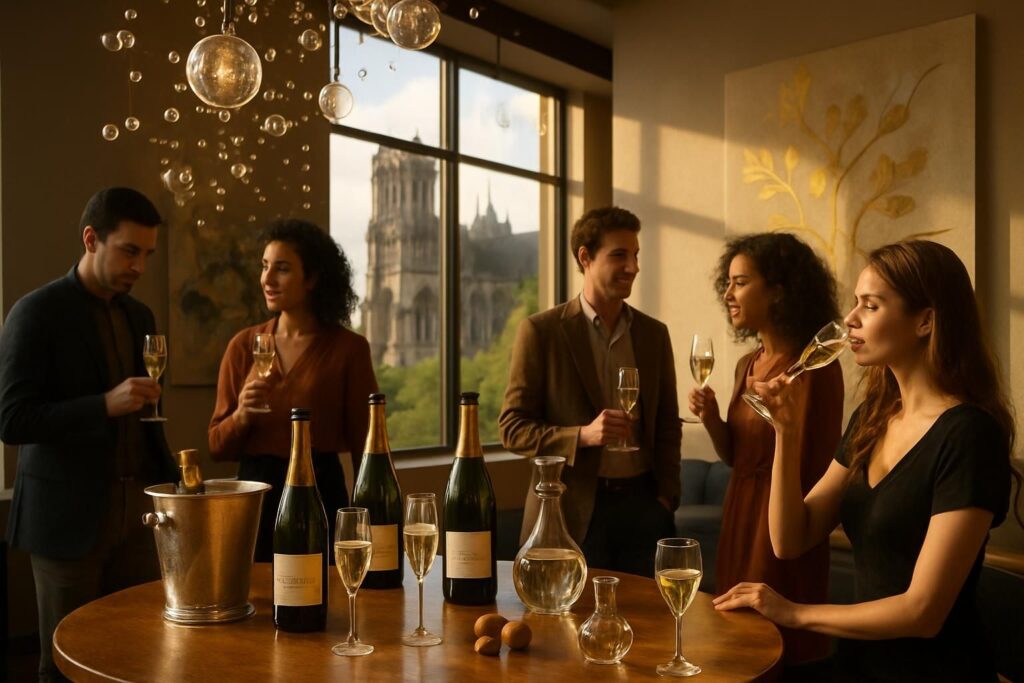
Reims, the undisputed cradle of champagne, today reveals itself as a stage where art, creativity, and oenological tradition meet to offer an extraordinary immersive experience. More than a simple tasting, the discovery of the precious nectar unfolds in a universe combining heritage, contemporary design, and artistic encounters. The historical richness of the listed crayères, combined with bold architecture and contemporary installations created by international artists, transforms the visit into a true sensory and cultural journey. By immersing themselves in these emblematic spaces, the public gains access not only to the sparkling magic of the wine but also to a profound reflection on the exchange between nature, ancestral know-how, and creative innovation.
This dialogue between past and present is particularly evident at 4, rue des Crayères, where the Ruinart house offers a unique adventure blending its famous underground cellars, an architectural pavilion designed by renowned names, and a collection of contemporary artworks. This approach redefines the way of apprehending champagne, inviting visitors to explore Champagne culture in its entirety, through the prism of nature, time, and matter. The tasting then becomes a natural step in a broader journey, where each bubble tells a story. Moreover, thanks to specialized events and artistic collaborations, Reims strengthens its status as a cultural and gastronomic capital, offering visitors a complete immersion in the majestic world of champagne.
4, rue des Crayères in Reims: a unique setting for an unprecedented immersive champagne experience
In the historic heart of Reims, the site at 4, rue des Crayères stands out as an exceptional place in the Champagne world. It is not just a simple house to visit, but an immersive journey that reveals the complexity and richness of sparkling wine through a subtle interaction between heritage, design, and art. The challenge is to transcend the classic cellar visit to deliver a genuine sensory and intellectual experience. Here, the crayères, these ancient chalk quarries listed as a UNESCO World Heritage site, serve as the starting point. They suggest the essential temporal and geological dimension for the maturation of champagne, offering a natural and authentic setting.
Visitors discover underground the traditional champagne-making process, including ancestral gestures such as riddling and manual stirring. This respect for techniques, almost forgotten elsewhere, is accompanied by meticulous signage and scenography that detail every stage of the winemaking process. This technical highlight is not limited to information: it invites an immersive dive into the history and stakes of champagne, enhancing know-how that conditions the finesse and effervescence characteristic of Champagne wine. Indeed, understanding these ancestral gestures allows for a better appreciation of the complexity of a tasting, while perceiving the efforts made on quality and authenticity.
Back on the surface, the architectural discovery continues with the Nicolas Ruinart Pavilion, a contemporary dialogue opposite the classical buildings. Designed by renowned architects such as Sou Fujimoto, this pavilion elevates the experience with an aesthetic that combines transparency, light, and references to the local terroir. The juxtaposition between glass and limestone symbolizes the balance between innovation and heritage, while the building’s curves evoke fluidity and life, inviting the visitor to perceive champagne as a dynamic, moving, living product. There, the wine also expresses itself through the surrounding space, each detail stimulating reflection on the natural and cultural dimension of the product.
Artistic creativity serving the heritage and culture of champagne in Reims
The uniqueness of this immersive experience largely relies on the integration of contemporary artistic creation, which extends far beyond a simple static exhibition. More than 110 works, created by 36 international artists, enrich this unique space. These installations, specifically designed to interact with the crayères, gardens, and historic lounges, translate in matter and form the multiple facets of the Champagne terroir, from the vine to consumption.
Each piece thus draws upon fundamental elements such as limestone, vine sap, or even the natural sound of bubbles, creating a sensitive bridge between the physical substance of champagne and its artistic and poetic dimension. The approach is holistic: the wine is both an oenological creation and an inexhaustible source of inspiration for contemporary forms of expression. For example, works such as Xylemia by Thijs Biersteker transpose the physiological data of trees into interactive visuals via real-time sensors, making tangible the health of the vineyard and its vitality.
The visual artist Tadashi Kawamata, invited in residence, also enriches this experience with his constructions made from simple, often reclaimed materials, which establish a dialogue with the surrounding landscape. His permanent works, such as Observatory or Nest, invite the visitor to a new way of perceiving the Champagne environment, highlighting biodiversity and the symbiosis between nature and culture. Art is not limited to decoration but imposes itself as an invitation to contemplation, to an attentive reading of natural cycles and ecological interactions that influence champagne production.
These artistic initiatives reinforce Reims’ position as a hub of exchanges between tradition and innovation, where wine culture fits into a broader reflection, particularly integrating the now unavoidable climate challenges. Environmental awareness is emphasized in these pathways, highlighting how practices such as reducing grape quotas or more reasoned harvests help preserve the quality of a historic product while respecting its terroir. To deepen these themes, specialized articles discuss, for example, the reductions in grape quotas in Champagne, a topic central to current concerns.
When tasting becomes a complete gastronomic and sensory journey
Reims does not only reveal champagne through its historical perspective or memory; the city also capitalizes on the combination of wine and gastronomy to offer a complete experience. Houses like Ruinart broaden their approach by offering gastronomic dinners where the complexity of champagne is expressed through sophisticated pairings. These exceptional events, orchestrated by renowned chefs such as Arnaud Donckele, highlight the finesse and plurality of cuvées through well-studied taste harmonies, enriched by seasonality and technical precision.
These multi-course meals create a favorable setting for discovery: each dish dialogues with a specific wine, revealing unprecedented textures, aromas, and sensations. The experience goes beyond mere consumption to become a true sensory learning, where the differences between a brut nature, a vintage, or a rosé are fully perceived in the gustatory dimension. Gastronomy thus acts as a genuine revealer of champagne, also suggesting that the art of the table is inseparable from the wine culture in Champagne.
Moreover, these gastronomic proposals actively contribute to positioning Reims as a destination of excellence, reinforcing its touristic and cultural appeal. Visitors no longer come only for a classic visit but to immerse themselves in a total experience, where creativity, refinement, and tradition converge in a celebration of taste and the moment. For a broader immersion in the Champagne universe, the discovery of the emblematic cellars of Reims enriches this oenotouristic and cultural quest.
The experience continues: artistic and cultural events at the heart of Reims, champagne capital
Reims, as the world capital of champagne, continually innovates to pay tribute to its heritage while welcoming today’s creativity. Champagne houses regularly organize events where art, wine, and gastronomy mingle, fostering encounters between the general public and professionals. Among these events, the Pommery Artistic Expedition embodies this spirit by offering each year an artistic plunge into historic cellars, with a selection of contemporary artworks investing these singular spaces.
This type of event makes Reims a true center of cultural experiences, constantly renewing the way Champagne culture is lived. Visitors participate in workshops, themed visits, or creative paths, which mark the year and celebrate both tradition and modernity. These participatory experiences strengthen the understanding of champagne as a cultural and artistic product in its own right, highlighting the multiple facets of the wine but also the viticultural ecosystem.
This trend is accompanied by an openness to new forms of creativity and well-being around champagne, indicating that wine culture is evolving with contemporary expectations regarding customer experience. The mix of gastronomy, art, and tasting thus finds a new resonance, designed to awaken all the senses and satisfy intellectual curiosity. The impact of these initiatives goes beyond the wine itself, as they contribute to the overall attractiveness of the Champagne region in a context of enhanced cultural tourism.
List of key elements not to miss during an immersive experience in Reims
- The Ruinart listed crayères: plunge into the historic cellars listed as heritage, true underground jewels to understand the maturation of the wine.
- The Nicolas Ruinart Pavilion: a remarkable example of contemporary architecture inspired by the Champagne terroir and local nature.
- The contemporary artworks: more than a hundred artistic installations integrated into the space, blending design, ecology, and culture.
- The gastronomic dinners signed by Arnaud Donckele: a refined gourmet experience combining exceptional food and champagne pairings.
- The cultural events such as the Pommery Artistic Expedition: an immersion mixing contemporary art and wine heritage accessible to all.
- The thorough discovery of know-how: workshops and guided visits to understand the ancestral techniques of wine.
What makes the Ruinart experience so unique in Reims?
The Ruinart experience combines exceptional underground heritage, contemporary architecture, and modern art into a unique sensory and cultural journey that goes far beyond a simple cellar visit.
How is contemporary art integrated into the discovery of champagne?
About a hundred artistic installations are scattered throughout the crayères and outdoor spaces, using materials and concepts linked to the terroir and biodiversity, offering a creative and sensory reading of the wine.
What are the advantages of a gastronomic dinner with champagne pairing in Reims?
These dinners reveal the aromatic richness of champagnes through precise culinary pairings, enhancing the gustatory and cultural dimension of the tasting.
What types of cultural events around champagne are offered in Reims?
Reims hosts artistic and wine tourism events such as the Pommery Artistic Expedition, blending contemporary art and viticultural heritage for an immersive experience.
Why is understanding oenological techniques important to appreciate champagne?
Knowing gestures like manual riddling or disgorging helps better grasp the complexity of the wine, enhancing the tasting experience and its cultural dimension.