
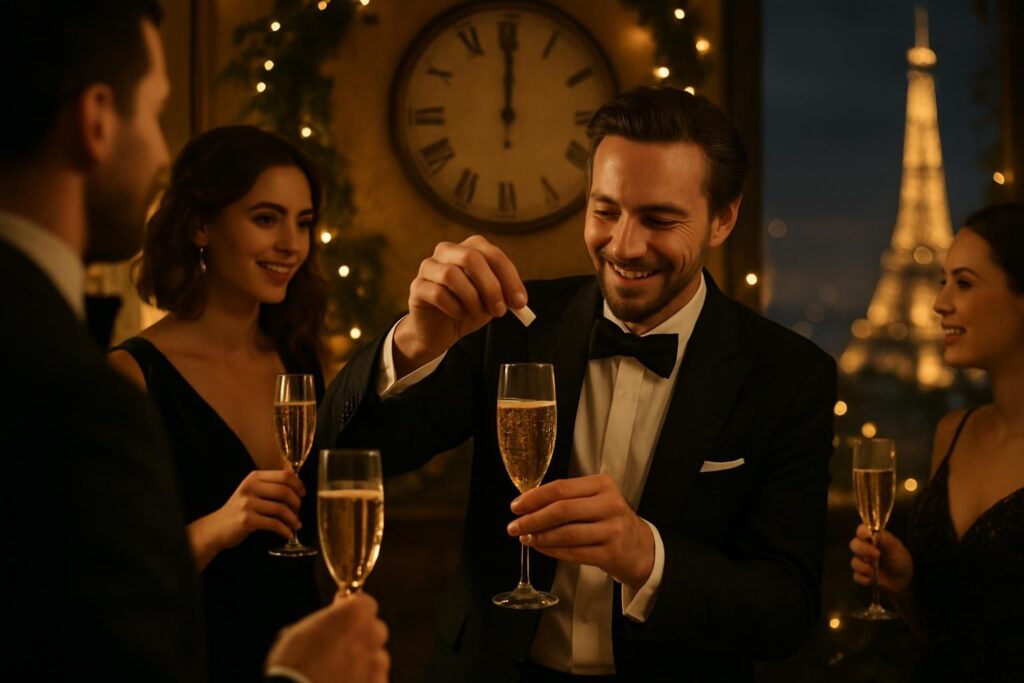
Every New Year’s Eve, it is common to observe an almost automatic gesture among many French people: placing a piece of sugar in their champagne glass at the stroke of midnight. This ritual, which seems trivial or even superstitious, actually has a rich and intriguing history. The origin of this custom is lost in past centuries, at a time when champagne had not yet reached the finesse and balance to which we are accustomed today. This gesture, which has become a symbol of celebration and prosperity for the new year, hides secrets linked to the science of bubbles, the chemistry of wine, but also to an aristocratic tradition that has endured through the ages.
At the dawn of the festivities, while the French prepare to pop the corks, this small piece of sugar reveals an unknown facet of champagne: although derived from a vineyard renowned for its exceptional cuvées, the sparkling wine had, for several centuries, very different characteristics. Understanding why this sugar is always added at midnight, and what effects it produces on the drink, not only allows us to appreciate this ritual with fresh eyes but also to better grasp its symbolic and cultural value.
The forgotten history of sugar in champagne: a remedy for original acidity
To grasp the essence of this tradition, one must go back to the 17th century. At that time, champagne was not the refined drink we enjoy today. On the contrary, it was often a very acidic wine, marked by a strong harshness that repelled some palates. The bubble, which today is the very soul of champagne, was considered a flaw. The famous Champagne monks, such as Dom Pérignon, were actually struggling to eliminate this effervescence deemed awkward and dangerous. Excessive pressure in bottles caused explosions in the cellars, both customary and unexpected.
To remedy these imperfections, the aristocrats of the time had the habit of sweetening their glass by placing a piece of cane sugar in it, a rare and precious commodity. This gesture served a dual purpose: it corrected the wine’s excessive sharpness and revealed an impressive spectacle of new bubbles. These bubbles were the result of a reaction between the sugar and the dissolved carbon dioxide, attracted by the sugar’s micro-cavities. This manual correction method is known as “dosage in the glass.”
Over the decades, this dosage became a way to display wealth: possessing sugar was an ostentatious sign, a symbol of opulence at the time. Each guest could thus adjust the degree of sweetness according to their taste, before the champagne houses perfected the technique by incorporating the dosage liqueur directly into the bottles themselves. This now standardized step aims to balance acidity and define the final style of the cuvées.
Despite this cellar mastery, the gesture persists. Why? Because it is rooted in a social and symbolic context that goes beyond pure gustatory aspects. Sugar in the glass remains a ritual passed down by word of mouth, blending tradition, superstition, and visual pleasure.
The chemical and sensory role of sugar in champagne: more than just sweetness
The effect of sugar in a glass of champagne goes far beyond a simple sweet sensation. The rough surface of a sugar cube, composed of many microscopic asperities, traps tiny air bubbles. These bubbles become favorable starting points for the formation of millions of carbon dioxide bubbles when the sugar is immersed in the sparkling liquid.
Studies conducted in 2012 at the University of Reims demonstrated that a single sugar cube can generate up to 10 million new bubbles. This phenomenon intensifies effervescence, causes a spectacular rise of bubbles, and directly influences the release of aromas. Champagne thus foaming gains in olfactory complexity, revealing fruity and brioche notes more quickly.
This process therefore modifies the sensory perception: the taste can seem rounder, richer, even though the added sugar is concentrated to such a point that its sweet flavor remains subtle, even imperceptible in some cuvées already dosed for sweetness.
Notably, this reaction explains why the gesture, although born of an ancient necessity, offers a pleasant visual spectacle and a slightly different gustatory experience. Sugar acts as an aroma activator, energizing the tasting during a celebration. The scientific magic behind this simple gesture links tradition and modernity, illustrating how popular rites can have a concrete and measurable basis.
A unique French tradition worldwide: sugar at midnight, a national custom
This practice of adding sugar to champagne at the stroke of midnight is an almost exclusive tradition to France. Throughout history, this gesture has become anchored as a symbol of celebration, festivity, and a desire to attract luck for the new year. However, in other countries producing or enjoying sparkling wines, this custom is rarely observed, if at all.
For example, in England, where champagne is also very popular, adding sugar is generally seen as a faux pas. The British prefer brut champagne, unaltered on the palate by additional sugar. In Italy, festive traditions around Prosecco or Spumante do not include this gesture, while in Spain, twelve grapes eaten to the rhythm of the midnight chimes largely replace any addition to the drink.
The cultural differences highlight the particular attachment of the French to their heritage and rituals. This uniqueness fits into the broader framework of intangible heritage around champagne, where conviviality, ceremony, and symbolism play a primary role. This practice also reflects local history, blending superstition (the belief in prosperity) and collective pleasure.
Moreover, this custom is even more astonishing when considering its almost obsolete gustatory character, as current cuvées, perfectly dosed and balanced, no longer require this correction. Yet the tradition remains alive, thus preserving a fragment of history and popular culture in every raised glass of champagne celebrating the New Year.
Sugar in champagne: beyond a ritual, a social and symbolic manifestation
The gesture of adding a piece of sugar in a glass of champagne at midnight is also a social expression, marking belonging to a community sharing common values. This custom testifies to a tradition that has been perpetuated through the centuries, fueled by the idea that this small addition brings luck, promotes success, and prosperity for the months ahead.
Beyond its historical and scientific implications, this ritual is a way to strengthen bonds between guests, symbolizing joy and shared wealth. In the Champagne region, the belief that sugar melting the bubbles represents rising wealth fits into a festive stance but also into a collective vision of luck.
This social bond around the gesture is reinforced by the familial transmission of practices, which persist despite technical evolutions in wine. This attachment to tradition illustrates how much the French value their viticultural and cultural history. Sugar in the glass thus becomes a sign of belonging, a symbolic heritage that no material wealth could replace.
In this context, tradition is thus a way to combine memory, pleasure, and celebration. While some cuvées innovate, as reported by regional actors in recent articles on the evolution of Champagne methods, this ancient tradition retains its charm and cultural relevance.
Gestures and habits around champagne on New Year’s Eve: a ritual with many facets
At the time of the celebration, sugar in champagne is not the only ritual adopted by the French. This period is rich in customs related to festive intoxication, luck, and the future. Here are some gestures and habits that often accompany this unique moment:
- The exact dosage of champagne: even if some add sugar to their glass, champagne houses today perfectly control dosages to ensure a balance between acidity and sweetness, as perfectly illustrated by the history of vintages throughout time.
- The serving temperature: serving champagne too cold crushes its aromas. A few degrees of difference are enough to profoundly change the tasting experience, a detail often neglected by consumers but constantly reminded by industry professionals.
- The popping cork: traditionally, popping the cork is one of the highlights of New Year’s Eve. This practice originates from an ancestral desire to mark the moment and chase away bad influences.
- The collective toast: associated with tradition and sharing, the toast raised at midnight reveals the festive and unifying spirit of French celebrations.
- The gourmet accompaniments: while some opt for simplicity, others prefer to marry their champagne with sweets, a natural extension of the sugar added in the glass.
These elements weave a festive universe and gather around a common goal: to celebrate the new year with elegance and optimism. The sugar gesture, although it may seem outdated, fits perfectly within this fully alive cultural mosaic.
Why is sugar added to champagne at midnight?
This gesture dates back to the 17th century, a time when champagne was more acidic and harsh. Sugar softened the wine and promoted spectacular effervescence, becoming a ritual borne by tradition and superstition for the new year.
Does sugar really change the taste of champagne?
Sugar stimulates the formation of additional bubbles, which intensifies not only the foam but also the release of fruity and brioche aromas, thus transforming the olfactory and gustatory experience.
Does this tradition exist outside France?
Very little. This custom is typically French. In other countries, such as England or Italy, adding sugar to champagne is rarely practiced, even considered inappropriate.
Is sugar necessary today with modern champagnes?
No, today’s champagnes are perfectly balanced thanks to the dosage technique in the cellar. Sugar in the glass has become a symbolic gesture rather than a gustatory necessity.
Are there other champagne-related rituals for New Year’s?
Yes, traditions are multiple: the ideal serving temperature, the cork popping, the collective toast, as well as gourmet accompaniments often accompany champagne especially during festivities.