
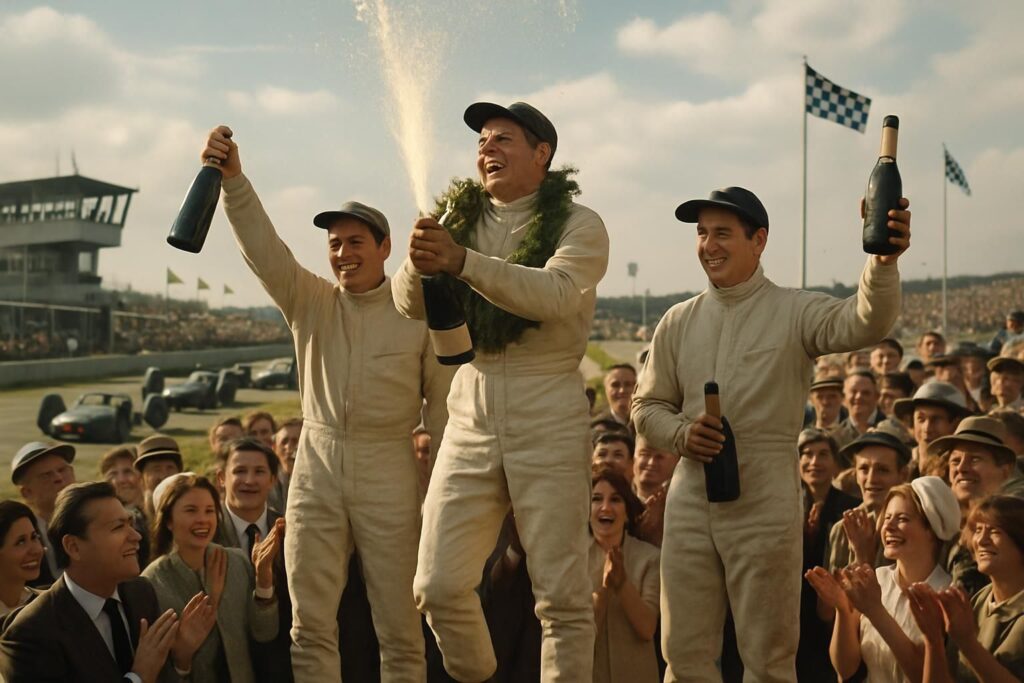
In the thrilling world of Formula 1, the podium celebration with a bottle of champagne has become an essential gesture, the ultimate symbol of victory and celebration. Yet, while this image now seems obvious, it was only established just over sixty years ago, and its origin is rooted in a rich story combining passion for motor racing and regional heritage. This spectacular visual ritual — particularly the act of shaking the bottle before spraying the surroundings — is both a demonstration of collective joy and a mark of recognition towards a complex and noble product. With roots grounded in the Champagne region of France, and protagonists who left a strong impression through their boldness, this tradition reflects a fascinating dialogue between sport and culinary culture.
Since its appearance, it has imposed itself on circuits worldwide, transcending national, cultural, and even religious borders in countries where alcoholic celebration is allowed. At the same time, it has experienced variations depending on local contexts and partner brands, before returning in 2026 to its origins thanks to a significant partnership with the LVMH group. A look back at a tradition that has successfully combined the excitement of the king of sports with that of champagne bubbles, to the point of becoming an iconic moment in Formula 1.
The historical origin of champagne on the Formula 1 podium
The link between Formula 1 and champagne draws its roots from the very history of Grand Prix racing, whose first official competition took place in France in 1950, on the legendary Reims-Gueux circuit. This emblematic place of motor racing lies at the heart of the Champagne region, renowned worldwide for its champagne production. From this first edition, the winners were rewarded not only with laurel crowns, but also with bottles of champagne offered by local producers such as Paul Chandon-Moët and Frédéric Chandon de Brailles. This initiative aimed to highlight the cultural and economic richness of the region.
Juan Manuel Fangio, a legendary figure and the first driver to receive this precious bottle in 1950, helped institutionalize this offering by tasting it modestly, without dispersing it. This gesture, long respected, was first considered a symbol of prestige and refinement accompanying sporting consecration. Recognition of champagne was thus closely linked to the renown and nobility of motor racing, particularly Formula 1, the premier category of competitions.
It would take more than ten years before the tradition of champagne evolved into a more spectacular and festive form. This change also reflects the evolution of the sport, combining sporting performance and popular spectacle aimed at the media and public. France, a pioneer in these early interactions between motor sport and terroir, thus offered the world a tradition that would become emblematic.
How was the famous “champagne shower” born? The key role of Dan Gurney
Although champagne was offered from the first races, the wild moment of shaking the bottle to spray drivers, teams, and spectators only appeared later, during another famous race: the 24 Hours of Le Mans. In 1967, Dan Gurney, American driver and two-time winner of the French Grand Prix and an iconic figure in motor racing, won this prestigious event at the wheel of a Ford. During the celebrations, he stood out by vigorously shaking his bottle of champagne before unleashing a foamy jet onto nearby people. This gesture, both spontaneous and festive, marked the start of a celebration that would easily become synonymous with victory.
This spontaneity by Gurney probably stemmed from a previous incident the year before, in 1966. During the 24 Hours, Bruce McLaren and Chris Amon had also won the race, but the ambient heat caused a thermal shock on a large bottle of champagne taken out of the refrigerator. The cork popped prematurely, projecting the precious sparkling liquid onto the spectators present. This accidental explosion, although unintentional, was perceived as a joyful moment heralding a new way to celebrate. Gurney, an active participant and knowledgeable of sports customs, chose to amplify the effect the following year, popularizing the now essential tradition.
The media broadcast of these images quickly enabled this practice to spread to all major motor competitions. The celebration with champagne, involving shaking the bottle to spray the surroundings, exploits the festive and joyful character of the sport and transforms this moment into an immediately recognizable spectacle, a ritual shared by drivers and fans alike.
The expansion and popularization of shaken champagne on Formula 1 podiums
Although the famous “champagne shower” was born outside the strict framework of Formula 1, it was precisely in this discipline that the practice massively spread afterward. The first official true appearance on a Formula 1 podium took place in 1969, during the French Grand Prix held on the Charade circuit, where Jackie Stewart, three-time world champion, helped firmly establish this gesture in the culture of motor racing.
With the advent of the 1970s, the tradition grew in scale: the bottle used gradually changed from a simple standard format to a gigantic jeroboam, containing the equivalent of four classic bottles. This change highlights the spectacular and collective nature of the event, reinforcing its visual impact for television and media, while offering a more festive and generous dimension to the ceremony.
Beyond traditional circuits, the champagne celebration has become a moment eagerly awaited by spectators, an instant of euphoria that crystallizes sporting success while creating an atmosphere of sharing between drivers, teams, and crowds. Of course, the custom undergoes some adaptations depending on local regulations and cultural usages: in some Middle Eastern countries, like Bahrain, Saudi Arabia, Qatar, or Abu Dhabi, where alcohol is strictly regulated, champagne has been replaced with non-alcoholic alternatives, often a rose-scented drink called “warrd.”
A notable example of variation involved Gilles Villeneuve, an avid hop lover, who sometimes forsook champagne for a local beer, in agreement with his suppliers and sponsors. These nuances add to the richness of this tradition celebrating victory while respecting local contexts and cultural diversity.
The evolution of champagne brands on F1 podiums and their impact
From the beginning, the relationship between champagne and Formula 1 has also been a story of commercial exclusivity and marketing strategies, inseparable from the image of this global sport. Since 1950, Moët & Chandon was the emblematic supplier, honoring champions with its prestigious bottles. This partnership lasted several decades, strengthening the association between luxury and performance.
In 2000, the Mumm house took over, supplying officially until 2015, before a brief return of Moët & Chandon from 2016 to 2017. Then, the Chandon brand gave way to a more modest but innovative house: the Carbon champagnes, led by Alexandre Mea, whose carbon coating process around the bottle guarantees perfect resistance and a modern touch. This innovation marked a turning point in the presentation of bottles and indicated remarkable attention to performance, even in accessories associated with racing.
In 2021, it was Ferrari’s turn, an Italian sparkling wine produced according to the traditional champagne method, to become the partner on the podiums. This step also illustrates brand diversification while remaining faithful to the original spirit of the celebration.
Finally, in October 2024, a return to the historic symbol occurred with the signing of a major partnership between Formula 1 and the LVMH group, parent company of Moët & Chandon. This contract guarantees the presence of the legendary brand for at least nine more years, thus reconnecting with the heritage of origins while fitting into a contemporary Luxury dynamic.
This evolution also reflects how champagne on the podium fits into a global image system, mixing prestige, high performance, and innovation in perfect balance. Discover more about the evolutions of champagne related to sport on specialized platforms.
The cultural and symbolic reasons behind the shaken champagne on the podium
Beyond the festive and spectacular aspect typical of motor racing, the tradition of shaking the champagne bottle to spray the podium conveys strong symbolic messages that have managed to gain universal reach. This practice primarily expresses collective joy and exuberance, visibly showing the triumph and release after intense efforts.
It also means a form of sharing: by spraying teammates, opponents, and spectators, the driver materializes the idea that victory belongs to a broad community, made up of his team, fans, and even competitors. The shower of bubbles falling back is a way to unite an entire universe around an exceptional moment, going far beyond simple sporting achievement.
The choice of champagne, specific to this celebration, is no coincidence either. Indeed, this beverage is traditionally associated with luxury, celebration, and refinement, reflecting the technical sophistication and excellence linked to Formula 1. Its effervescence recalls the intensity of the race, the thrill of competition, and the brilliance of success.
The profound meaning of this practice thus finds an echo in the contemporary evolution of sport that aims to be total spectacle, where every gesture contributes to building a legend shared by millions of viewers worldwide. Without this tradition, the post-race ceremony would lose a touch of visual magic, as if the celebration itself were deprived of a magnificent and instantly understandable symbol.
The economic and commercial impact is no less obvious. The visibility offered to champagne partner brands is immense, and the association of the product with sporting victory reinforces its qualitative and prestigious image, like other sectors related to high-level sport. This phenomenon fully fits into modern communication, where consumers no longer seek just a product but an experience and a story behind every bottle.
- The festive celebration: expressing joy and releasing tension after effort.
- The symbolic sharing: uniting drivers, teams, and fans in a collective moment.
- Luxury and prestige: representing high performance and excellence.
- The visual impact: creating a strong image, immediately recognizable by all.
- The commercial aspect: enhancing the brand through global visibility.
It is also fascinating to note how, in 2026, this tradition persists despite technological evolutions, new race formats, and cultural adaptations. The formula has managed to establish itself as a timeless ritual at the heart of Formula 1.
Why shake the champagne bottle before opening it?
Shaking the champagne bottle before opening it has become a symbolic and spectacular gesture allowing for a wider spray around the podium to mark the joy and exuberance of victory. It is a festive extension of the classic celebration.
What is the geographical origin of this tradition?
This tradition was born in France, more precisely in the Champagne region, during the 1950 Formula 1 French Grand Prix in Reims, where drivers were offered a bottle of champagne by local producers.
Why don’t some Grand Prix events use champagne?
In countries where alcohol is forbidden or strictly regulated, such as Bahrain or Saudi Arabia, the tradition is adapted by using non-alcoholic scented drinks, such as warrd, a symbolic rose water.
What role do champagne brands play in this tradition?
Brands like Moët & Chandon have built a prestigious image associated with Formula 1, enhancing their visibility and reputation through this partnership. These collaborations are essential for the marketing and prestige of champagne houses.
How has the tradition modernized over time?
The tradition has modernized through the use of innovatively designed bottles, such as those protected by a carbon coating, and by adapting to local regulations while preserving the festive and prestigious essence of the ritual.