
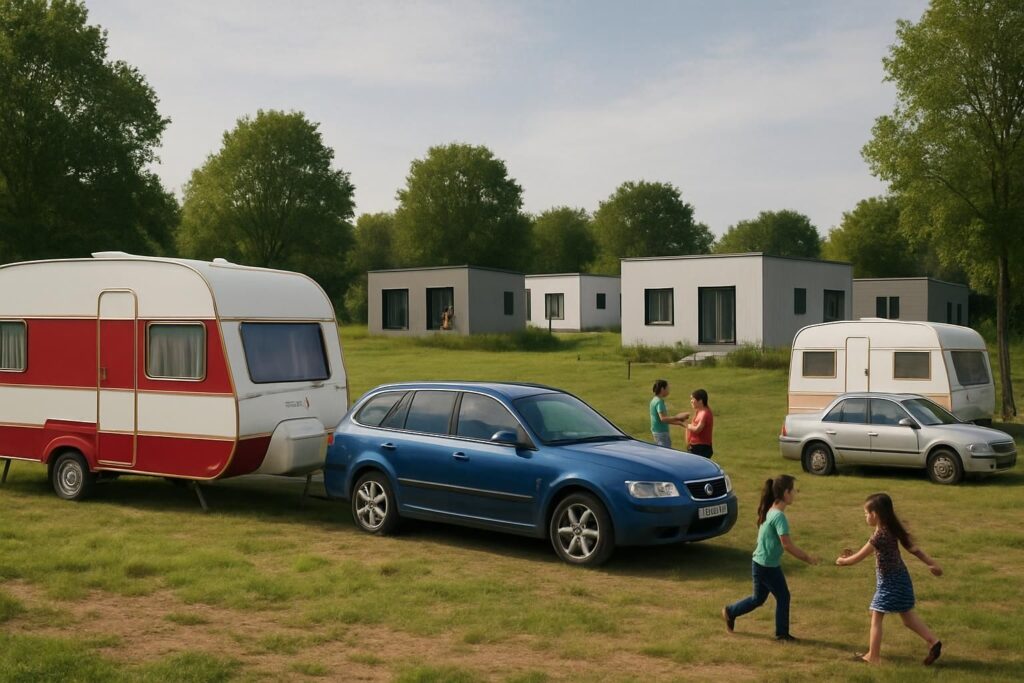
The debate surrounding the reception of Travellers in Pacé generates keen interest while the large transit area project in Champagne is still under study. This file, at the crossroads of urban planning, mobility, and housing issues, reveals the complexities of managing spaces intended for a population in constant movement. The municipality of Pacé is considering not only the creation of an adapted large transit area but also the integration of four family homes aimed at strengthening the permanent housing offer. This dual project illustrates a current trend to reconcile the temporary reception of itinerant travellers with the need for a stable living environment for some of them.
This project, located in the municipality of Champagne, reflects the growing demands around the organization of transit areas, which must comply with precise standards derived from the latest regulations. The planned developments fit into a context where municipalities seek to better structure reception, sometimes a source of tension, while ensuring their harmonious integration into the local fabric. These initiatives, although complex, remain essential to facilitate the mobility of Travellers while guaranteeing respect for existing rules and social balance in the territory.
The context and challenges of the large transit area project in Champagne
The notion of a large transit area designates a space specially arranged to temporarily accommodate the caravans and equipment of Travellers during large gatherings or seasonal movements. These areas are essential to meet the legal obligation of reception while limiting illegal parking that often disrupts public order. In Pacé, the project in Champagne is therefore part of a desire to control this mobility while creating a secure and comfortable environment for this specific population.
The ongoing study project involves not only the development of a site suitable for temporary reception but also reflection on the integration of the site into the local environment. Municipal authorities and urban planning services are working to design an area capable of hosting a significant number of caravans while respecting environmental and safety standards. The issue is also major for the image of the municipality and the peace of the inhabitants, often concerned about the effects of poorly organized reception.
Moreover, the social impact of the project is paramount. By integrating four social housing units within this system, the municipality aims to address a dimension often neglected: the partial sedentarization of some families from the Travellers. These homes would offer stable housing to those who wish or need a fixed residence while retaining the possibility of mobility during periods of large transit. This dual approach seeks to reconcile mobility needs and aspirations for stability, marking a more comprehensive and nuanced reception policy.
In this perspective, several criteria must be taken into account during the study, notably:
- The dimensions and infrastructure necessary to accommodate an adequate number of caravans, with access to electricity, water points, and appropriate sanitation networks.
- Security, both for occupants and the neighborhood, with a surveillance system and regulated flow management.
- Landscaping and environmental integration of the site to limit visual and noise nuisances on the natural and urban environment.
- The role of various local actors, including representative Traveller associations, to ensure effective consultation.
The management of such a project therefore requires a delicate balance between logistics, legislation, and social acceptance, while anticipating the evolving dynamics of the concerned population. The sustainability of the site and its capacity to meet the fluctuating needs of Travellers will remain at the heart of concerns during the study phase.
The legal and regulatory obligations governing large transit areas in France
For several decades, French legislation has progressively strengthened the frameworks governing the reception of Travellers. The law of July 5, 2000 is a cornerstone in this field, requiring local authorities to establish reception areas and large transit areas to respond to nomadic and seasonal needs. This obligation aims to avoid illegal parking and guarantee decent conditions for the concerned populations.
In the current context, the standards detailed in decree no. 2019-171 of March 5, 2019 specify the technical characteristics of large transit areas, notably their capacity, minimum equipment, and management conditions. For a municipality like Pacé, these requirements must be scrupulously respected within the framework of the Champagne project, making the ongoing study a crucial step to avoid any litigation or administrative rejection.
Beyond technical standards, the law also introduces strict rules concerning mobility and parking. Large transit areas must thus be accessible to large convoys, secured, and equipped with devices facilitating connections to essential networks (electricity, water, sanitation). The capacity of these areas is generally sized to accommodate several dozen caravans, depending on the specific needs linked to large gatherings, such as fairs or cultural events.
The implementation of these regulations is often accompanied by a phase of dialogue between local authorities, representatives of Travellers, and state services. This dialogue allows reconciling mobility imperatives, respect for public order, and decent living conditions. In 2026, this dynamic is considered a pillar for the success of a large transit area project, especially in regions where these populations have historically been present.
Moreover, the project of integrating social housing associated with the large transit area opens the door to a complementary system, included in the departmental reception scheme for Travellers 2019-2025. This scheme encourages innovative initiatives aiming to offer rental housing solutions for families seeking to settle permanently while maintaining mobility adapted to their lifestyle.
The legal issues related to these projects also include management aspects and internal regulations, which must clearly define rules for parking, respect for neighbors, and intervention devices in case of non-compliance. These rules guarantee peaceful coexistence between sedentary populations and travellers.
The advantages and constraints of establishing a large transit area in Champagne
The choice to establish a large transit area in Champagne, near Pacé, offers several benefits for the municipality and the region, but also challenges that require careful management. This strategic positioning responds to a growing demand from Travellers, especially during major seasonal movement periods or key regional events.
Among the main advantages, one can cite:
- A regulated framework for temporary reception, ensuring security and hygiene, as well as managing flows linked to large processions.
- A reduction of illegal parking which often create tensions with neighbors and disrupt local life.
- The creation of a dedicated space likely to improve the quality of life of Travellers, thanks to adapted facilities (play areas, sanitary facilities, common spaces).
- A lever for social integration through social housing and associated services that can facilitate partial sedentarization.
- An opportunity for strengthened dialogue between the municipality, traveller associations, and residents, fostering better coexistence.
Thus, the project would lay a solid foundation for peaceful management of mobility and temporary facilities, ensuring a balance between the needs of Travellers and those of the municipality. The urban framework could thus benefit from more effective regulation, without sacrificing the essential human dimension in this file.
However, the constraints are also significant:
- The cost of developments remains high, involving substantial investments to meet current standards.
- Reluctance from some residents can slow the project’s progress, generating debates and sometimes heated opposition.
- The administrative complexity for site management and maintenance, particularly in waste management and upkeep.
- The challenge of harmonious coexistence between sedentary and nomadic populations in an area sometimes marked by pre-existing social tensions.
These elements show that the project’s implementation requires close coordination among all stakeholders to avoid obstacles and promote effective deployment. Experiences conducted in other municipalities provide valuable lessons on levers to activate to succeed in this type of development.
The role of the planned housing in balancing mobility and sedentarization
The inclusion of four social housing units in the large transit area project in Champagne constitutes an essential innovation aimed at reconciling the historical mobility of Travellers with contemporary needs linked to residential stability. These homes will allow some families to have a fixed base while continuing to participate in large seasonal transits.
This proposal accompanies a growing awareness that itinerant life does not always translate into a total absence of ties with a territory. By offering a durable housing solution, these homes promote social, economic, and school integration, thereby facilitating access to services for the families concerned.
Practically, these homes will be designed according to social standards, with secure access, modern amenities, and proximity to the dedicated transit area. This should allow establishing a dynamic mixed housing where temporary and permanent occupancy coexist with mutual respect.
Temporary or partial sedentarization also makes possible adapted support policies, notably supporting:
- Access to education for children of housed families.
- Integration into the local economic fabric through employment or training.
- Targeted social follow-up to promote cohesion and conflict prevention.
The experience of other local authorities that have integrated this dual system shows that social housing can become a powerful lever to stabilize a migrant population, reduce tensions, and prepare more lasting life projects. However, this approach requires sustainable commitment in terms of financing, maintenance, and dialogue between permanent residents and travellers.
In summary, the association between large transit area and family housing aims to create a dynamic balance reconciling traditional mobility and modern housing expectations, respecting the cultures and lifestyles of Travellers.
Future prospects and solutions for successful development in Pacé
While the large transit area project in Champagne remains under study, prospects for evolution are emerging around strategic axes aimed at ensuring its success and sustainability. These guidelines fit into a regional and national dynamic that aims to better organize the reception of Travellers while optimizing territorial resources.
One of the main axes lies in strengthened consultation. The mobilization of local, departmental, and associative actors is crucial to developing a project accepted by all. Experience shows that without transparent and continuous dialogue, the risks of blockages and resistance are high. In Pacé, the involvement of Traveller representatives would better adapt developments to real needs and establish a climate of trust.
Moreover, the integration of innovative technologies in site management could constitute an asset. For example, online reservation systems for spaces or anonymous surveillance devices contribute to fluidity and security, while facilitating the work of managers.
Funding is also a major issue. Resorting to departmental or national funds, as well as public-private partnerships, is necessary to amortize the high costs of infrastructure and maintenance. The project’s robustness will thus depend on the ability to gather these resources over the long term.
To ensure harmonious coexistence, specific actions in social integration and mediation must be planned. Cultural workshops, administrative assistance services, and educational support could strengthen ties between Travellers and the local population.
Finally, the establishment of a monitoring and evaluation system will allow sustainably adapting the area to changing needs and practices. This involves a periodic assessment including all actors to correct potential shortcomings and enrich the system.
- Establish shared local governance.
- Ensure sustainable and diversified funding.
- Promote regular communication and awareness among residents.
- Develop services adapted to the hosted population.
- Integrate technological innovations to optimize management.
What is a large transit area?
A large transit area is a space arranged to temporarily accommodate the caravans and vehicles of Travellers during large gatherings or seasonal movements. It offers sanitary facilities, electrical connections, and secure parking.
Why is Pacé investing in this project in Champagne?
Pacé aims to control the reception of Travellers and reduce illegal parking while offering decent solutions meeting mobility and stability needs.
What are the main challenges of integrating housing in this project?
Integrating four social housing units allows combining mobility and partial sedentarization, facilitating social, economic, and school integration of the families concerned.
What are the main constraints of the project?
Among the constraints are the cost of developments, local opposition, administrative complexity, and the challenge of harmonious coexistence between sedentary and nomadic populations.
How to guarantee the success of the large transit area project in Champagne?
Success depends on strengthened consultation, sustainable funding, the establishment of adapted services, transparent communication, and the integration of technological innovations.