
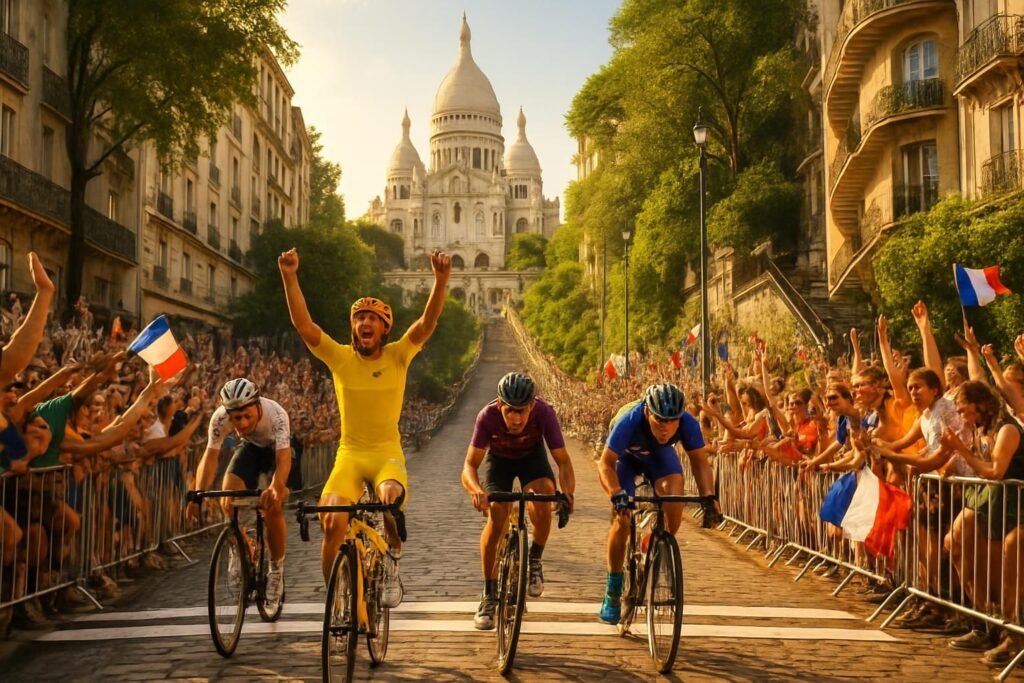
This Sunday marks the spectacular end of the 113th edition of the Tour de France with its 21st stage, a day whose route has been profoundly altered. Due to devastating fires affecting several French regions, notably in Gironde, the race has been shortened to preserve the resources of the security services. The traditional finale on the Champs-Élysées remains at the heart of the event, carrying a unique historical and sporting significance, while the ascent of Montmartre, now etched into the DNA of the Tour, adds an exhilarating dimension to this final stage. This route combines physical demand with the mythology of the most famous cycling race in the world, offering riders and spectators a spectacle worthy of expectations.
Originally planned over a distance of 132.5 km, the 21st stage was reduced to 89 km. To compensate for this reduction, the organizers decided to include a triple passage through Butte Montmartre, a strategic choice that gives this day an unexpected relief. This detail helps to revalue the race, offering an additional challenge at this crucial moment of the Tour, often seen as a celebration of performance but also of French cycling and cultural heritage. The peloton will set off directly from the Champs-Élysées finish line in the afternoon, setting the tone for a final dance that is both festive and intense on Paris’s most famous avenue.
A reworked route combining tradition and adaptation to exceptional constraints
The layout of the final stage of the Tour de France 2026 reflects a remarkable adaptation to an exceptional situation. The decision to shorten the distance to 89 km stems from an urgent necessity: redeploying security forces to fight the fires ravaging certain territories. In this context, the organizers and the police prefecture acted pragmatically, ensuring the safety of the riders while preserving the quality of the race. The modified route, however, retains all its flavor by offering riders a symbolic start from the Champs-Élysées, followed by a thrilling finale.
The start, traditionally given in the suburb at Thoiry, is replaced by a team presentation on site, then transport of participants by bus to the capital. So, the calmer phases conducive to exchanges and spectacle around the Champagne effervescence that often accompanies these moments, yet praised on the Champagne News site for their friendly and festive atmosphere, are now gone. Nevertheless, this offers an opportunity to refocus attention on the sporting effort and strategic stakes of the race.
The modification of the route, notably around the Parisian circuit, reveals a desire to balance technicality, spectacle, and regulation of distances. Unlike the previous edition where the passage left the traditional route via Rue Royale towards Boulevard Malesherbes, the 2026 itinerary proposes an exit towards Place des Ternes and the Arc de Triomphe. This variation lengthens the distance between the summit of Butte Montmartre and the finish on the Champs, increasing it from 6.5 to 10.5 km, a choice that will have a direct impact on the tactical development of the final phase.
The Butte Montmartre, a mythical challenge in the final stage of the Tour de France
Since its introduction at the Paris 2024 Olympic Games, the ascent of Butte Montmartre has established itself as an emblematic feature of the Tour. Its cobbled climb on Rue Lepic offers a welcome difficulty in a stage primarily designed for sprinters, injecting a dose of tension and suspense. The triple ascent scheduled this year represents a unique opportunity for aggressive riders to create significant gaps during this final day.
The climb, short but intense, requires power and intelligent effort management. It has thus become fertile ground for individual feats and strategic attacks, as seen in 2025 with Wout Van Aert. During that edition, the Belgian had taken the yellow jersey from Tadej Pogacar on the last passage of Montmartre, winning solo on the Champs-Élysées thanks to his boldness and exceptional time-trialling qualities.
However, due to the lengthening of the section from the summit to the finish line, gaps could be smaller this time. The delay is sufficient to allow groups of chasers, probably made up of strong sprinters like Mads Pedersen or Jasper Philipsen, to try to regroup. Thus, the race promises to be a thrilling duel between bold attackers and an organized peloton, with unbearable suspense until the last meters.
- Triple ascent of Butte Montmartre: adding unprecedented difficulty to the final stage.
- Cobbled climb of Rue Lepic: a technical terrain mixing climbers and sprinters.
- Lengthening of the final segment: 10.5 km from the summit to the finish, likely to modify strategies.
- Impact on race dynamics: favors offensive moves and restricts gaps between riders.
- Consequences for the classification: last chance to shine for contenders for the stage victory.
The mythical arrival on the Champs-Élysées: a stage for an intense and spectacular finale
The Tour de France would not be what it is without its legendary arrival on the prestigious avenue of the Champs-Élysées. This final straight, a true cathedral of cycling, attracts millions of spectators each summer who come to cheer the champions. In 2026, despite adjustments to the route, the soul of this mythical finish remains intact, combining sporting demands with a symbolic dimension.
More than a simple sprint, this finale is often the arena of complex strategies where sprinters, sharpened throughout the Grande Boucle, seek to inscribe their name in the palmarès. The return to a widened Parisian circuit, with two laps on the Champs before reaching Montmartre for the last time, offers a renewed spectacle for cycling aficionados. This configuration, combined with the increased distance between the summit and the finish, introduces a new parameter in managing strength and timing attacks.
This context notably favors cleverly tuned team tactics, with sprinter’s teammates playing a crucial role to keep a vigilant peloton, ensure the ideal train, and counter solo offensives. This complexity adds a rare tactical richness and beautifully illustrates the diversity of talents in the race, from brute endurance to mastery of high-speed sprinting.
Moreover, the final stage also serves to underline the importance of the relationship between sport and culture. The place taken by champagne, an emblem of French celebrations, does not go unnoticed. Wine tourism events such as those featured on Veuve Clicquot Oenotourisme Champagne highlight the complementarity between high-level sport and local heritage, offering spectators a unique festive immersion. The route’s reduction implies a more sober organization, but the stakes remain intact both for the riders and the public with the desire to magnify this unmissable moment in the sporting calendar.
Current context and future prospects for the final stages of the Tour de France
The 21st stage of this edition of the Tour highlights, more than ever, the need for a balance between tradition and adaptation. Faced with climatic hazards and security issues, the organizers must show ingenuity without ever denying the essence of a race that has become national heritage. The 2026 season thus confirms this capacity for innovation by revisiting the Parisian finale with an approach that combines sporting demands and necessary respect for external constraints.
This context also reflects broader changes affecting modern cycling. The preservation of territories, climate risk management, as well as the organization of major events in increasingly complex urban environments offer a field of innovation that the Tour, as an emblematic cycling race, fully embraces. At the same time, the celebration of terroirs and local products, of which champagne is a major example, fosters an enriching dialogue between sport and culture.
In this perspective, the city of Reims, a future major stage announced for the Tour de France 2028, perfectly illustrates this dynamic. This Champagne city, known for its wine history and architectural heritage, will be a crossroads between sporting tradition and regional promotion, strengthening the place of cycling in the French cultural and economic landscape. This close link between sporting event and terroir fits into a sustainable perspective of development and international influence.
Sporting and strategic stakes during the 21st stage of the Tour de France 2026
The final stage of the Tour is often portrayed as a formality for the general classification, but the 2026 edition refocuses the tension between sprinters and attackers within the peloton. With the revisited route, the repeated presence of Butte Montmartre, and the increased distance between the final climb and the finish, the strategies adopted prove crucial.
Riders with good power on cobbles and climbs can consider decisive attacks, forcing sprint specialists to mobilize their teammates in counterattacks. The situation recalls iconic cycling episodes where small daring groups unsettled the peloton’s balance despite the pressure from favorite teams. Thierry Gouvenou, an essential figure of the Tour, suggests that this stage could see an intense face-off between a breakaway group and about thirty riders regrouped, giving rise to a spectacle full of twists and turns.
The organization of the race will also have to take into account the precise schedule: the official start at 5:50 p.m. from the Champs-Élysées and the finish scheduled before 8 p.m. guarantee visibility optimally adapted to broadcasters and the public. This timing constrains tactics with reduced attack windows, requiring fine management of effort and energy resources. This outlook reinforces the exceptional nature of a stage designed as much to celebrate victory as to demonstrate the technical and collective mastery of the teams.
Why was the 21st stage of the Tour de France shortened in 2026?
Due to major fires affecting certain French regions, notably in Gironde, security forces were redeployed, which forced organizers to shorten the last stage to ensure everyone’s safety.
What is the impact of the triple ascent of Montmartre on the race?
The triple climb of Butte Montmartre increases the difficulty of the final stage, favoring attacks and making the competition more open between sprinters and aggressive riders, thus changing the traditional dynamic of the finale.
How does the distance between the summit of Montmartre and the Champs-Élysées influence the race?
The lengthening of this distance to 10.5 km gives groups more time to regroup, which can reduce gaps between riders and give sprinters a chance to come back after uphill attacks.
Why is the arrival on the Champs-Élysées considered mythical?
This arrival symbolizes the grand finale of the Tour, a moment filled with history and prestige where the best sprinters compete in a unique festive atmosphere, offering millions of spectators an exceptional show every year.
What role does champagne play in the tradition of the Tour de France?
Champagne is closely linked to the celebrations of the Tour, embodying a form of festive and cultural heritage, notably through wine tourism initiatives that strengthen the connection between sport and terroir, such as those developed by maisons like Veuve Clicquot.