
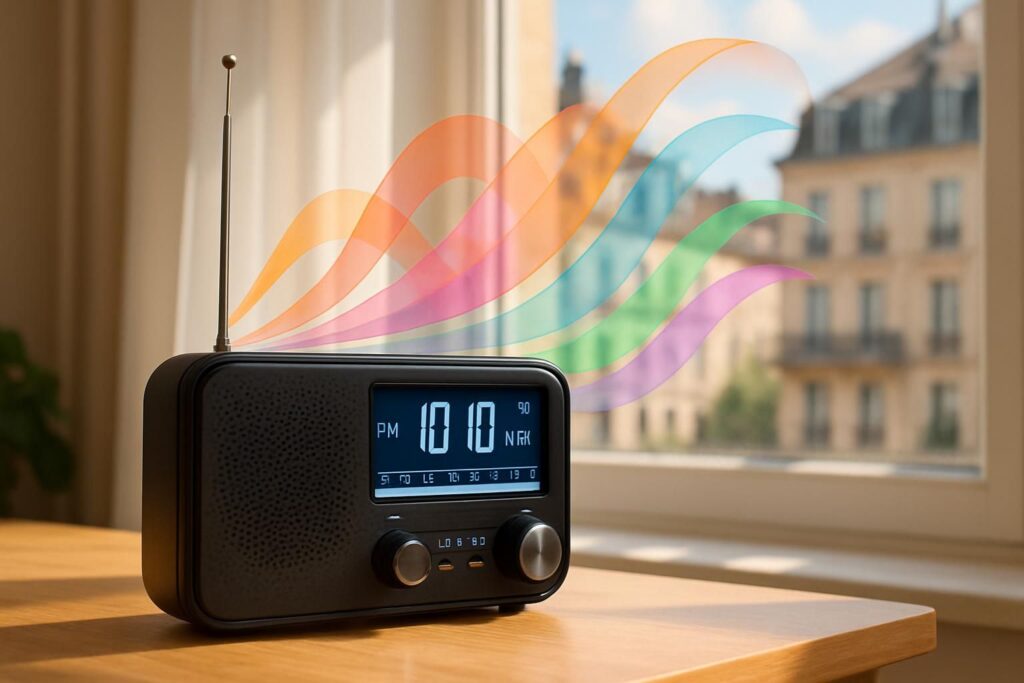
This Wednesday marks an important date for Radio France listeners, with a significant overhaul of FM frequencies in several French urban areas. These adjustments, essential to optimize broadcast quality and ensure better signal reception, impact a large part of the territory. In an increasingly competitive and digitized media landscape, this change carries a strong strategic dimension, both for Radio France and its thousands of loyal listeners. Retuning, or readjusting radios, thus becomes an essential step not to lose track of programs, but also to benefit from the enhanced sound clarity that these new frequencies promise.
The phenomenon, far from trivial, occurs in a context where French cities are readjusting their radio broadcast infrastructures to better meet the technical requirements imposed by the evolution of broadcasting standards. These changes will notably limit interference between stations, improve signal stability, and support the transition to hybrid devices combining analog and digital. For listeners, it is a pressing reminder to redo an automatic search for their favorite stations to avoid interruptions and maintain optimal access to information, culture, and entertainment offered by Radio France.
How the change of FM frequencies affects listening quality at Radio France
The transformation of FM frequencies is not just a simple technical operation; it directly affects the quality of the listening experience. By modifying transmission channels in several cities, Radio France commits to improving sound clarity while reducing disruptions. Old settings, sometimes obsolete, led to interference or unstable reception, especially in urban areas where the number of electronic devices is dense.
This change is a response to the inherent limitations of the FM band, particularly in terms of range and sensitivity to external noise. The frequency readjustment, accompanied by an update of emission power and antenna orientations, aims to guarantee a more stable and uniform signal. Retuning is therefore more than a technical gesture for the listener: it is the promise of superior listening comfort, whether it is to capture the nuances of Culture, Music, or Information broadcasts.
Take the example of the city of Rennes, where Radio France’s FM frequencies have been recalibrated to reduce interference from other local stations, which significantly improved reception in the outskirts. In Strasbourg, the change now allows better coverage in rural areas, often poorly served. Several listeners have already reported richer sound quality, making them forget the frequent crackling before the operation.
The energy challenge and environmental impact should also be addressed. Broadcasting focused on optimized frequencies promotes lower electricity consumption, as transmitters can operate at precisely adjusted levels. This optimization is part of Radio France’s overall dynamic in favor of ecological transition, demonstrating that listening quality is now accompanied by increased environmental responsibility.
Which cities are concerned by the retuning of Radio France’s FM frequencies this Wednesday?
Several French metropolitan areas are seeing their FM frequencies modified as part of this major operation initiated by Radio France. This strategic deployment notably targets urban areas of various sizes, ranging from large cities to smaller urban basins, demonstrating a desire for large-scale optimization. Retuning involves complex adjustments for each site, taking into account local specificities and geographical constraints.
Among the affected communities are notably Paris, Lyon, Marseille, Nantes, Lille, Rennes, Bordeaux, Strasbourg, Toulouse, and Montpellier. This panel reflects the current listening map, targeting both densely populated centers and regions with more rural profiles, where FM broadcasting still plays an essential role in radio access. For each city, the concerned frequencies may evolve differently depending on needs:
- Paris: channel adjustments to improve coexistence with local radios and reduce indoor disruptions, where urban density complicates reception.
- Lyon and Marseille: calibration of emission powers in the outskirts to better cover peri-urban and surrounding areas.
- Nantes and Strasbourg: improved coverage in rural areas to ensure continuous access to public information.
- Bordeaux and Toulouse: optimization of the FM band in historic neighborhoods for better broadcast quality in dense environments.
This list, though not exhaustive, illustrates the diversity and complexity of the operations undertaken. Each city benefits from a precise analysis of local needs before deployment, contributing to the overall success of this initiative. The importance of these adjustments is also reflected in close coordination with the CSA (Higher Audiovisual Council), guaranteeing full compliance with regulatory and technical frameworks.
It is essential that the affected listeners become aware of the necessity to retune their radio to continue following Radio France programs without interruption. This well-prepared operation takes a few minutes and a simple but crucial action: launching an automatic frequency search to update the list of available stations. Without this adjustment, some broadcasts could disappear or suffer a sudden degradation in reception quality.
Practical steps to retune your radio and avoid broadcast interruptions
Retuning FM frequencies, although technical, is relatively simple and quick for any user. The success of this operation depends primarily on listener vigilance, who must be ready to adjust their equipment starting Wednesday, under penalty of encountering cuts or poor reception quality.
Here is a precise step-by-step guide to retune your radio effectively:
- Turn on the radio: Activate the radio set in FM mode; the operation does not work in digital modes or certain streaming applications.
- Access the search menu: Depending on the device, this could be a function called “Automatic Search,” “Scan,” or similar.
- Launch the search: The radio then scans the entire FM band, picking up available frequencies and registering those with a sufficient signal.
- Save the new stations: Once the search is complete, the radio updates the list of present stations, including the new frequencies assigned to Radio France.
- Test reception: It is advisable to scan several frequencies to check listening quality and possibly adjust antenna wear or position.
For radios integrated into vehicles, the method is similar but may vary slightly depending on the manufacturer or model. It is useful to consult the manufacturer’s user manual, as some cars offer automatic software updates with alert possibilities during a signal change. For listeners using older receivers, the operation may require a little more care but remains perfectly accessible.
This retuning is not just a technical formality. It is a strong invitation to review one’s listening habits, sometimes questioning the general condition of the equipment, and to optimize reception to fully enjoy Radio France’s editorial content. Moreover, some connected radios now offer notifications announcing these changes, further simplifying the transition for the end user.
Strategic and technical stakes behind the reinvention of Radio France’s FM frequencies
The readjustment of FM frequencies is not only a maintenance operation: it is an essential strategic and technical lever for Radio France in a profoundly evolving radio market. Today, with the rise of digital solutions such as Digital Terrestrial Radio (DAB+) and online platforms, the FM band must be optimized to remain competitive while offering impeccable quality.
This reinvention is part of a broader approach, aiming to:
- Improve listening comfort through a more stable signal and better geographical coverage, especially in areas where reception was previously problematic.
- Rationalize spectral usage of the FM band, a limited radio frequency spectrum, by avoiding overlaps and interference.
- Gradually transition to hybrid technologies mixing FM and DAB+, allowing the listener to smoothly switch to digital radio without breaking habits.
- Comply with new broadcasting standards imposed by authorities, particularly regarding spectrum management and emission levels.
- Optimize operating costs by modernizing infrastructures and reducing the energy consumption of FM transmitters.
A concrete example is found in the Lyon network, where this operation allowed the installation of more automated transmitter management systems, thus reducing human intervention and improving overall reliability. From a technical point of view, these changes implement innovative processes such as dynamic adaptation of emission powers according to demand and environmental conditions. These advances show how FM, though traditionally static, can integrate modern technical solutions.
These stakes are all the more crucial as FM remains the most listened-to audio medium in several regions, notably among populations far from stable internet access or motorists who rely on radio despite mobile connectivity. This Wednesday of change must be seen as a step towards smoother, higher-quality, and more sustainable listening.
Why is it necessary to retune your radio this Wednesday?
Radio France’s FM frequencies change in several cities to improve reception. Retuning allows access to the new frequencies and prevents any interruption in listening.
How to perform retuning easily?
Simply launch an automatic station search in FM mode on your device or car radio. This updates the list of available stations with the new frequencies.
What are the consequences of not retuning?
Without retuning, some Radio France programs may become inaudible or suffer interference, reducing listening quality.
Do these changes impact digital radios?
These changes exclusively concern FM broadcasting. Digital terrestrial radio or online platforms are not affected.
Can I retune my radio later?
It is possible to do it later, but this exposes you to a period where reception may be poor, especially starting Wednesday.