
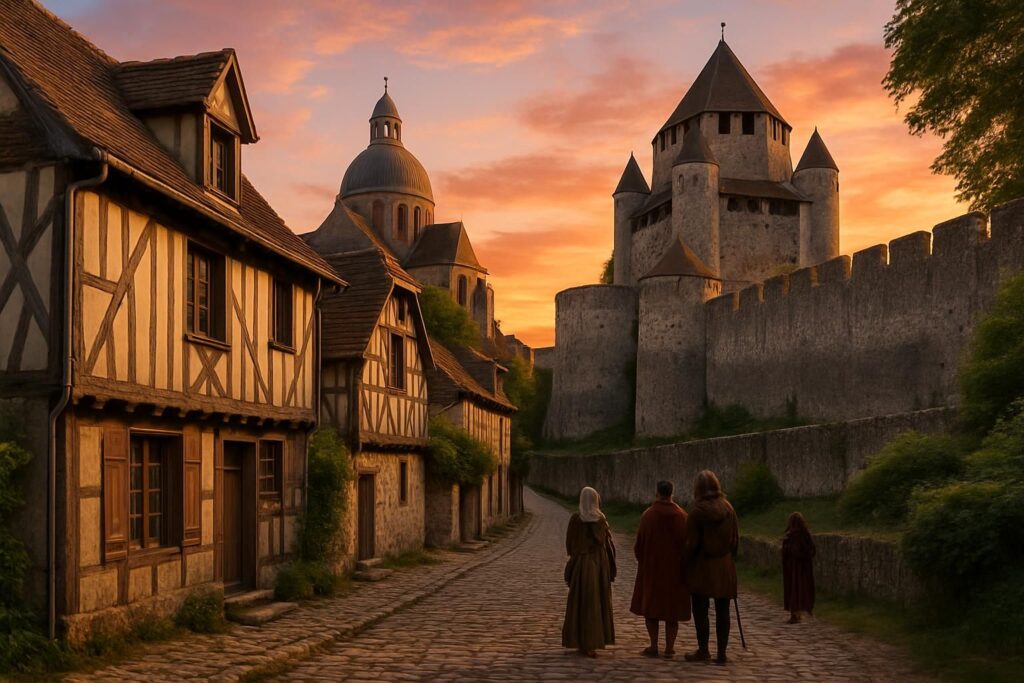
Provins stands as one of the most remarkable medieval jewels of France, offering a living testimony to the former splendor of the counts of Champagne. Located in the heart of a region steeped in history, this fortified town long held a prominent place in the economic and cultural development of the Middle Ages. Listed as a UNESCO World Heritage Site, it attracts each year a growing number of travelers passionate about history, medieval architecture, and cultural tourism.
The impressive ramparts, the iconic Tour César, as well as the carefully preserved cobbled streets, tell the epic story of a city that was once one of the most influential economic capitals of the Kingdom of France. In the 12th and 13th centuries, Provins hosted the famous Champagne fairs, true international gatherings where merchants, artisans, and nobles exchanged goods and skills. The result of these exchanges has left an architectural and urban heritage that still enchants visitors today.
Provins, a medieval jewel and exceptional heritage: a concentration of living history
The town of Provins perfectly embodies the richness of the medieval era thanks to its preserved architecture and strategic location that made it a nerve center of trade in the Middle Ages. The city’s defensive system, with its ramparts nearly 25 meters high, testifies to the power of the counts of Champagne and their determination to protect a place vital to the region’s economy.
Beyond its fortifications, Provins offers exceptional built heritage that illustrates the daily life of a prosperous city between the 11th and 13th centuries. Timber-framed houses, private mansions, and especially the imposing and mysterious Tour César reveal the architectural sophistication of the era. The latter served both as a donjon and a prison, symbolizing the seigneurial power and judicial rigor of the time — a duality that still fascinates curious visitors.
The remarkable preservation of the site allows visitors to dive into the history of medieval Champagne. Provins’ heritage is not limited to its buildings: the network of underground passages, old market halls, and spaces dedicated to the fairs remain elements that bear witness to the intense commercial activity that once animated the city. These features helped list Provins as a UNESCO World Heritage Site, thus ensuring the preservation of its authenticity amid modern pressures.
This town also offers a privileged perspective to understand the economic challenges of the Middle Ages, thanks to its position as an “economic crossroads.” The Champagne fairs, held in spring and autumn, were among the largest in Europe, attracting merchants from all over Europe, but also from the East. This role as a trading crossroads created a cosmopolitan society where languages, currencies, and diverse cultures mingled.
The former capital of the counts of Champagne: a major political and economic influence
In the Middle Ages, Provins was not only a dynamic commercial center: it was also the former capital of the counts of Champagne, a powerful dynasty that rivaled the kings in the political and economic organization of the kingdom. The counts of Champagne played a key role in consolidating their power through an ambitious policy, consisting of alliances, protection of fairs, and promotion of international trade.
The political context of medieval Champagne allowed Provins to become a real center of power, capable of influencing royal affairs. For example, Thibaud IV, one of the most famous counts, is often mentioned in historical accounts for having organized crusades and brought back cultural and botanical elements, such as the famous red rose of Provins, which still symbolizes this flourishing period today. This link between political power and symbolic heritage strengthens the city’s renown throughout medieval Europe.
The economy of Provins relied on several solid pillars: the fairs, certainly, but also the wool industry and luxury crafts. These sectors created a unique synergy that helped energize the territory. The wool trade, in particular, was a key sector that enabled Provins to export a precious raw material for textile manufacturing to the major European capitals.
The political importance of Provins is also reflected in its civic and religious architecture. The urban plan, with its Romanesque and Gothic churches, its seigneurial mansions, illustrates the counts’ desire to assert their prestige through each laid stone. These constructions played a diplomatic role, hosting not only merchants but also dignitaries, thereby promoting cultural diffusion.
For a deeper understanding of the history of the counts of Champagne remains an essential source to grasp the historical significance of this dynasty and its impact on the rise of Provins.
Tourism in Provins: a journey back in time for history and architecture enthusiasts
Today, Provins stands out as a favored destination for travelers seeking authenticity and cultural discoveries. Its World Heritage status attracts visitors from around the world, eager to wander its cobbled streets and attend the numerous historical events offered throughout the year.
This carefully organized tourism highlights the city’s most evocative aspects: medieval shows, historical reenactments, old-fashioned markets. These events bring the past to life, and showcase the unique architecture of the fortifications, towers, and central squares. Each visit transforms into a true immersion where history becomes tangible.
The architectural heritage, notably the Tour César, the Grain d’Or, or the Roseraie classified as a “Remarkable Garden” since 2014, constitutes a major attraction. These sites offer a sensory journey into the heart of the Middle Ages, and for some enthusiasts, a fascinating discovery of what life was like at that time. The rose garden, in particular, offers a timeless experience, evoking both nature and memories of the crusades, with the famous red rose carried by Thibaud IV.
Whether for a day trip or a longer stay, the tourism infrastructure, including several tourist offices and specialized guides, assist visitors in a comprehensive exploration. Hotels and restaurants in the region celebrate local and Champenoise gastronomy, adding a gastronomic dimension appreciated by travelers.
- Guided walks in the medieval town to discover history from an authentic perspective.
- Visits to emblematic sites such as the Tour César and its donjon-prison, a strong testimony of seigneurial power.
- Participation in medieval spectacles reenacting the fairs and daily life of inhabitants.
- Discovery of the rose garden and its unique botanical collections, linked to the region’s history.
- Immersion in local museums illustrating the craft and historical trade of Provins.
The secrets of the Tour César, medieval donjon and prison enrich understanding of the city’s judicial and military past.
The medieval architecture of Provins: distinctive features and technical innovations
Provins’ architectural heritage embodies not only a characteristic medieval style but also the technical innovations of the era that allowed the town to assert itself as a major center. The ramparts, with their numerous bastions and defensive towers, represent a feat of medieval military engineering.
The keystone of this architecture lies in the robustness and functionality of the structures, designed to withstand sieges and attackers. The Tour César, an emblematic monument, is a perfect illustration with its thick walls and secret rooms, which testify to an advanced defensive strategy. This tower also served as a prison, reflecting the complex and authoritarian social organization established by the counts.
The medieval dwellings, merchants’ halls, and churches of the city display an aesthetic blending sobriety and elegance, often enhanced by sculpted details and Gothic ornaments. This decorative richness stems from the multiple cultural influences crossing the region during the trade fairs, making Provins a crossroads of exchanges not only material but also artistic.
Furthermore, the urban planning of Provins is distinguished by its centered organization, with public squares that were once places of exchange and conviviality. The paved streets still enable visitors today to walk in the footsteps of merchants and inhabitants of the Middle Ages, offering a unique and authentic sensory experience.
These elements make the architecture of Provins studied by many specialists who find there a rare example of a well-preserved European medieval town. Its harmonious integration into the surrounding landscape, preserved from massive urbanization, enhances the attractiveness of this heritage, essential to local culture and tourist appeal.
Current challenges of tourism and heritage conservation in Provins
The major challenge faced by Provins today is to reconcile tourism development with the preservation of its fragile heritage. The need to welcome numerous travelers without altering the authenticity of the sites requires strict and innovative management. This issue is all the more important as Provins is recognized worldwide as a medieval jewel and a former capital with priceless heritage values.
Local institutions implement policies aimed at preserving the ramparts, historic buildings, and promoting sustainable tourism. This type of tourism offers visitors a complete experience, respectful of the site and traditions. Among the initiatives, virtual walks, guided tours with enriched narrative supports, and the organization of cultural events contribute to maintaining a living link between past and present.
Another crucial issue lies in the promotion of traditional know-how of the Champagne region, notably trades related to wool production or craft art, which historically supported Provins’ economy. Integrating these skills into the modern tourism offer constitutes a bridge between past and future, strengthening local cultural identity.
Finally, education and raising awareness among inhabitants and visitors remain essential to ensure the site’s sustainability. Indeed, it is through a deep understanding of historical and ecological challenges that Provins will be able to maintain its status as an essential destination of French medieval heritage.
These strategies are highlighted in various publications and conferences, emphasizing the interest in ongoing dialogue between historians, tourism professionals, and public institutions.
What makes Provins a unique medieval jewel?
Provins stands out for the exceptional quality of its fortifications, its preserved medieval architecture, and its rich history linked to the counts of Champagne, offering an immersive experience in the Middle Ages.
How did the Champagne fairs influence the development of Provins?
The Champagne fairs made Provins an international commercial crossroads in the 12th and 13th centuries, boosting its economy, cultural influence, and political power within the kingdom.
What are the must-see sites to visit in Provins?
The Tour César, the ramparts, the rose garden, as well as the traditions of medieval shows and local museums are among the unmissable visits.
What are the challenges related to the conservation of Provins’ heritage?
The main challenge is managing growing tourism while preserving the integrity of historic buildings and the urban ecosystem, promoting sustainable and respectful tourism.