
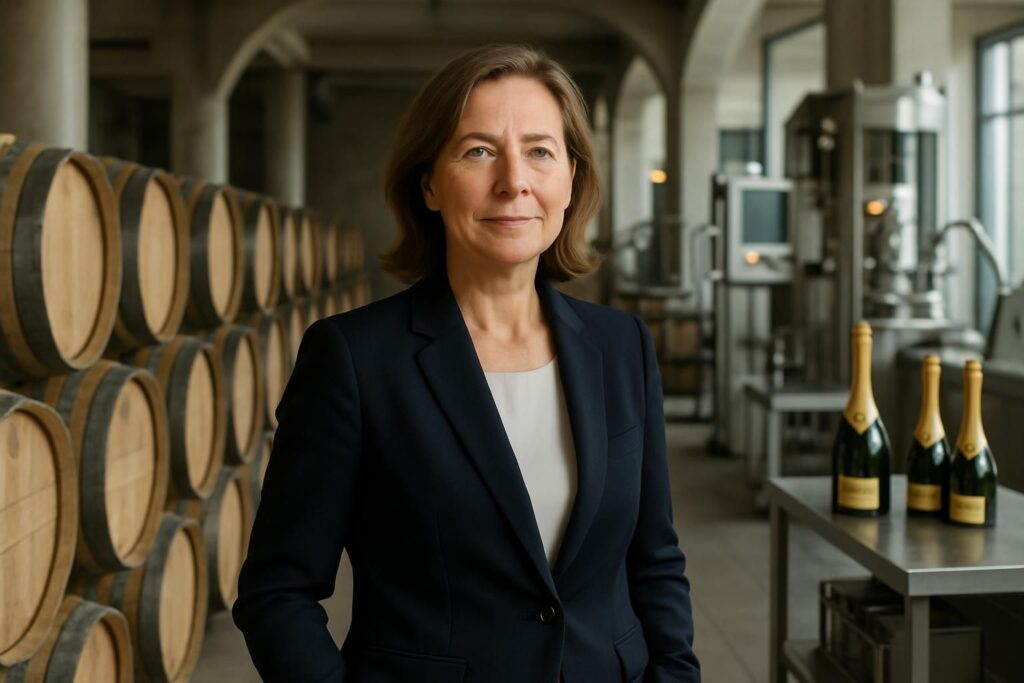
The Krug house, an iconic figure of the Champagne region, has always embodied excellence and innovation in the crafting of grand crus. Since 2020, it has been Julie Cavil who has taken the reins as cellar master, infusing the prestigious brand with a modern vision combined with a deep respect for traditions. With an unconventional background mixing advertising and oenology, she brings an innovative approach to winemaking and terroir management. In 2024, the launch of the Joseph 2.0 project concretely reflects this commitment, promoting more precise control of fermentations and a drastic reduction of oxidation risks. Julie Cavil thus symbolizes a Champagne looking towards the future, where technical innovation combines with sustainability and the enhancement of the unique characteristics of base wines, within a broader context of modernization of the region and its methods.
Beyond Krug, she also represents contemporary Champagne at major events such as Big Bang Vin, where the region showcases its technological advances. This driving force particularly relies on artificial intelligence and digital solutions, already used to optimize grape sorting or to strengthen traceability, notably through the Krug ID tool established in 2011. In this demanding and constantly evolving environment, Julie Cavil combines winemaking know-how, oenological expertise, and an innovative vision to reveal a Champagne that renews itself without denying its roots.
Julie Cavil, cellar master: a unique journey at the heart of Krug’s oenological innovation
Julie Cavil’s commitment at the helm of winemaking at Krug reveals an original professional trajectory, quite unconventional in the Champagne field. Coming from the advertising sector, she was able to transfer her rigor and analytical capacity to the demanding world of oenology after studies at the CFPPA in Avize and the University of Reims Champagne-Ardenne. This dual expertise brings a fresh perspective that relies on both a technical and creative approach, essential for a house that stands out for the excellence of its processes.
Since she has been managing the cellars, Julie Cavil has led several ambitious technical projects. Among them, the launch of the “Krug ID” in 2011 marks a turning point in terms of transparency and consumer experience. Each bottle is equipped with a unique code, offering a digital window into the wine’s history, possible pairings, and composition. This innovation manifests the house’s willingness to integrate new technologies to elevate tasting and strengthen the relationship with the consumer.
At the same time, the Joseph 2.0 project, inaugurated in 2024 in Ambonnay, symbolizes a revolution in winemaking. The main objective is to preserve the integrity of the wines by limiting oxidation risks and eliminating many mechanical manipulations such as pumping, which often disturb the final quality. This innovative building allows precise control of fermentation parameters and encourages the production of champagnes combining finesse and aromatic intensity, true signatures of the house. This dynamic materializes the innovative vision carried by Julie Cavil in the service of a Champagne respectful of its terroir while integrating the best of modern technology.
Innovative vision and sustainability: the pillars of tomorrow’s Champagne at Krug
At Krug, under the drive of Julie Cavil, the quest for innovation is not limited to oenological techniques alone. It is part of a global sustainability approach that takes into account current climatic constraints and the environmental impact of production. Champagne, confronted with heatwaves and weather variations, must adapt its practices to preserve its exceptional quality.
One major response to these challenges is the integration of grape sorting machines equipped with artificial intelligence, capable of precisely removing damaged or undesirable berries. This advancement, progressively adopted in the region, facilitates the selection of the best materials from the harvest, an essential foundation for an exceptional vintage. Julie Cavil regularly emphasizes the importance of this fine screening, guaranteeing consistent quality in winemaking.
Moreover, the Krug house strives to limit fermentation impact thanks to the new Joseph 2.0 cellar, which focuses its efforts on mastering every stage of the process. By reducing mechanical interventions, the risks of oxidation are minimized, contributing to the longevity and stability of the wines over the long term. These choices perfectly illustrate the desire to reconcile tradition and modernity while respecting the sustainability of the Champagne terroir.
Within this framework, Krug will also work to strengthen relationships with partner winegrowers, indispensable for guaranteeing the quality and typicity of each vineyard plot. Julie Cavil often repeats that one must listen to the individualities of each “base wine,” a technical expression designating the base wines before blending, because that is where the richness and complexity of the final wine reside. Attentive listening to these elements, combined with technological advances, shapes a new erudition in the oenological approach, innovative and mindful of environmental respect.
Joseph 2.0: a futuristic winemaking laboratory for Krug
The birth of the Joseph 2.0 cellar in Ambonnay stands as an important marker of the innovative vision carried by Julie Cavil. This winemaking building, inaugurated in 2024, is the result of several years of reflection and applied research with a clear objective: to rethink fermentation methods in order to obtain an exceptional wine while minimizing defect risks.
Designed to eliminate pumping steps that can cause oxidative stress or losses, Joseph 2.0 stands out for its tank systems and ultra-efficient circuits. This installation offers scrupulous control of temperatures and flows, thus facilitating a slow and controlled fermentation, inherent to the preservation of the most delicate aromas.
This innovative technology does not reject tradition. On the contrary, it respects its fundamentals by highlighting the unique characters of the terroirs through individualized fermentations. Julie Cavil insists on this point, stating that each tank reflects its own identity, making possible a finer approach during blending, a crucial feature in the rigorous crafting of Krug champagnes.
The adoption of such an installation has a significant impact on the entire role of the cellar master. It becomes possible to steer winemaking with a precision worthy of high-tech industry, while maintaining the soul and unique profile characteristic to each cuvée. This synergy assures the Krug house a cutting-edge place in the Champagne world, while offering consumers an innovative product faithful to its terroir.
Technological modernization and key role of the cellar master in Champagne
The progressive evolution of technologies is upheaving the Champagne landscape, and Julie Cavil appears as an influential ambassador of this transformation. Her active involvement in introducing innovations into winemaking processes is also a response to the demands of contemporary markets, where quality and traceability have become fundamental imperatives.
Technological advances notably include the digitalization of harvest and winemaking data, visible through devices like Krug ID, which offers complete traceability to informed enthusiasts. This integrated approach also facilitates real-time actions on fermentation and maturation, making the cellar master a kind of technological conductor, orchestrating various parameters to achieve the best possible cuvée.
The Champagne region today is engaged in a vast digital innovation process, with the increasing use of artificial intelligence, whether for grape sorting or for optimized resource management. Julie Cavil is also involved in this dynamic at the regional level, participating in forums like Big Bang Vin, where she represents Champagne and shares her experience on future challenges linked to modernization.
Among the key contributions of this modernization are:
- Reduced mechanical handling to improve wine quality and limit losses.
- Precise fermentation management through digital monitoring and temperature control.
- Use of artificial intelligence for more selective sorting of grapes right from the harvest.
- Improved traceability to enhance transparency towards consumers.
- Adaptation to climate changes thanks to prioritized sustainable techniques.
Tomorrow’s Champagne: preserving terroir while innovating in winemaking
At the heart of Julie Cavil’s current concerns remains the enhancement of the Champagne terroir, an environment characterized by its geological, climatic, and human uniqueness. The quality of Krug champagnes largely depends on the ability to bring out the soul of these lands, taking into account the specificities of each plot.
For this, the cellar master encourages oenology respectful of the individuality of wines. Each base wine, defined as the pure expression of a plot, is worked on with particular attention. This approach allows, by blending, the creation of complex and balanced champagnes that honor tradition while marking their originality.
This approach is inseparable from a rigorous sustainability policy since respect for the terroir also involves preserving soils and natural resources. Working with winegrowers in a logic of sustainable partnership is thus a fundamental axis. In 2026, this collaboration is facilitated by digital tools that provide better traceability and precise monitoring of interventions, ensuring quality throughout the production chain.
The Krug house thus proves how it is possible to combine respect for terroir and technical innovation, an essential balance to sustain the reputation and quality of an exceptional Champagne in a context where climatic challenges are becoming more pressing.
To discover a selection of exceptional champagnes combining tradition and modernity, it is recommended to consult the best Champagne vintages as well as accessible options through champagnes at affordable prices, ideal to appreciate the richness of the Champagne terroir in all its facets.
What is Julie Cavil’s main role at Krug?
Julie Cavil supervises winemaking and guides the production of champagnes, combining tradition and innovation to preserve the unique character of Krug cuvées.
What does the Joseph 2.0 project consist of?
It is an innovative winemaking cellar launched in 2024, which reduces mechanical handling to better control fermentation and limit oxidation.
How does Krug use artificial intelligence?
Krug integrates artificial intelligence notably in grape sorting machines to precisely select quality berries from the harvest.
How does Julie Cavil’s vision contribute to sustainability?
Her approach promotes an oenology respectful of the terroir by reducing environmental impact and closely collaborating with winegrowers to preserve soils.
What is Krug ID?
Established in 2011, this innovation offers a unique code on each bottle allowing access to its history, compositions, and personalized advice.