
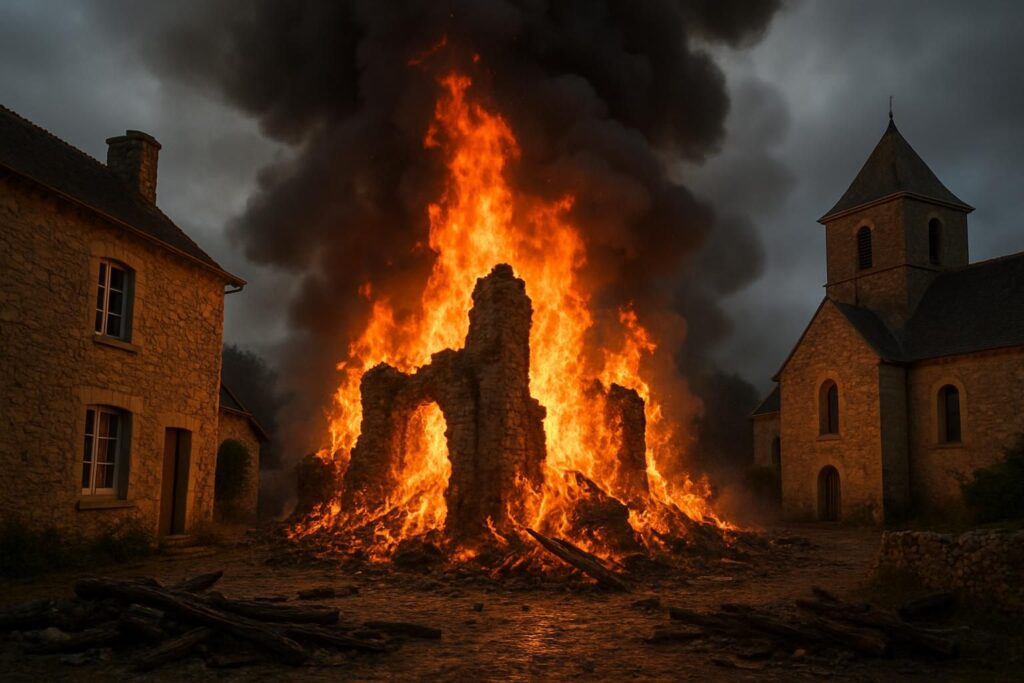
An exceptionally large fire recently ravaged the ruins of a historic site in Cossé-en-Champagne, endangering two heritage buildings of great value. The flames, fueled by a persistent drought, consumed what remained of these ancient constructions, emblematic of the region’s rich architectural past. In 2026, this dramatic episode highlights the vulnerability of historical heritage in the face of climatic hazards and underscores the urgency of increased protection.
The mobilization of rescue teams was swift and vigorous, but the damage is considerable. The fire, which broke out in the early evening, spread at a speed that surprised local authorities and firefighters. Despite about thirty firefighters deployed, full control of the disaster took several hours. This event highlights the major challenge of preserving historical buildings, often isolated and constructed with ancient materials, against fires and complex emergency situations.
Beyond the direct consequences on the structure of the buildings, this disaster rekindles debates around the management of heritage ruins. How to reconcile the conservation of fragile heritage with contemporary realities such as climate change and increasing urbanization? The situation in Cossé-en-Champagne illustrates the necessity of an integrated strategy combining prevention, rapid intervention, and methodical restoration.
The nature of the fire and the risks to heritage in Cossé-en-Champagne
The fire that struck the ruins at Cossé-en-Champagne is neither a simple forest fire nor a classic urban fire. It is a disaster that occurred in a context particularly favorable to the rapid spread of flames. Prolonged drought weakened the wooden structures of historic buildings, while the ruins, left abandoned, fueled the blaze with flammable debris. From the very first moments, the fire proved exceptionally violent, making rescue especially perilous.
Dangerous historic buildings are particularly sensitive to fires. Their old construction, often of wood and crumbly stones, does not withstand extreme temperatures. In Cossé-en-Champagne, two buildings, one of which has been classified as a historic monument for several decades, saw their integrity threatened, causing an incalculable loss for local and national heritage. No victims were reported, but the threat to these buildings requires constant mobilization for their preservation.
This situation echoes other recent disasters, where lightning or natural phenomena triggered devastating fires in historically significant locations. For example, in Haute-Vienne, an 18th-century castle struck by lightning had its roof ravaged by fire, as reported by several specialized media outlets.
To limit these risks, it has become essential to strengthen fire protection for similar sites, notably by installing advanced detection devices, regularly maintaining surroundings to reduce natural fuels, and training intervention teams on the specificities of heritage. These actions must be integrated into a global preservation policy blending urgency and long-term planning.
Rescue operations: challenges and responses to the emergency
Faced with the scale of the fire in Cossé-en-Champagne, the emergency response was immediate and coordinated. About thirty firefighters were dispatched on site, equipped to battle a devouring fire in a difficult environment where the presence of unstable ruins complicated the intervention. The danger of collapse and toxic smoke required a carefully crafted strategy, alternating between direct attacks on the flames and protection of still salvageable buildings.
Rescue plans for this type of disaster involve precise logistical coordination, including water supply, often problematic in rural areas, as well as the mobilization of suitable equipment. Indeed, the proximity of water reserves and the creation of secure access points are decisive factors for successful interventions. The fire in Cossé-en-Champagne revealed the limits of some local infrastructures, confirming the need to strengthen resources available to face disasters of this magnitude.
The firefighter teams can also rely on close collaboration with cultural authorities to prioritize the protection of the most precious elements of the heritage. Rescuing two historic buildings in this emergency context is thus a real challenge, both on the human and technical levels.
The local community, as well as the site owners, also showed strong solidarity and active involvement, providing crucial moral support to the rescue teams. This type of collective mobilization is essential to overcome critical moments and to immediately engage reflection on the forthcoming restoration.
Long-term consequences on the heritage and ruins of Cossé-en-Champagne
The damage caused by the fire in Cossé-en-Champagne is not limited to the visible destruction of buildings. The ruins affected by the fire now face accelerated deterioration due to exposure to the elements. Structural integrity weakened by combustion exposes these remains to progressive collapse, compromising their conservation and historical value.
Heritage experts emphasize that post-fire interventions must be conducted with the utmost care. They require precise diagnostics and development of appropriate restoration plans to enable durable safeguarding. The method used must also consider historical coherence, in order to respect the authenticity of the buildings while integrating modern technologies to enhance their resistance.
Another crucial aspect concerns the tourist and educational valorization of this heritage. The disaster in Cossé-en-Champagne can be a catalyst to rethink the management of heritage ruins, including arrangements to attract and raise public awareness of heritage protection issues. The economic and cultural impact is thus an essential aspect to justify necessary restoration investments.
Among the envisaged measures:
- Meticulous inventory of damages to guide the work
- Collaboration with architects specialized in restoring old buildings
- Implementation of regular monitoring and enhanced surveillance to prevent new dangers
- Energizing cultural projects around local history
- Seeking public and private funding to support restoration
Restoring heritage is a long and complex process and must be approached as a lasting commitment from public and private actors, as well as civil society. This also requires capitalizing on past experiences, including other fires, to improve alert systems and reduce the impact of future disasters.
Preventing future disasters: stakes and strategies for endangered historic sites
The tragedy in Cossé-en-Champagne raises a crucial question: how to prevent the emergence of new fires and, more generally, protect historic buildings from increasing risks linked to extreme climatic conditions? The answer lies in global strategies integrating prevention, awareness, and innovation.
Prevention begins with a rigorous risk assessment coupled with regular site maintenance. It is essential to control the surrounding vegetation, often flammable, and reinforce vulnerable structures with specific treatments. The use of advanced technologies, such as drone detection or thermal sensors, is imposed as an important lever to continuously monitor sensitive areas.
Moreover, training rescue teams on the specificities of historic buildings is crucial. A deep knowledge of these heritages and their fragilities enables adopting adapted strategies in emergencies, thus limiting damage. In this context, joint exercises between fire services, cultural authorities, and local communities should be encouraged.
Finally, raising awareness among the local population plays a determining role. Explaining the risks associated with fire and ruins, informing about responsible behaviors, and promoting collective commitment will reduce accidental causes and foster a preservation dynamic.
These initiatives, although demanding, prove effective when sustainably supported. Additionally, seeking funding and developing public-private partnerships are essential to guarantee the durability of protection measures.
The mobilization of civil society and authorities to protect heritage in Cossé-en-Champagne
In the wake of the disaster, collective mobilization is imposed as a key factor for heritage preservation in Cossé-en-Champagne. Local authorities, in liaison with national cultural services, have announced support measures and the creation of an emergency management committee tasked with coordinating rescue and restoration efforts.
Civil society, including residents and various associations, is also strongly engaged. This participative dynamic not only amplifies the means of action but also creates a strong bond between local heritage and citizens, an essential element for long-term safeguarding.
Among the actions planned by the community:
- Organizing awareness campaigns on historical value and risks involved
- Fundraising to finance repairs and restorations
- Involving youth in educational workshops around heritage
- Partnerships with heritage experts to promote innovative projects
- Collaboration with specialized media to maintain focus on the situation
In this context, it is also essential to remind that heritage preservation cannot be done without rigorous risk management and swift response to emergencies. Recent examples, such as those reported in articles dedicated to protection in other sectors, show that rapid intervention is a determining factor to limit damage, as observed in various situations of emergency and major fires.
This fight for the safeguarding of heritage in Cossé-en-Champagne perfectly illustrates the 21st century’s challenges in conservation, blending tradition, modernity, and collective responsibility.
{“@context”:”https://schema.org”,”@type”:”FAQPage”,”mainEntity”:[{“@type”:”Question”,”name”:”Quelles sont les principales causes de l’incendie u00e0 Cossu00e9-en-Champagne ?”,”acceptedAnswer”:{“@type”:”Answer”,”text”:”L’incendie a u00e9tu00e9 du00e9clenchu00e9 tru00e8s probablement par la foudre lors d’un violent orage, combinu00e9 u00e0 la su00e9cheresse prolongu00e9e qui a facilitu00e9 la propagation rapide du feu dans les ruines anciennes.”}},{“@type”:”Question”,”name”:”Comment se du00e9roulent les opu00e9rations de sauvetage sur des bu00e2timents historiques ?”,”acceptedAnswer”:{“@type”:”Answer”,”text”:”Les opu00e9rations nu00e9cessitent une coordination complexe entre pompiers, autoritu00e9s culturelles et propriu00e9taires afin de protu00e9ger les parties intactes, limiter les effondrements et mau00eetriser le feu dans des zones difficiles d’accu00e8s.”}},{“@type”:”Question”,”name”:”Quels sont les enjeux u00e0 long terme apru00e8s un incendie dans des ruines historiques ?”,”acceptedAnswer”:{“@type”:”Answer”,”text”:”Au-delu00e0 des du00e9gu00e2ts visibles, il faut assurer une restauration respectueuse de l’authenticitu00e9, pru00e9venir les risques d’effondrement et mettre en place un suivi ru00e9gulier pour pru00e9server durablement le patrimoine.”}},{“@type”:”Question”,”name”:”Quelles mesures sont recommandu00e9es pour pru00e9venir de futurs incendies dans le patrimoine ?”,”acceptedAnswer”:{“@type”:”Answer”,”text”:”La pru00e9vention inclut un entretien rigoureux, la surveillance technologique, la formation des u00e9quipes de secours, ainsi que la sensibilisation des populations locales pour limiter les risques.”}},{“@type”:”Question”,”name”:”Comment la communautu00e9 locale peut-elle contribuer u00e0 la sauvegarde du patrimoine ?”,”acceptedAnswer”:{“@type”:”Answer”,”text”:”Par des actions de sensibilisation, de soutien financier, d’engagement u00e9ducatif et en favorisant la collaboration avec des experts, la sociu00e9tu00e9 civile joue un ru00f4le essentiel dans la protection et la valorisation du patrimoine.”}}]}What are the main causes of the fire in Cossé-en-Champagne?
The fire was very likely triggered by lightning during a violent storm, combined with the prolonged drought which facilitated the rapid spread of the fire in the ancient ruins.
How are rescue operations carried out on historic buildings?
Operations require complex coordination between firefighters, cultural authorities, and owners in order to protect intact parts, limit collapses, and control the fire in hard-to-reach areas.
What are the long-term challenges after a fire in historic ruins?
Beyond visible damage, it is necessary to ensure a restoration respectful of authenticity, prevent collapse risks, and set up regular monitoring to sustainably preserve the heritage.
What measures are recommended to prevent future fires in heritage sites?
Prevention includes rigorous maintenance, technological surveillance, training of rescue teams, as well as raising awareness among local populations to limit risks.
How can the local community contribute to the safeguarding of heritage?
Through awareness actions, financial support, educational engagement, and promoting collaboration with experts, civil society plays an essential role in the protection and enhancement of heritage.