
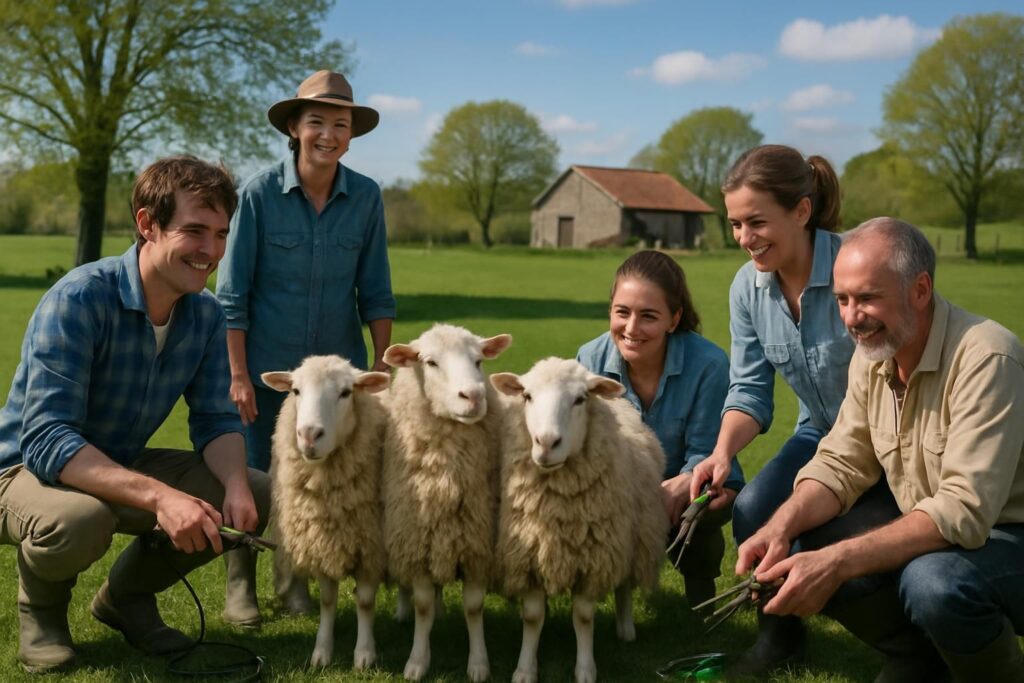
At Champagne-Mouton, a family farm is facing an urgent situation: two ewes are currently overwhelmed by abundant wool, requiring a swift and caring intervention. This call for volunteers is part of a context where shearing is not only essential for the animals’ health but also for the smooth running of the farm. Faced with an increased workload, the farmers are seeking the valuable help of one or two willing individuals ready to support a professional shearer during this delicate operation. Beyond the technical act, this mobilization reflects a collective commitment to preserving animal welfare, encouraging volunteer work, and promoting mutual aid within the rural community of Champagne-Mouton.
Excessive wool can pose health risks to the ewes, notably by causing heat stress or promoting parasite proliferation. Moreover, when the fleece becomes too dense, it limits the animal’s mobility, directly affecting its comfort and quality of life. It is with this in mind that shearing becomes a vital act, combining technical expertise and attentive care. The planned intervention at Champagne-Mouton thus offers an opportunity to learn the precise and methodical gestures required, while participating in a collective approach at the heart of a traditional farm’s life.
The health and environmental stakes of sheep shearing at Champagne-Mouton
Sheep shearing is not limited to simply removing the wool. At Champagne-Mouton, this operation holds paramount importance in preventing many ailments. Wool that is too thick and poorly maintained can become a favorable breeding ground for parasites such as ticks or lice, responsible for sometimes severe infections.
Furthermore, during the summer period, wool overload causes a significant risk of heat stress. The ewes overheat, which can lead to a general deterioration of their health, weakened immunity, or even fatal complications if no timely action is taken. Regular maintenance of the fleece is therefore a public health issue within the farm.
On the environmental level, shearing also enables responsible wool management. The wool harvested at Champagne-Mouton will be carefully sorted to be transported to a spinning mill in England, where it will be valued in the making of sustainable textiles. Thus, this natural fiber, a by-product of livestock farming, finds a second life, helping to reduce waste and encourage a local circular economy.
Finally, the call for volunteers is also a response to the need to optimize human resources on a farm where labor is often limited. The help of competent or simply motivated volunteers is a valuable opportunity to ensure animal safety while carrying out the shearing according to best practices.
How a professional shearing is carried out: methodology and precautions to observe
Shearing is an operation that requires mastered technique and special attention to the ewe’s comfort. At Champagne-Mouton, the intervention is conducted by an experienced professional assisted by volunteers. Everyone’s role is crucial so that the shearing is quick, effective, and above all safe.
Preparation and restraint of the animal
First of all, the ewes must be approached calmly and gently. Shearing is a stressful step, all the more so when the animals are fearful, notably in the case of the two concerned ewes. An adapted restraint system, often a catching pen, reduces the movement space and facilitates handling while avoiding injury risks for both the staff and the animal.
Restraint must be carried out in a way that minimizes emotional stress. Slow movements, a calm environment, and a reassuring presence will be key for the ewe to cooperate. Once immobilized, the shearer proceeds with shearing using a specific clipper adapted to the current wool density.
Technical gestures for optimal shearing
Shearing follows a precise order to remove the wool in one single piece, which facilitates its sorting afterwards. The professional generally starts at the belly, then moves to the flanks and the back, taking care not to cause cuts or irritations.
The wool removal is done in thin and continuous layers, with regularly sharpened equipment. The shearer must keep pace without losing precision, and volunteers are called upon to adjust the ewe’s position as needed.
A key moment is constant vigilance regarding the animal’s health during the act. Any skin anomaly or potential injury detected must be reported immediately for appropriate care.
Sorting and valorization of the wool in connection with the spinning mill
Once sheared, the wool is sorted and packaged before being sent abroad for processing. At Champagne-Mouton, the partner English spinning mill is renowned for its expertise in ecological and qualitative fiber valorization. This local-to-international trade exemplifies new dynamics around a traditional farm oriented towards a sustainable economy.
To support this approach, everyone is invited to participate in the collection and funding of wool transformation. Every euro donated directly contributes to supporting a supply chain respectful of the environment and socially engaged. You can learn more about local events in the region, such as the Grande Champagne trade fair.
The importance of the call for volunteers in local farms
According to testimonies from farmers like those in Champagne-Mouton, relying on volunteer work has become essential in the daily management of farms. Modern agriculture faces many constraints, be they economic, climatic, or social, which require collective solutions.
Sheep shearing is a clear example where citizen mobilization is crucial. Without the support of willing individuals, it becomes difficult for farmers to meet all deadlines while ensuring the quality of care for the animals. This human mutual aid helps create a strong bond between the farm and the local community.
The experience, although physically and technically demanding, is rewarding. It also offers a unique gateway to discovering agricultural realities and traditional know-how. Volunteers who get involved actively contribute to preserving Champagne-Mouton’s rural heritage and transmitting this essential profession.
Here are the main qualities and skills expected from volunteers for such work:
- Patience and gentleness: essential for handling the ewes while minimizing their stress.
- Good physical condition: shearing is often a demanding activity requiring endurance and agility.
- Availability for the duration of the shearing: it often takes several hours to complete the operation.
- Team spirit: collaborating with a professional and other volunteers.
- Respect for safety rules: both for the protection of animals and people.
This support contributes to a delicate balance on the farm, relieving the farmers and strengthening social cohesion. More broadly, the initiative illustrates how mutual aid can effectively unfold in a rural environment often facing major difficulties.
Volunteering in the animal sector represents much more than a simple helping hand: it is a responsible, humane, and sustainable gesture that supports an agricultural vocation and an authentic way of life.
The economic and social benefits of local wool valorization
Beyond the health and practical aspects, shearing at Champagne-Mouton is part of a virtuous economic cycle. Wool from local sheep, once processed, generates significant added value for the farmer. This model thus strengthens the farm’s financial resilience faced with market fluctuations and climatic constraints.
Establishing a local or regional valorization supply chain is a powerful lever to energize the rural economy. Wool, being a renewable raw material, can be converted into textiles or even ecological insulation, responding to the growing demand for environmentally friendly products.
Moreover, the supply chain helps maintain an artisanal and industrial fabric, connected with traditional skills often threatened. At the local level, this enables job creation, innovation in textile processing, and promotion of a flagship product of the Champagne terroir.
The association of the inhabitants of Champagne-Mouton and its surroundings has already initiated several projects aimed at promoting these activities, with the support of significant events such as the Marais horse races, which represent a fine showcase of local wealth. These actions help raise awareness of the wool sector and educate the public on the importance of the work done by farmers.
Supporting a family farm towards a sustainable future through mutual aid
The concrete example of the call for volunteers at Champagne-Mouton highlights the importance for family farms to benefit from broad solidarity. This form of mutual aid humanizes and sustains professions often subject to strong economic pressure and growing demands.
Collective work during key operations such as shearing is both a learning, transmission, and moral support tool. For farmers, it is also an effective way to preserve the quality of care given to animals and ensure the maintenance of production respectful of good practices.
From this perspective, every volunteer initiative takes on a major ethical dimension: it is not only about providing occasional service but above all embedding the action in a sustainable development approach and responsible natural resource management. Farmers thus encourage the co-construction of an agricultural model where citizen participation becomes an indispensable lever.
Finally, this local dynamic fosters better understanding between generations, generations who find themselves working together in respect of traditions and the valorization of Champagne’s heritage. Fruitful exchanges are thus observed, between inherited know-how and innovative approaches, notably around gentle shearing methods and ecological valorization.
The call for volunteers at Champagne-Mouton is not merely a request for technical assistance but a civic commitment upheld by strong values of solidarity, respect for the animal, and sustainable economy, essential for the future of the French countryside.
Why is it important to shear ewes regularly?
Regular shearing is essential to prevent risks of overheating and parasitic infestation, thus ensuring the well-being and health of the ewes.
What are the risks for ewes if shearing is delayed?
Wool that is too dense can cause heat stress, reduced mobility, and promote parasite appearance, compromising the animal’s health.
How can volunteers effectively contribute during shearing?
They assist the shearer by ensuring gentle restraint, maintaining a calm environment, and ensuring the safety and comfort of the ewes.
What qualities are essential to participate in shearing?
Patience, physical endurance, team spirit, and strict compliance with instructions are essential to guarantee the operation’s success.
How is Champagne-Mouton wool valued?
The wool is sorted then sent to a specialized spinning mill in England, where it is transformed into sustainable textiles, contributing to the development of a local circular economy.