
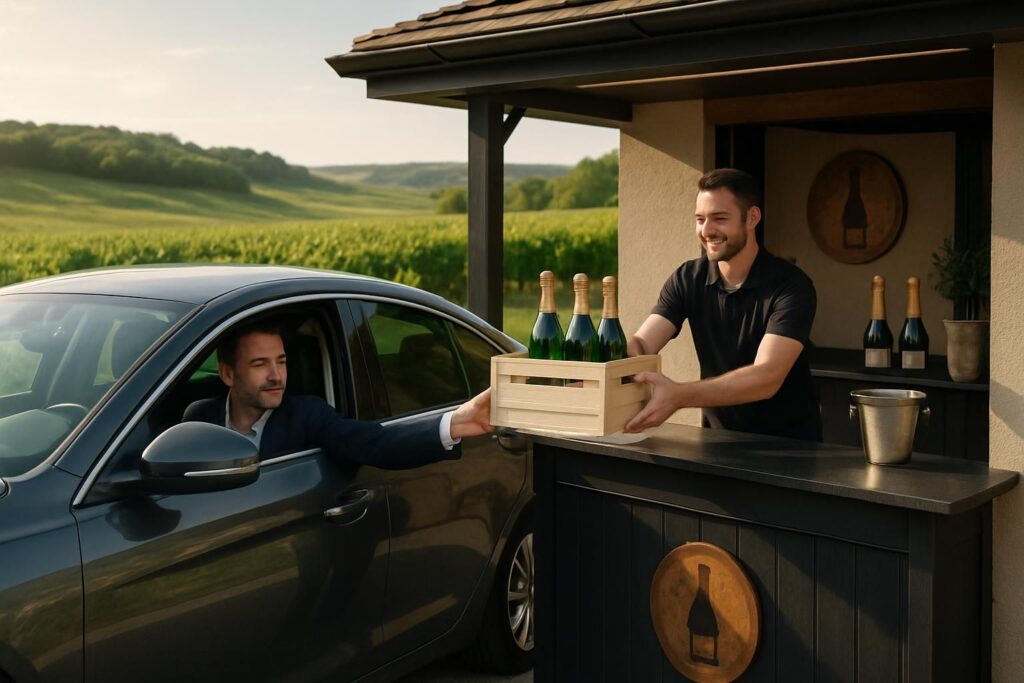
In the heart of the Reims mountain, at the Ludes estate, an innovation steeped in tradition is emerging: the Canard-Duchêne house has established an unprecedented “drive” service specifically dedicated to purchasing champagne. This initiative, launched last June, offers enthusiasts and tourists a new way to acquire their favorite bottles, combining convenience and an oenotouristic experience. This device, unique in Champagne, addresses a dual challenge: facilitating purchase while enhancing onsite hospitality, at a time when the region is experiencing exceptional growth in the field of oenotourism.
Open seven days a week, this service offers a fast pick-up system, adapted to orders ranging from small quantities to more than a hundred bottles. The rise of oenotourism in this region is now accompanied by strong customer expectations, whether local or international, for a smooth, professional, and personalized purchasing experience. Thus, beyond the simple transaction, Canard-Duchêne offers a genuine extension of its hospitality, promoting the discovery of Champagne terroirs on a 2.5-hectare estate, combined with a modern digital service.
This new way of envisioning champagne purchase reflects a fine adaptation to contemporary uses and evolving expectations. It also illustrates the dynamism and innovation that characterize the Champagne wine sector today, eager to simplify access to its exceptional products while enhancing its heritage. Through this approach, the Canard-Duchêne house opens a promising path for beverage sales in Champagne, betting on the complementarity between tradition and modernity.
The drive service in Champagne: a revolution in bottle purchase
The concept of “drive,” largely popularized in large retail, is now establishing itself in the refined world of Champagne, reinventing the way to buy these famous bottles. The Canard-Duchêne house has deployed a pick-up system on its Ludes estate that combines speed, organization, and quality hospitality. This innovative mechanism simplifies the consumer’s journey who can place their order online, choose a suitable time slot, and come to collect their selection directly in a privileged setting.
Contrary to the classical perception of the drive as a tool exclusively associated with speed and convenience, this service in Champagne was designed to maintain a careful relationship with customers. Indeed, Jérôme Durand, leader of Canard-Duchêne, emphasizes that the primary intention is not to promote industrial speed but to provide an adapted service, capable of meeting the demands of a noble product. The ambition is clear: to offer a personalized experience that combines the convenience of the drive with particular attention paid to presentation and advice.
The uniqueness of this implementation also lies in the ability to manage orders of varying volumes. For purchases under 30 bottles, the processing is almost instantaneous, ensured within less than an hour. Beyond that, a 48-hour delay is planned, guaranteeing optimal service even for the largest orders, which can reach around a hundred bottles. This margin facilitates management and preparation in advance, without ever compromising the quality of hospitality and availability of cuvées.
This drive service positions itself as a direct response to the rapid growth of oenotourism in Champagne, a phenomenon that gradually transforms consumer expectations. The evolution of purchasing modes, the rise of online reservations, and the search for a smooth and pleasant customer journey outline a new dynamic, where digitalization meets wine tradition.
The boom of oenotourism in Champagne: a catalyst for commercial innovation
The Champagne region today stands out as the top oenotouristic destination in France, driven by growing international enthusiasm. According to a recent analysis by Winalist, in 2025, the average basket per booking reaches 129 euros, highlighting the high added value of this experience. Even more impressive, 82% of visitors come from abroad, notably the United Kingdom, Germany, the Netherlands, and Belgium, illustrating the global attractiveness of this exceptional terroir.
This massive tourist flow encourages producers and Champagne houses to rethink their marketing methods. The Canard-Duchêne house seized this opportunity by designing its drive as an innovation addressing two major needs: on one hand, offering a simplified purchasing process able to absorb large volumes destined for an international clientele; on the other hand, enhancing customer relations through qualitative hospitality in an authentic natural setting.
Orders via this service are rooted in a dynamic where visitors seek more than just a simple purchase. They aspire to an immersive experience, where tasting the cuvées is accompanied by cultural, gastronomic, and landscape discoveries. The Ludes estate, with its 2.5 cultivated hectares, thus offers a tangible immersion in the heart of the Reims mountain, strengthening the link between product and terroir.
To welcome this demanding clientele, Canard-Duchêne has also equipped its estate with electric charging stations, allowing visitors to park longer, explore, and fully enjoy their visit. This facilitation, well rooted in a sustainable and responsible vision, supports this innovative sales model while respecting the environment.
Finally, this model reinforces accessibility to rare or limited edition cuvées, often difficult to find in traditional circuits. Whether summer series, special editions, or exclusive bottles, this drive allows clients to benefit from personalized advice and direct access to the full richness of the Champagne offer.
Operation and advantages of the drive: a new era in wine sales in Champagne
The establishment of this innovative service required thorough reflection on logistical and organizational mechanisms. The capital of Champagne wine is thus beginning a gradual transformation of its distribution channels. The dedicated platform for ordering online is designed to allow intuitive navigation, facilitating the choice of cuvées and the scheduling of a tailor-made pick-up.
One of the major strengths of the service lies in adaptive order management. By quickly processing small volume orders while anticipating larger ones, Canard-Duchêne optimizes bottle circulation on the estate, thus avoiding congestion at pick-up. The staff is trained to provide a warm and attentive welcome, highlighting the characteristics of the selected champagnes, their story, and possible pairings. This device thus enhances expertise while simplifying the purchase process.
This system brings several notable benefits:
- Simplification of the customer journey: no need to wait in the shop, the order is prepared and handed over in a dedicated drive area.
- Flexible hours: the estate remains accessible every day, including weekends, to capture tourist flows without constraint.
- Improved stock management: anticipation of large orders and better internal organization.
- Privileged access to exclusive products: limited editions or special selections, enhancing interest in the estate.
- Reduction of physical contacts for a safe and quick purchase, an aspect still appreciated despite the lifting of health restrictions.
The success of this innovation also lies in the ability of the service to combine digital and terroir. Customers, while benefiting from the convenience of digital, are encouraged to extend their experience onsite, to immerse themselves in the landscape and heritage. This complementarity strengthens the relationship with the house, enhancing long-term loyalty.
A look at other initiatives in France: drive trends for wines and beverages
While the Champagne region innovates with this first drive service dedicated to champagne, this trend is also spreading in other French wine regions. As early as 2025, in Provence, a similar concept emerged, offering winemakers the possibility to install self-service points of sale, thus meeting a growing demand for simplification and accessibility.
This rise of the drive in the beverage sector relies on several observations. First, the digitalization of consumption, increased notably by recent health upheavals, has durably changed distribution modes. Online sales combined with fast pick-up allow the customer to manage their time and limit traditional frictions related to in-shop purchase.
Then, the democratization of wine drive reflects an increased valuing of proximity and better control of the purchase journey. It also allows producers to optimize their logistics, refine stock management, and better segment their clientele, thus offering tailored solutions adapted to various consumer profiles.
Finally, innovation is not limited to the practical dimension. Some actors develop complementary services such as:
- virtual visits reservation linked to orders, reinforcing the cultural dimension,
- integration of personalized recommendations according to tastes and purchase history,
- offering thematic boxes and special editions accessible only via the drive channel,
- organization of wine and food-pairing champagne events reserved for service clients.
These trends illustrate a global movement aiming to make wine purchase simpler, more connected, and more enriching, in line with contemporary consumer expectations. In Champagne, this launch of a drive constitutes a significant milestone in this transformation.
Focus on the customer experience: personalized advice and offers to simplify the purchase of Champagne bottles
One of the strengths of the new Canard-Duchêne drive service lies in the ability to personalize the customer journey. Buying champagne bottles is no longer just a commercial act; it now fits into a supportive approach where each consumer benefits from advice adapted to their specific preferences and needs.
The house has implemented digital tools to support visitors’ choices, notably on the online ordering platform. It offers detailed sheets for each cuvée, highlighting taste particularities, recommended food-and-wine pairings, and terroir stories. Thus, the purchase act is enriched by a genuine educational dimension.
For large orders, a dedicated advisor can intervene to propose personalized blends or guide towards limited editions not available in traditional shops. This tailor-made offer is particularly appreciated by international clients, who often wish to leave with a unique and authentic souvenir of their visit.
Here are some practical tips to fully enjoy the drive service in Champagne:
- Plan your order: anticipate your needs by choosing a specific time slot for pick-up, especially during high season.
- Consult recommendations on the platform to discover the best gastronomic pairings with the selected champagnes.
- Take advantage of exclusive editions often reserved for onsite clients, like limited summer series.
- Take time to visit the estate at pick-up, exploring the 2.5 hectares of vineyard to understand the terroir.
- Use the charging stations if arriving by electric vehicle, to make the break even more pleasant.
With this approach, the drive goes beyond its traditional role to become a vector of immersive experience. This strategy complements the rise of oenotourism in Champagne and confirms the Canard-Duchêne house’s commitment to combining innovation and traditional know-how to optimize the sale and distribution of its champagnes.
How does the Canard-Duchêne champagne drive service work?
The service allows customers to order online and choose a time slot to pick up their bottles at the Ludes estate, with fast order processing and personalized hospitality.
What are the advantages of the drive for buying champagne?
The drive simplifies the purchasing journey, offers flexible hours, exclusive access to certain cuvées, and improves order management.
Is the drive service suited for large orders?
Yes, for orders of more than 30 bottles, a 48-hour delay is planned to ensure careful service and good organization.
Is the Champagne drive aimed at international tourists?
Absolutely, it particularly targets foreign clients who seek an easy and quick way to buy bottles before leaving.
Is this drive concept unique in France?
While it is a first in Champagne, similar services exist in Provence and other wine regions, reflecting the evolution of wine commerce.