
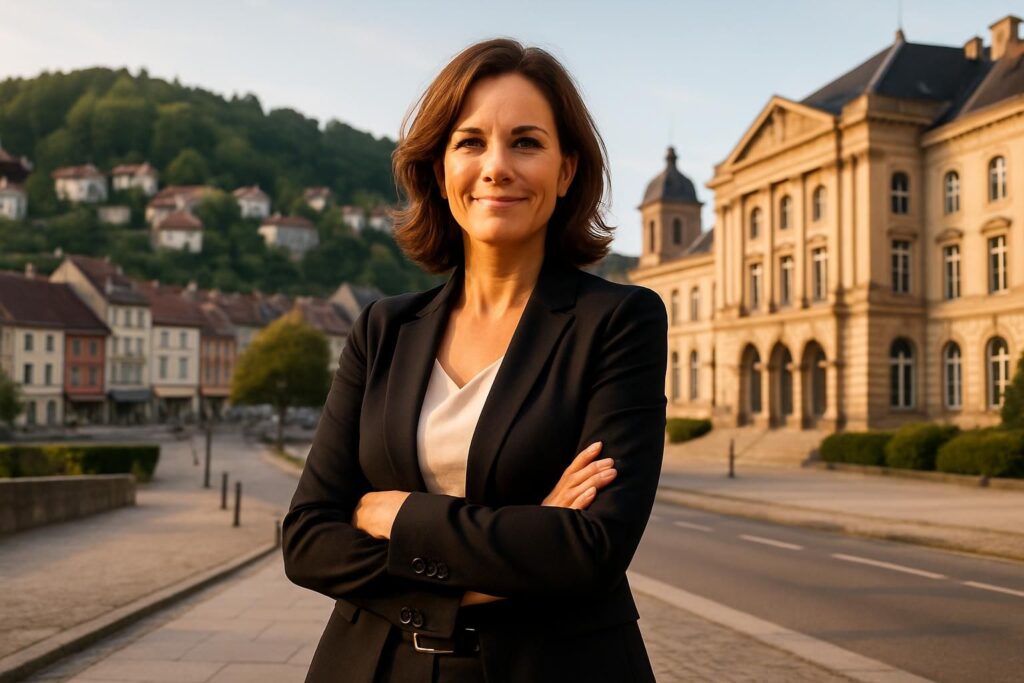
Coming from a background rooted in the diversity of Vosges environments, Patricia Champ embodies a striking example of success within Épinal’s local politics. This woman, whose journey began in the working-class neighborhoods of the Vosges prefecture and led her to municipal responsibilities, carries with her the mark of unwavering civic commitment. Originally from Mirecourt, she experienced several cities due to relocations linked to her father’s police career. Ultimately establishing her home in Épinal at the age of ten, she has woven a deep connection there, nurtured by an intimate knowledge of the neighborhoods, their history, and their needs. In 2024, her arrival as deputy mayor marks a crucial stage in the urban development of this human-sized city, which she knows better than anyone else.
Her political action is set within a local context where proximity between elected officials and residents is paramount, especially in a city that aims to keep its soul while evolving towards new challenges. Her mission, which covers areas as varied as urban planning, roads, parking, and buildings, reflects a desire to work in consultation with grassroots actors and neighborhood interest committees, essential structures for Épinal’s democratic and social life. This inspiring path is also a reflection of a political vision based on knowledge of the Vosges realities and a constant concern for quality of life. Patricia Champ’s destiny is thus an example of how local life can become a true school of power, rooted in values of public service and respect for people.
From Mirecourt to Épinal: a gradual rooting in the Vosges neighborhoods
Born in Mirecourt, Patricia Champ was quickly immersed in a life marked by several moves, a direct consequence of her father’s police career. Regular relocations to Dijon and Boulogne-sur-Mer shaped an adaptable personality, but it was the definitive arrival in Épinal when she was only ten that truly laid the foundation for her future commitment. These beginnings in a human-sized city perfectly match her aspirations: she identifies neither with the anonymity of large metropolises nor with the isolation of rural villages.
Her adolescence spent in the upper parts of Épinal strengthened this attachment. The neighborhoods of Épinal, each with its own dynamic, offered her a rich range of experiences, between organized neighborhood life and challenges linked to urban changes. These territories allowed her to understand the vital role of local politics attentive to residents’ needs. It is indeed in these neighborhoods that she began to get actively involved in associative life and neighborhood interest committees, indispensable tools for citizen mobilization at the local level.
This proximity to ground realities was a school of practical politics. She built in these daily interactions and citizen listening a sense of public service rooted in solving concrete problems: urban renewal, parking management, preservation of architectural heritage, and local economic dynamism. Her journey perfectly illustrates how grassroots engagement, in the neighborhoods, can lead to broader responsibilities — a trajectory often seen among elected officials attached to their territory in the Vosges.
A civic commitment nurtured by action in neighborhood committees
Active participation in neighborhood interest committees was a decisive stage in Patricia Champ’s journey. These structures, well established in Épinal for several generations, are essential platforms to represent residents and contribute to local democracy. Patricia Champ was able to grasp their full strength, fully investing herself in these committees to create bridges between the municipality and neighborhoods often marked by specific issues.
Neighborhood committees in Épinal play a key role in enabling residents to make their voices heard in areas as varied as security, urban development, and public space renovation. The new deputy mayor has been a fervent advocate of this political proximity, embodying the transition from engaged citizen to responsible elected official, while always remaining close to the residents. In a context where trust in local institutions is crucial, this direct link with neighborhoods is an indispensable condition for any political effectiveness.
Through her presidency within an interest committee, she coordinated several projects that demonstrate the success of this localized approach. For example, the renovation of public spaces in certain neighborhoods was carried out in concert with the committees, fostering constructive dialogue and appropriation by residents. This participatory approach strengthened social cohesion and allowed better response to expectations concerning roads or parking, themes at the heart of her current responsibilities.
Here are the main contributions of neighborhood committees in Patricia Champ’s journey:
- Active listening to residents’ needs, enabling better targeting of municipal interventions.
- Civic mobilization fostering a sense of belonging and shared responsibility.
- Support in managing urban projects thanks to a detailed knowledge of the local social fabric.
- Creation of bridges between the municipality and residents, reinforcing political legitimacy.
- Development of a solid local network, essential for any progressive political career.
Presentation of Patricia Champ’s missions as the new deputy mayor
Since her appointment in March, Patricia Champ has held significant responsibilities, notably in key sectors of urban development in Épinal. In charge of urban planning, roads, parking, and municipal buildings, she intervenes directly in the operational and strategic management of the territory. Her precise knowledge of neighborhoods and her associative experience facilitate informed decision-making, always in a spirit of dialogue and efficiency.
Urban planning constitutes a major part of her mandate. She coordinates projects aimed at modernizing the city while respecting its unique architectural heritage. Épinal’s policy thus seeks to energize the city center and peripheral zones, in close connection with the residents. The challenges linked to urban renewal are numerous, notably in managing public spaces and adapting infrastructures to new environmental and social requirements.
In terms of roads, Patricia Champ works on improving road networks, traffic safety, and neighborhood accessibility. Parking, often a source of dissatisfaction, is also part of her domain. Innovative solutions are considered to meet user expectations while limiting environmental impact, fitting into a broader sustainable development strategy.
Municipal buildings, finally, represent a major issue to guarantee the quality of local public services. The management and renovation of these facilities require a vision both pragmatic and ambitious, taking into account budget constraints but also the future needs of the population. Patricia Champ’s on-the-ground experience in neighborhoods is a major asset to prioritize actions and ensure overall coherence.
The influence of Patricia Champ’s journey on Vosges local politics
Patricia Champ’s journey illustrates the particular dynamic that can exist in the Vosges between grassroots engagement and access to political responsibilities. This pattern, widely visible in the region, highlights the fundamental role of local actors who combine associative life, professional environments, and political commitment. In a city like Épinal, municipal power relies on strong involvement in neighborhoods, which contributes to the success of development projects.
Her path is also a source of inspiration for new generations aspiring to a more participative and community-focused local politics. Through the success of her rise to responsibility, highlighted in several media, including champagne.news/marcel-geslot-sixieme-mandat/”>the local and regional press, she demonstrates the possibility of a political career built on solid foundations, driven by civic engagement. This dynamic is all the more valuable in the Vosges, where territorial specificities require constant adaptation of public policies.
By contributing to the implementation of innovative projects in urban planning and daily life, Patricia Champ also helps strengthen Épinal’s attractiveness. The city, relying on the experiences of its elected officials from the neighborhoods, improves its capacity to combine tradition and modernity, an essential balance for a city at the interface between heritage and innovation.
Future challenges of urban development in Épinal under the impulse of Patricia Champ
Épinal’s future is shaped by the policies carried by its elected officials, and Patricia Champ occupies a central place in this perspective. The challenges linked to controlled growth and the transformation of neighborhoods require a clear and shared vision. The new deputy mayor, aware of the stakes, frames her action around several priority axes.
Firstly, the balance between preserving the living environment and modernizing infrastructures is at the heart of her concerns. In a city like Épinal, where heritage is a strong symbolic wealth, urban projects must respect this identity while meeting current needs in housing, mobility, and public spaces.
Secondly, ecological transition represents an important lever for urban development. Patricia Champ, in her role, collaborates with various actors to integrate sustainable solutions, promoting carbon footprint reduction, rainwater management, and green spaces. These initiatives align with a firm intent to sustain the living environment for future generations.
Finally, the social and economic dynamics of neighborhoods constitute a priority. She aims to enhance neighborhood attractiveness, facilitate access to public services, and encourage private investment in targeted areas. Collaboration with neighborhood interest committees ensures fine adaptation of measures to ground realities, thus contributing to shared local governance.
The perspectives translate into a series of concrete objectives:
- Strengthening transport infrastructures to better serve neighborhoods and ease traffic flow.
- Energy modernization of municipal buildings, integrating environmentally respectful technologies.
- Creation of multifunctional public spaces fostering social interactions and neighborhood life.
- Support for citizen participation through digital platforms and local meetings.
- Enhancement of architectural heritage in all urban planning projects.
What is Patricia Champ’s personal background before her political commitment?
Originally from Mirecourt, Patricia Champ lived in several cities including Dijon and Boulogne-sur-Mer before settling in Épinal at the age of 10, a city to which she is deeply attached.
How did Patricia Champ get involved in Épinal’s local life?
She was initially active in neighborhood interest committees, where she strengthened dialogue between residents and the municipality, before being elected deputy mayor.
What responsibilities does Patricia Champ hold as deputy mayor?
She is responsible for urban planning, roads, parking, and municipal buildings, essential areas for urban development and quality of life in Épinal.
Why are neighborhood committees important in Épinal’s local politics?
They allow direct representation of residents, promote civic mobilization, and facilitate the implementation of urban projects adapted to local needs.
What are the major axes of urban development in Épinal towards 2030?
The focus will be on ecological transition, heritage preservation, infrastructure modernization, and strengthening citizen participation.