
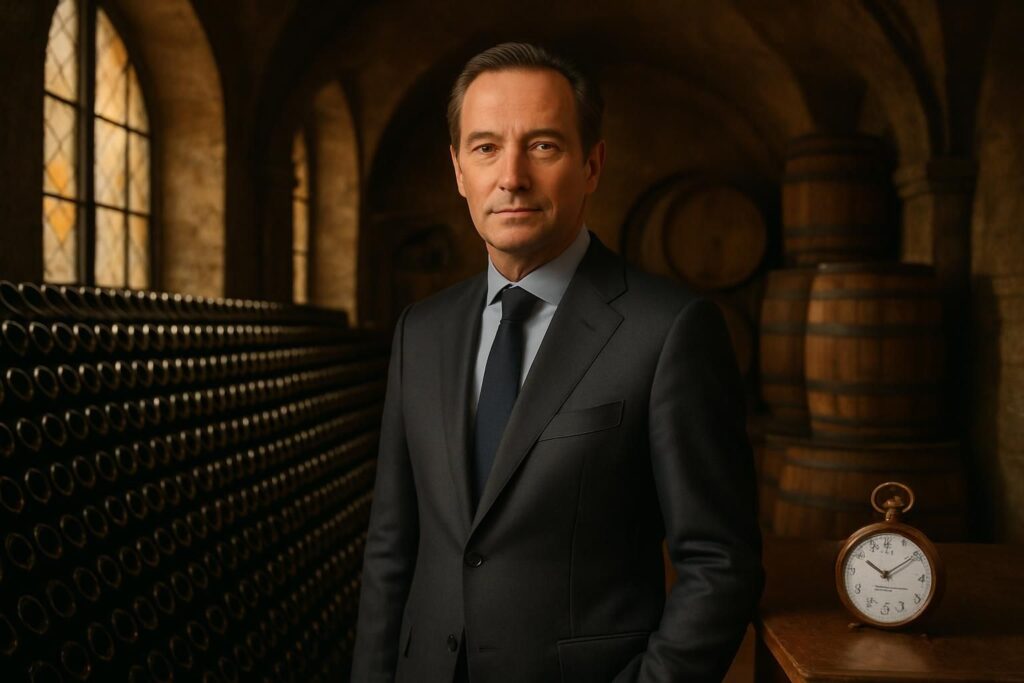
In the world of champagne, the house of Louis Roederer has embodied for 250 years a rare alliance between excellence, heritage, and long-term vision. On the occasion of this prestigious anniversary, Frédéric Rouzaud, president of the family house, discusses a unique conception of luxury: a wealth built around time and patience. More than a simple champagne producer, Louis Roederer symbolizes a tradition that combines respect for the terroirs, controlled innovation, and meticulous know-how, with the ability to project itself into the future without ever neglecting the essential past. It is in the understanding of this deep link between tradition and modernity that the strength and prestige of this great independent house are revealed, proud to pass on a heritage stemming from continuous family management.
At the heart of the activity, champagne becomes a vector of emotion, shaped by time and constant demand. The house of Roederer, with its 250 hectares in Champagne and about a thousand in other wine regions such as Bordeaux, Provence, or California, demonstrates controlled diversity, where each terroir reveals a singularity. Frédéric Rouzaud, with a gaze both historical and prospective, provides the keys to success founded not on haste, but on a patient vision that makes time the true luxury. The dialogue with the terroirs, rigor in vineyard management, and constant reflection in the face of contemporary challenges, notably climatic and economic, are all essential elements to ensure sustainability and quality.
Time, fundamental wealth and lever of authentic luxury at Louis Roederer
The obsession with time as a key factor of prestige and quality defines the unique philosophy of Louis Roederer. For this house, time is not a constraint but a precious capital. Patience is already expressed in the acquisition of the vineyards, begun in the 19th century with the desire to control the entire production chain. Thus, the vines are left to mature for two to three decades before the grapes from the most noble crus are destined for elaboration, notably of the famous Cristal.
This respect for time is also reflected in the exceptional duration of aging in the cellar, where Louis Roederer champagnes mature slowly until reaching a perfect balance between finesse, power, and aromatic complexity. This longevity in maturation, far from being a vain luxury, guarantees a tasting experience where elegance and depth mingle.
Patience and mastery of time also contribute to an approach of sustainability and innovation respectful of natural cycles. Faced with the environmental challenges of the 21st century, the house has been able to integrate the notion of climatic adaptation without compromising its know-how. Every decision is made with the awareness that champagne is an exceptional wine that cannot be produced hastily.
Some concrete examples illustrate this strategy: the house has invested in biodynamic viticultural techniques on certain terroirs, optimized cellar aging thanks to strictly controlled conditions, and highlights rare vintages by limiting quantities produced to guarantee impeccable quality. This mastery of time is also an expertise that the house shares with its teams, often stemming from families with several generations in the Roederer house.
A family heritage and independence as guarantees of tradition and excellence
Since its creation in 1776, Louis Roederer has distinguished itself by nearly uninterrupted family management, now embodied by Frédéric Rouzaud, the seventh owner at the head of the house. This continuity gives the house a strong identity and a unique alignment between values, strategy, and know-how. Family longevity is more than a tradition: it is a true cultural and economic heritage that feeds the prestige and worldwide reputation of the house.
This independence, rare in a sector where many houses have been absorbed by large groups, allows for an autonomous approach, without concessions, where luxury is defined above all by the freedom to take the time necessary at every stage of production. The prestige of Louis Roederer is thus the fruit of a constant commitment over the long term, from vineyards to cellars, involving both the family and collaborators often connected to the house for several generations.
This stability combines with a controlled evolution, notably in the diversification of estates that the house owns throughout the world, in particular in Bordeaux, the Rhône Valley, Portugal, and California. This international presence creates an enriching exchange dynamic between terroirs and teams and confirms the opening strategy. It consolidates a global network that values the unique history of the house while constantly adapting its production and distribution methods to market developments.
Frédéric Rouzaud emphasizes the need to ensure succession while respecting the personal pace of the heirs. He mentions a healthy freedom of commitment, where everyone can choose whether or not to join the house, thus guaranteeing inspired and competent leadership, serving quality and sustainability.
Champagne as an exceptional wine: emotion, prestige, and modernity
Through the lens of Louis Roederer, champagne reveals a triple dimension: celebratory wine, gastronomy wine, and aging wine. This multiplicity is at the heart of the aura of champagne, exalted by the house which has the ambition to create singular wines, carriers of emotion and character.
Cristal, the flagship product of the house, perfectly illustrates this quest for excellence. Created at the request of Tsar Alexander II in 1876, it symbolizes one of the first sparkling wines to marry prestige and originality. This cuvée embodies a subtle balance between tradition and modernity, crafted with a constant concern for finesse.
In a constantly evolving international market, where champagnes are becoming more and more democratized, the house of Louis Roederer defends a high-end positioning adapted to demanding consumers, sensitive to quality and the story behind the product. Attention paid to the terroir, mastery of winemaking methods, and extended aging contribute to a rich aromatic profile, whose notes evolve with time.
Faced with competition and new consumption patterns, the house also innovates by adapting its communication and valuing its heritage through oenotourism projects. This approach encourages encounters with enthusiasts and strengthens the transmission of its values.
Champagne oenotourism is thus a booming sector where prestigious houses like Louis Roederer offer immersive experiences, telling the story and richness of their vineyards, ancestral know-how, and innovations. This dynamic allows for the lasting rooting of the emotional bond between the product and its audience.
Adaptation and diversification: the keys to a house tested by time
Louis Roederer has, for several decades, extended its expertise beyond Champagne, with a strong presence in international vineyards, notably in California, Portugal, and the Rhône Valley. This controlled diversification is not only a response to economic challenges but a driver of creativity and stimulation.
In California, the house has established itself in Anderson Valley, favoring a cool terroir conducive to the elaboration of excellent sparkling wines, close to Champagne conditions. This establishment testifies to a desire to remain faithful to know-how while exploring new horizons.
Moreover, the house always promotes production respectful of terroirs with the support of international teams, fostering fruitful dialogue between different experiences. This collaboration nourishes constant innovation and the ability to adapt to climatic, economic, and societal upheavals.
This balance also manifests itself in prudent and coherent management in the face of global market changes. In a context where French wine exports, notably to the United States, undergo fluctuations, Louis Roederer relies on the quality of its wines and customer loyalty, like other great houses that value their heritage and ability to innovate.
Diversification therefore proves to be a strategic asset, a source of inspiration, but above all a means to guarantee the sustainability and international influence of a house attached to tradition, while inscribing its history in modernity.
Human values and the importance of collaboration in the success of Louis Roederer
Beyond the vineyards and bottles, it is above all a human capital that makes the wealth of Louis Roederer. The house relies on a strong relationship with its collaborators, some of whom have been linked to the family for several generations, demonstrating deep commitment and attachment to the mission.
This relationship fits into a model where the transmission of know-how and values is paramount. Innovation does not replace tradition but is built on it, allowing constant improvement of techniques and renewed creativity. Thus, patience, a central value at Louis Roederer, is also expressed through progressive learning, where time spent mastering each stage is a guarantee of quality.
The sharing of experience, recognition of all viticultural and oenological trades, as well as attention paid to the diversity of skills, are essential factors for preserving the prestige and uniqueness of the products. The house intends to cultivate this cohesion, in a context of economic and social challenges, as a lever of motivation and excellence.
The intimate bond between the Roederer family and its teams offers a dynamic where everyone, from the vine grower to the cellar master, can contribute to writing the story of a prestigious house. This collaborative approach fosters creativity and strengthens the capacity to adapt, indispensable to perpetuate the reputation of Louis Roederer and assert its authenticity in a competitive global market.
- A family spirit and responsible management
- Respect for the terroir and sustainable viticultural practices
- Quest for excellence at every stage of production
- Openness to innovation without denying tradition
- Constant adaptation to economic and climatic challenges
What is the peculiarity of family management at Louis Roederer?
The house has been managed by the family for over two centuries, ensuring continuity in vision, strategy, and respect for values, with a free choice as to the integration of heirs.
How does Louis Roederer integrate time into its production?
Time is an essential capital, notably through long cellar maturation and the patience necessary for vineyard establishment, ensuring a unique gustatory balance specific to the house.
What are the major challenges the house faces today?
The main challenges include climate change, global competition, evolving consumer tastes, and the need for economic adaptation while preserving quality.
Is Louis Roederer only present in Champagne?
No, the house is also established in Bordeaux, Provence, the Rhône Valley, Portugal, and California, cultivating and producing singular wines in several terroirs.
What innovative approaches has the house adopted?
The house invests in biodynamic practices, promotes oenotourism, encourages exchanges between international teams, and adapts its viticultural techniques to the challenges of global warming.