
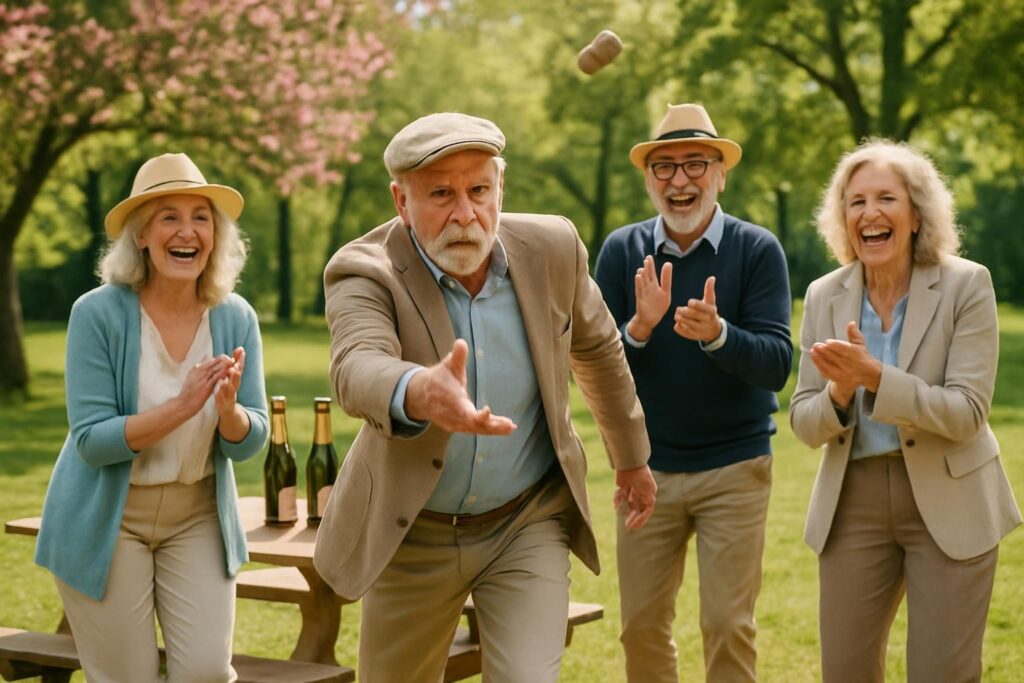
Champagne cork throwing is increasingly establishing itself as a fun and competitive activity at the heart of events dedicated to seniors. This discipline, both technical and entertaining, particularly appeals to retirees eager to combine skill, precision, and conviviality. Rooted in the festive tradition of champagne, this practice has gained popularity, especially in 2026, thanks to regional events that encourage agility and a sense of challenge among retirees. The game thus becomes a sparkling true challenge, blending dexterity and enjoyment in contact with Champagne culture, offering a new playground where experience has its rightful place. Between good humor, competitive spirit, and sharing, cork throwing asserts itself as an innovative response to the animation and socialization desires of this often underestimated age group.
Retirees see it as a great opportunity to stay active and widely involved, far from usual clichés. Mastering this technical gesture requires patience, precise movement, and fine coordination, all qualities that can be maintained and even improved through regular practice. By bringing these elements together in a festive and sparkling setting, champagne cork throwing becomes an accessible, motivating, and enjoyable activity. It is also an excellent way to strengthen social bonds between participants, stimulate body control, and combine the useful with the pleasant in an atmosphere typical of the Champagne region. This challenge, between play and competition, thus unfolds as a vector of overall well-being for skilled and curious retirees.
The stakes of cork throwing for retirees: technique and precision on the agenda
Champagne cork throwing is not a simple festive gesture, but a true exercise demanding precision and coordination. For retirees, this activity offers a challenging stimulation both on the motor and cognitive levels. Success in this game primarily depends on mastering the movement, which must be smooth, controlled, and above all adapted to the force necessary to send the cork a good distance without compromising safety. The technique is learned quickly but requires particular attention to the details of the gesture.
A correct grip of the cork, the angle of propulsion, and the applied force must be adjusted according to the characteristics of each cork and the wind when the challenge takes place outdoors. These parameters allow aiming efficiently and optimizing the trajectory. Thus, the activity mobilizes fine motor skills, stimulating hand-eye coordination and, more broadly, concentration. For retirees, the exercise then becomes a tool for maintaining dexterity that can help preserve functional autonomy.
The progressive adaptation of the effort required also helps avoid gestures that are too abrupt or too violent, often causing discomfort or injuries. Cork throwing is also practiced in a safe and supervised environment, with clear rules that facilitate integration into the game. Many retirees find real interest in taking on this challenge, thus establishing a form of healthy competition. They appreciate the alternation between learning phases and moments of entertainment, which values pleasure as much as performance.
Many organizations offer adapted training sessions and dedicated workshops for seniors, to familiarize them with the best throwing techniques. Thanks to this support, participants develop growing confidence and can pace their sessions according to their physical condition, avoiding fatigue and imbalances. This professional approach guarantees regular progression and sustained engagement in the game.
Finally, this skill challenge proves particularly inclusive. Whether in a family, associative, or intergenerational setting, cork throwing facilitates exchanges and stimulates sociability, beyond simple performance. By maintaining a friendly spirit and valuing each effort, it allows skilled retirees to live a rewarding experience, where precision plays a key role, thus consolidating their physical and mental well-being.
A friendly entertainment combining Champagne heritage and competition
Champagne cork throwing is part of a cultural heritage that goes beyond the simple playful gesture. For retirees, this exercise becomes the expression of a festive heritage transmitted from generation to generation in the Champagne region. Each propelled cork is both a nod to ancestral traditions and a moment of sharing around strong values such as solidarity and joie de vivre.
This activity has reinvented itself to meet the contemporary expectations of seniors, who seek to combine pleasure and intellectual stimulation. Many local events have integrated it into their programs, transforming it into an accessible and dynamic competition. The Champagne setting, known for its exceptional terroir and unique know-how, brings an authentic and warm dimension. Participants thus evolve in a sparkling atmosphere, where refinement and pleasure remain at the heart of exchanges.
To establish a true competitive spirit, organizers set precise game rules, a timer, and scoring systems based on distance and accuracy of throws. The best throwers, often retirees who have developed refined technique, compete for the title in friendly but serious contests. This structure helps maintain competitors’ motivation while ensuring a rigorous and safe environment.
This excitement is accompanied by a friendly atmosphere that encourages meetings and the creation of bonds between participants and spectators. Through the game, retirees find a playful way to break solitude, strengthen their social network, and maintain their dynamism. They exchange tips, celebrate each success, and encourage the less experienced. This increases the feeling of belonging to a living community, where shared pleasure prevails.
In addition, there are side activities such as tastings, cellar visits, and thematic workshops on the art of champagne, which enrich the overall experience and enhance the region. Altogether, this alliance of play, tradition, and competition makes cork throwing a complete entertainment, celebrating local expertise and the renewed vitality of retirees.
Preparing retirees for this challenge: practical tips to succeed at cork throwing
To excel in cork throwing, it is essential to properly prepare retirees for the physical and technical demands of this game. Initiation must revolve around several axes, ensuring safety and efficiency.
Mastering grip and momentum
The champagne cork, often chosen for its particular shape, requires an adapted grip. It should be held with moderate pressure between the thumb and fingers, avoiding excessive tension. The throw does not depend solely on strength but mainly on the smoothness of the performed momentum. Practicing first with plastic or cork stoppers can facilitate learning and prevent accidents.
Adapting posture and gestures
The thrower’s position greatly influences the success of the throw. Good balance, slightly bent legs, and feet spaced shoulder-width apart ensure stability and range. It is important to coordinate arm movement with a slight torso pivot to gain impulse while protecting the back. Seniors thus benefit from a natural gesture that optimizes trajectory while limiting muscular tensions.
Progressive and regular training
Like any discipline requiring precision, cork throwing demands regular practice. Workshops and training sessions organized for retirees promote short but frequent sessions, including warm-ups and suitable stretches. These routines help strengthen the muscle groups involved and improve overall coordination while preventing injuries.
Managing the environment and outdoor conditions
Weather conditions and terrain type greatly influence throwing performance. Outdoors, the wind can alter the trajectory, while a stable surface facilitates posture. Learning to anticipate and adapt the gesture according to these parameters is a real asset for participants who want to excel in this sparkling challenge.
By combining these practical tips, retirees can approach cork throwing with serenity and ambition. Progressive mastery gives access to sensations of success and enhanced pleasure, stimulating both body and mind in a healthy and playful dynamic.
The physical and social benefits of cork throwing for skilled seniors
Beyond its playful aspect, champagne cork throwing presents multiple benefits for retirees, particularly on the physical and social levels. Engaging in this type of game contributes to maintaining motor skills and preventing age-related disorders.
Physically, this light sport mainly solicits the muscles of the arms, shoulders, and torso. The repetitive gesture promotes muscle tone and improved motor coordination. The demand for precision also encourages concentration and attention, aspects often challenged in seniors. By mobilizing these faculties, cork throwing supports better quality of life and can even help delay some signs of aging.
On the social level, this activity offers an environment where retirees fully flourish. Participating in dedicated clubs or events helps break isolation, fostering exchanges and the creation of lasting bonds. The warm atmosphere and respectful competition generate regular engagement, stimulating motivation and self-confidence. Thus, cork throwing becomes as much a moment of entertainment as a vector of social balance.
Specialists also highlight the psychological interest of this type of challenge. Success in the game provides satisfaction that boosts self-esteem, essential at any age. The combination of moderate physical effort and social interactions acts positively on morale and mental health.
- Enhancement of fine motor skills: precise gestures improve hand-eye coordination.
- Maintenance of physical fitness: moderate and adapted muscular engagement.
- Cognitive stimulation: concentration and reflection necessary to optimize each throw.
- Creation of social bonds: sharing and conviviality within groups and clubs.
- Mental balance: sense of accomplishment and shared pleasure reinforcing well-being.
Considered in its entirety, champagne cork throwing stands out among activities for seniors by its combined contribution to physical dynamism and socialization. It embodies a true promise of vitality and joy in the daily lives of skilled retirees.
Cork throwing events and competitions: a space dedicated to skilled retirees
Champagne cork throwing competitions have experienced remarkable growth in 2026, with a rich calendar of local and regional events specially designed for skilled retirees. This growing popularity reflects the enthusiasm surrounding this sparkling challenge, which combines dexterity, pleasure, and conviviality.
Organizers take advantage of this momentum to structure dedicated days where the game blends with the discovery of the Champagne terroir. In these competitions, participants compete for the best distance or greatest precision, under the watchful eye of an enthusiastic audience. The rules, simple but codified, guarantee a fair and accessible competition, often with categories adapted to the age and level of competitors.
Among the major events, several annual gatherings attract hundreds of seniors wishing to demonstrate their skill and share a moment of intense entertainment. These meetings also include cultural and gastronomic animations, reinforcing the festive and integrative nature of the event.
The winners depart with symbolic trophies, but above all with the satisfaction of having taken on a challenge that is both sporting and social. The lived experience far exceeds the simple performance and participates in enhancing the active role of retirees within local communities. It also contributes to positively changing the image of retirement, close to a period of dynamism and renewed fulfillment.
Through these competitions, champagne cork throwing asserts itself as a true catalyst for social bonds and well-being, while perpetuating a typically French know-how. Participation also encourages the transmission of traditions and questions the importance of play in the quality of life of seniors.
How to learn the technique of champagne cork throwing?
It is recommended to start by training with corks made of cork or plastic in order to master the grip and the propulsion gesture. Workshops and courses dedicated to seniors also allow acquiring the basics in a safe setting. Regular practice improves precision and throwing distance.
Are there specific competitions for retirees?
Yes, many events in France organize cork throwing competitions specially for retirees, with rules adapted to their age and skill. These events foster conviviality and encourage participation from seniors of all levels.
What are the benefits of cork throwing for seniors?
Cork throwing stimulates motor coordination, strengthens concentration, maintains muscle tone, and promotes social exchanges. It is a playful activity that helps maintain good physical and mental shape while having fun.
How to ensure the safety of cork throwing practice?
It is important to organize practice in an open space with appropriate supervision. Wearing suitable protection, progressive learning of the technique, and respecting instructions guarantee a safe and enjoyable activity.
Is cork throwing accessible to beginners?
Absolutely. This activity is designed to be accessible to all, including beginners. The simplicity of the game and the possibilities of adapting the rules allow for quick integration and enjoyable learning.