
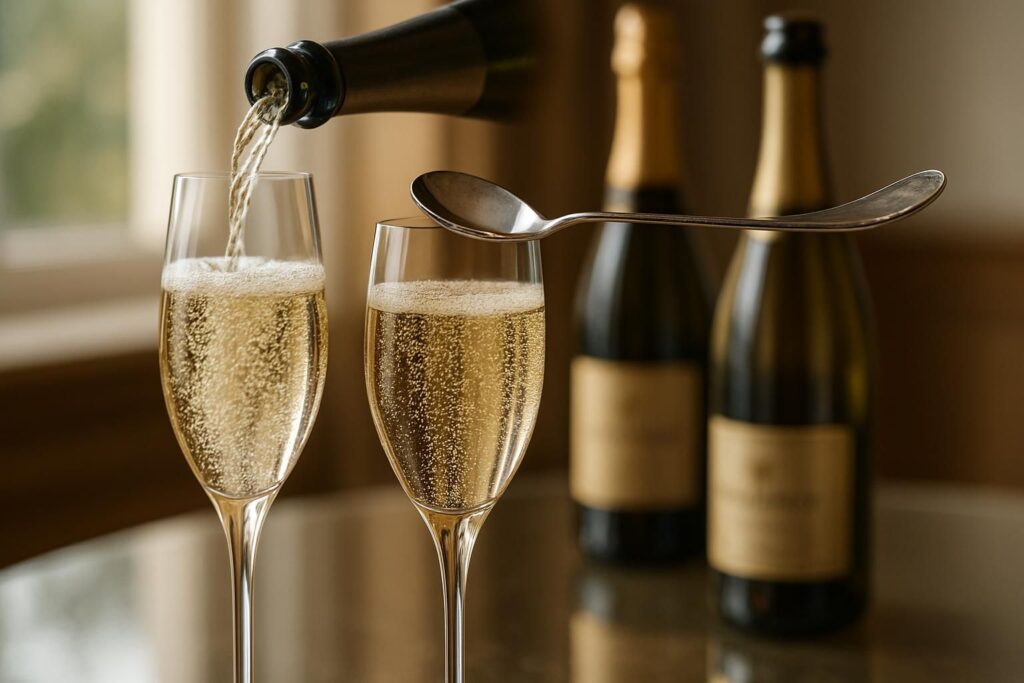
In the world of sparkling wines, Champagne and Crémant hold a special place, celebrated for their finesse and unique effervescence. However, a question regularly arises among enthusiasts and professionals alike: how to best preserve the precious liveliness of the bubbles once the bottle is opened? The popular answer often shared, especially during celebrations and meals, is to insert a spoon into the neck of the bottle to preserve the bubbles until the next day. This method, rooted in the tradition and folklore of tastings, appeals by its apparent simplicity. Yet, several scientific experiments conducted notably by the Comité Champagne invite us to reconsider this now ritual gesture, even to qualify it as a myth. Beyond this widely shared belief, there are more solid and proven techniques to ensure better preservation of effervescence, a crucial approach to preserving the aromatic richness and freshness of the served glass, whether in the context of a professional tasting or a festive meal. With the multiplication of sparkling wines offered on the market, from Champagne to Crémant, through Prosecco or Cava, understanding the reality of carbon dioxide preservation becomes an important issue to avoid the disappointment of a “flat” wine the day after opening.
Origins and Spread of the Spoon Myth in Champagne and Crémant
The belief that slipping a small spoon into the neck of an opened bottle of Champagne or Crémant would preserve the bubbles is a widespread ritual in France and other countries fond of sparkling wines. This habit dates back several decades, even centuries, and has been passed down from generation to generation as a simple and effective grandmother’s trick to prevent effervescence from escaping. The supposed principle is based on the idea that the metal of the spoon, often silver or stainless steel, would act as a thermal regulator, keeping the neck cool and thus slowing the release of carbon dioxide (CO₂).
This explanation seems logically sound at first glance: temperature plays a crucial role in the dissolution of carbon dioxide in the liquid. The colder the sparkling wine, the better the CO₂ remains trapped, limiting the bubbles’ escape into the atmosphere. In a convivial context, where the bottle remains open for a few hours or overnight, this trick has been adopted into habits to try to prolong the freshness and liveliness of the wine.
However, in light of recent knowledge in fluid physics and food chemistry, this gesture now receives a critical look. The tiny size of the spoon compared to the neck opening cannot form a watertight barrier nor recreate the pressure necessary for bubble stability. The spoon indeed occupies space, but it does not suppress air exchange nor block the wine’s degassing. Despite this, the persistence of the myth reveals above all the cultural and emotional importance linked to the consumption of sparkling wines.
It is interesting to note that this practice does not only concern Champagne. Crémant, this sparkling wine often produced according to the same methods but outside the Champagne region, is also subject to this popular belief. The parallel between Champagne and Crémant illustrates the universal dimension of the spoon myth, transcending geographical boundaries and finding wide resonance among sparkling wine enthusiasts.
Scientific Analysis: The Comité Champagne Tests on Bubble Preservation
To settle the question, the Comité interprofessionnel du vin de Champagne (CIVC), now Comité Champagne, conducted in 1995 a series of rigorous experiments to evaluate the actual effectiveness of the spoon in preserving effervescence. This study, often cited as a reference, remains essential today in the debate around the preservation of Champagne and Crémant bubbles.
The Comité researchers first partially emptied twelve bottles of sparkling wine, divided into four distinct groups: three bottles left as such, three others with a silver spoon inserted into the neck, three equipped with an airtight stopper, and finally three capped with a simple capsule. All were regularly weighed over 72 hours to measure the weight loss which directly corresponds to CO₂ escape.
The results clearly debunked the myth: after 24, 48, and 72 hours, the gas loss is almost identical for bottles opened or capped with a spoon. For example, an average loss of about 0.8 g at 24 hours, 1.2 g at 48 hours, and nearly 1.9 g after three days is observed in both cases. These figures reflect a significant and comparable leakage of carbon dioxide despite the presence of the spoon.
On the other hand, bottles equipped with an airtight stopper show almost perfect preservation, with no gas loss detected over the same period. This difference is explained by the stopper’s ability to recreate a physical barrier and stabilized pressure around the wine, effectively preventing degassing. A parallel tasting confirms this finding: only the bottle with the airtight stopper preserves a fully perceptible effervescence and an intact aromatic bouquet, thus revealing its superiority for preservation. This experiment scientifically illustrates why amateurs should favor dedicated accessories rather than the spoon, regardless of the quality of Champagne or Crémant.
Physical Mechanisms of Bubble Loss in Sparkling Wine
The sparkling character of Champagne and Crémant is linked to the presence of dissolved carbon dioxide, resulting from the second fermentation in the bottle. This gas, under high pressure, dissolves in the wine, creating both the effervescence and the sought-after sensory pleasure. As soon as the bottle is opened, the pressure suddenly drops, and the CO₂, no longer able to stay dissolved at this new pressure, begins to escape.
The gas escape accelerates with each pour and even when the bottle is simply left open. The size of the bubbles, their release, as well as the freshness sensation in the glass therefore depend on a fragile balance between pressure and temperature. When the bottle is left out of the cold or poorly stored, these phenomena intensify, accelerating the loss of effervescence.
The spoon, often made of metal, is no more than a partial obstacle that does not affect either the internal pressure or the gas exchange between inside and outside. It neither limits degassing nor slows CO₂ diffusion. On the other hand, temperature plays a major role: a well-chilled wine will maintain its bubbles longer. This characteristic is valid for any sparkling beverage, whether Champagne, Crémant, Prosecco, or Cava.
That is why controlling preservation relies on a combination of essential elements, more reliable than simply placing a spoon:
- Recap the bottle with a suitable stopper in order to recreate an airtight seal.
- Keep the wine cool, ideally between 6 and 10 degrees Celsius.
- Store the bottle upright to minimize the air exchange surface.
- Avoid any sudden movement which speeds up gas loss.
- Consume within 24 hours of opening for a better tasting experience.
These practices guarantee the longevity of effervescence and the freshness of the glass, far beyond the supposed effect of the spoon.
Effective Alternatives to Fully Enjoy Champagne and Crémant
Facing the scientific and experimental findings, how can one then ensure that the spoon does not act as a Damocles’ sword over the quality of the tasting? The answer lies in adopting specific tools and simple know-how. The airtight stopper, designed for sparkling wines, is now widely available on the market and easily usable by consumers.
This stopper allows maintaining the internal pressure in the bottle, limits CO₂ release, and thus preserves the sparkling character of the wine for several hours, even a whole day. Accompanying this closure with cold storage, notably using an ice bucket or refrigerator, ideally prolongs freshness.
Furthermore, adopting the right posture by placing the bottle upright reduces the space occupied by air above the wine, reducing gas exchanges and slowing bubble loss. Contrary to common belief, it is not recommended to shake or stir the bottle after opening, lest you accelerate degassing and rapidly lose effervescence.
For enthusiasts wishing to extend the experience, certain Champagne-based cocktail recipes allow recycling opened bottles that have lost some bubbles. Fruity mocktails such as the creamy lychee mocktail offer a new, elegant, and refreshing tasting approach. Similarly, easy Champagne-based cocktails from well-measured recipes constitute an alternative that enhances the product while maintaining a pleasant mellowness and lively scents see here.
Finally, raising awareness of these preservation practices, widely reiterated during oenology courses or in Champagne houses, represents significant progress for preserving the intrinsic qualities of sparkling wine and improving consumers’ tasting experience. Thus, science debunks a popular myth while offering simple and effective solutions to fully enjoy the unique pleasure brought by a glass of Champagne or Crémant.
Can the silver spoon really preserve the bubbles in Champagne?
Rigorous tests conducted by the Comité Champagne have shown that the spoon does not slow down the loss of carbon dioxide. It therefore does not effectively protect the bubbles and does not change the pressure inside the bottle.
What is the best method to preserve effervescence after opening?
The most effective method is to recap the bottle with an airtight stopper and keep it cool. Keeping the bottle upright and avoiding shaking also help to preserve the bubbles longer.
Is Crémant preserved like Champagne after opening?
Yes, the physical principles are identical. Whether it is Crémant, Champagne, or other sparkling wines, preservation relies on managing pressure and temperature, independently of the traditional spoon method.
How long can an opened bottle of Champagne be kept with a stopper?
With an airtight stopper and cold storage, it is possible to preserve the freshness and effervescence of Champagne for 24 hours or even a little longer, without significant bubble loss.
Are there alternatives to using opened Champagne that has lost its bubbles?
Yes, it is possible to prepare cocktails or mocktails based on slightly flat Champagne, such as the creamy lychee mocktail, a refreshing and elegant option to avoid wasting the product.