
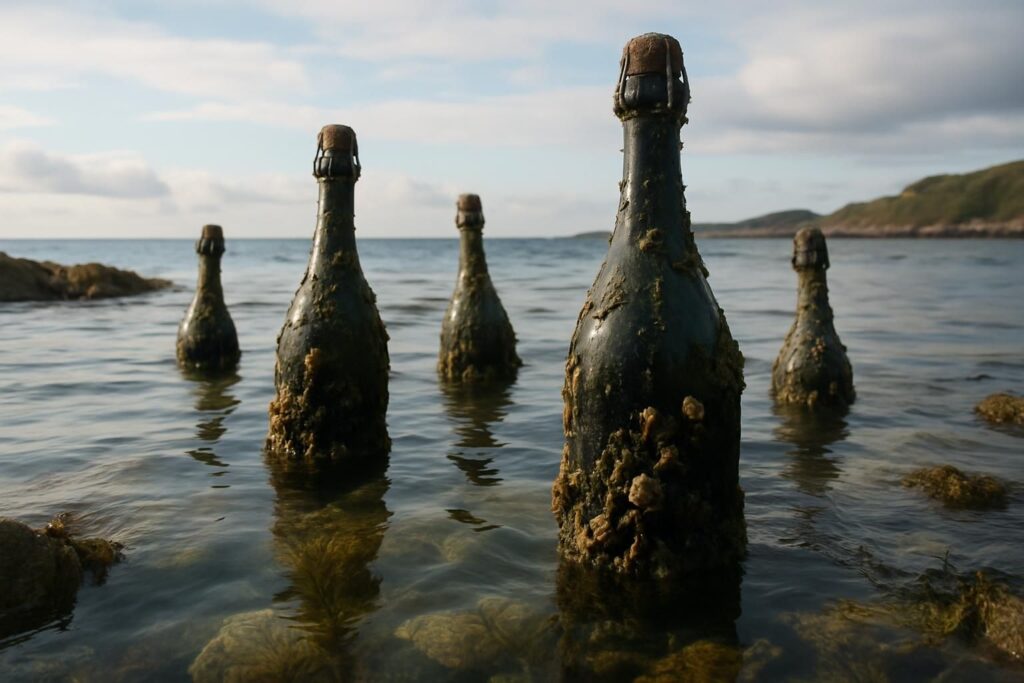
The small bay of Trédrez-Locquémeau, nestled in the heart of Côtes-d’Armor, has recently transformed into the setting of a rare and fascinating discovery. After six years spent at more than 30 meters deep, nearly 1,500 bottles of champagne have resurfaced, marking an unprecedented milestone in the understanding of the underwater aging of sparkling wine. This event is not limited to a local curiosity: it opens exciting perspectives on the role of the marine environment in the maturation of prestigious wines and on the untapped potential of maritime heritage associated with viticulture.
In this context, the Drappier house, renowned for its expertise and respect for traditional methods, undertook this exceptional immersion in Breton waters. The observation of these bottles that remained intact over the years, despite sometimes extreme conditions, has been fueling discussions among experts and enthusiasts for several months. It is also a long-term experiment that highlights the complex interactions between pressure, temperature, and the marine micro-ecosystem on the quality and characteristics of sparkling wines stored underwater.
Beyond its oenological significance, this discovery rekindles attention to Breton maritime heritage. Trédrez-Locquémeau, a small artisanal port, now hosts this submerged treasure that brings together the passions for diving, adventure, and gastronomic excellence. The media echo of this operation also illustrates the close connection between Land and Sea, reminding us that the cultural and natural heritage of the region maintains surprising and fruitful dialogues.
The mechanisms of underwater aging of champagne: an artistic immersion
The aging of sparkling wines underwater is not simply a curiosity; it is a genuine refining method that profoundly transforms the organoleptic characteristics of champagne. The bottle immersed at Trédrez-Locquémeau was exposed to climatic and environmental conditions radically different from those of a traditional cellar. Among these parameters, it is important to note: constant hydrostatic pressure, a stable and cool temperature, almost total darkness, as well as slight agitation of the waters caused by ocean currents.
Pressure at 31 meters deep modifies the dynamics of the dissolution of carbon dioxide contained in the champagne. This phenomenon directly influences the texture of the bubbles, which tends to become finer and more persistent, often described by tasters as “silky” on the palate. The micro-balance between bubbles and wine thus resolves into a delicate maintenance of effervescence.
Stable temperature, generally around 12°C in this marine zone, slows down the natural chemical reaction that accompanies wine aging, notably oxidation and the degradation of aromatic compounds. This constant coolness proves favorable to preserving fruity and floral characteristics, as well as the emergence of new olfactory nuances. The temperate temperature ensures slow maturation, comparable yet different from the rigorous conditions of a traditional limestone cellar such as those found in the Champagne region.
The light factor also plays a crucial role since the near total absence of lighting excludes photodegradation, an unavoidable risk in poorly protected cellars or overly exposed premises. Thus, the protective capsule of the bottle proves doubly effective, ensuring both isolation against external shocks and a stable environment ideal for qualitative refining. It is even observed that the layer of labels, often weakened by typical weathering, remains perfectly intact after this prolonged immersion.
This set of conditions creates a harmonious balance where biochemical interactions evolve at a slowed pace regulated by the marine environment. This gives champagne a unique gustatory signature, both on the palate and the nose, that many connoisseurs have sought to decode after this spectacular recovery of the bottles. This phenomenon invites reconsideration of certain oenological practices by integrating the aquatic environment as a key factor in the singularization of products.
Diving and bottle recovery: a technical and human feat
Extracting nearly 1,500 bottles of champagne, preserved in an environment as hostile as it is deep at 31 meters under the surface, represents a major technical achievement. The mission, orchestrated by a team specialized in professional diving and maritime heritage management, began early on the morning of Thursday, June 25, 2026.
During several rotations, divers equipped with suitable compressors, thermal suits, and autonomous communication systems precisely located the submerged crates on the sandy seabed. Logistical coordination relied on precise marking, as well as modern systems designed to limit both drift and shocks during handling. The artisanal port of Trédrez-Locquémeau thus took on the appearance of an underwater base, combining cutting-edge technology and human expertise.
The human aspect must not be underestimated, as diving at such a depth imposes difficult physical and psychological conditions. Team safety was paramount, involving rigorous decompression phases and continuous monitoring of the divers’ health status. They had to handle each bottle with extreme care, ensuring a return without alteration.
Recovery was also crucial to preserve the integrity of these sparkling wines, a goal that fits into a patrimonial enhancement logic beyond the purely commercial aspect. All these operations sparked great interest in the champagne world, recalling the importance of collaboration between the wine universe, maritime heritage, and diving professions.
Key stages of the recovery
- Precise detection via electronic tags and sonar
- Individual rotation diving to respect decompression time
- Delicate handling of sealed crates at 31 meters deep
- Assisted ascent by motorized pulleys to avoid jolts
- Temporary storage at controlled temperature on the support vessel
- Transport to Drappier house cellars for analysis
Influence of prolonged immersion on the taste of champagne bottles
The rediscovery of these bottles after six years underwater offers an opportunity to study how this type of aging affects the flavor and texture of sparkling wine. Experts from the Drappier house conducted a series of comparative tastings between traditionally cellared bottles and those retrieved from the seabed.
The main finding reveals that champagne from immersion stands out by its remarkable finesse and delicacy, particularly thanks to a finer perlage. These characteristics are explained by the modulation of bubbles induced by the constant pressure and cool temperature of the underwater environment. The aromatic profile is enriched with increased complexity, featuring subtle marine notes blended with floral and fruity nuances, such as ripe pear and acacia flower.
However, some tasters note a slightly denser texture and extended persistence on the palate, indicating a unique concentration and balance. This suggests that sea aging could become an innovative complement or alternative for certain blend cuvées. This discovery opens an interesting commercial perspective, especially for prestige cuvées seeking an original signature.
For both the general public and professionals, this experimentation also fuels reflection on the sustainability of champagne practices and their integration into a sensitive environmental context. The choice of site, Trédrez-Locquémeau, reflects a commitment to respecting and enhancing Brittany’s natural riches.
The role of Trédrez-Locquémeau in the enhancement of maritime and oenological heritage
The port of Trédrez-Locquémeau stands out as a hub of innovation blending maritime heritage and viticultural tradition. Located at the heart of the Bay of Lannion, this small Breton port has adapted to welcome this rare experimentation, promoting a heritage and tourist dimension. The discovery of bottles after six years of immersion strengthens local identity, while highlighting the richness of seabeds that hold unsuspected treasures.
This initiative highlights the close historical exchanges between sea and land in this region. Maritime heritage, often linked to fishing and port activities, is today enriched by a new facet where sparkling wine becomes an unexpected ambassador. The site now serves as a natural laboratory to explore extraordinary refining methods.
Trédrez-Locquémeau thus offers a model for other coastal territories wishing to enhance their maritime heritage in connection with cultural or gastronomic productions. The local community has also benefited from renewed dynamism, with increased visitor numbers, amateur divers, and oenological art enthusiasts. This phenomenon is accompanied by heightened awareness of seabed preservation and a reasoned exploitation of natural resources.
This positive interaction between innovation, tradition, and environment has also been relayed by several specialized media. For example, one can visit champagne.news to find an overview of current trends in the world of sparkling wine, emphasizing how disruptive methods like immersion are now establishing themselves in the debates.
Future perspectives: what developments for champagne with the use of aging by immersion?
This experience led at Trédrez-Locquémeau opens a promising path for the champagne sector. Underwater aging, combined with conventional techniques, could redefine quality criteria and production standards in the coming years. The reduced environmental impact of this practice, linked to natural conservation and autonomous conditions, also makes it an attractive option in an industry constantly seeking sustainability.
Some champagne houses are already considering integrating cuvées from similar immersions in their range, convinced by the sensory and marketing potential. This phenomenon also prompts deeper research in oenology to better understand the precise mechanisms related to underwater biochemistry and to adapt blends according to expected results.
We can thus expect that the coming years will see a multiplication of similar projects, fostering a diversification of aging approaches and stimulating winemakers’ creativity. The public, always eager for authenticity and novelty, should respond positively to these initiatives. They also help reinforce champagne’s place as an emblematic wine on an international scale, combining tradition, innovation, and respect for ecosystems.
Furthermore, the notoriety of sites like Trédrez-Locquémeau should encourage the development of eco-tourism focused on the discovery of underwater oenological heritage and diving, thus combining culture, know-how, and natural discovery. This opens new economic and cultural perspectives, straddling terrestrial terroirs and the seabed.
- Development of targeted immersions for different cuvées
- Scientific research on the effects of pressure and the marine environment
- Promotion of maritime heritage linked to wine and diving
- Integration of sustainable practices in sparkling wine viticulture
- Emergence of tourist circuits dedicated to marine wine tourism
Moreover, to better understand current dynamics in the world of champagne, it is useful to consult several specialized resources. Among them, in-depth analyses of renowned houses or the selection of champagnes accessible to all offer valuable insights.
Why immerse champagne bottles rather than preserve them in a cellar?
Immersion in a marine environment offers a stable setting with constant pressure and temperature that favorably modify the aging process, giving champagne a finer texture and more complex aromas.
What is the ideal depth for champagne immersion?
Projects conducted at Trédrez-Locquémeau indicate that a depth of about 30 meters combines sufficient pressure to influence effervescence while ensuring a cool and stable temperature ideal for slow and harmonious aging.
How to ensure safety and quality during bottle recovery?
Recovery requires coordination between professional divers and specific techniques, including precise marking, managing dive times for safety, and delicate handling to avoid any wine alteration.
What gustatory signs differentiate underwater-aged champagne?
Tasters notice increased bubble finesse, a silky texture, and enriched aromatic complexity, including floral, fruity notes and a subtle marine imprint.
Is this type of underwater aging likely to become a sustainable trend?
Yes, this process offers not only sensory interest but also aligns with sustainable development logic, which could attract more and more champagne houses seeking to innovate while respecting the environment.