
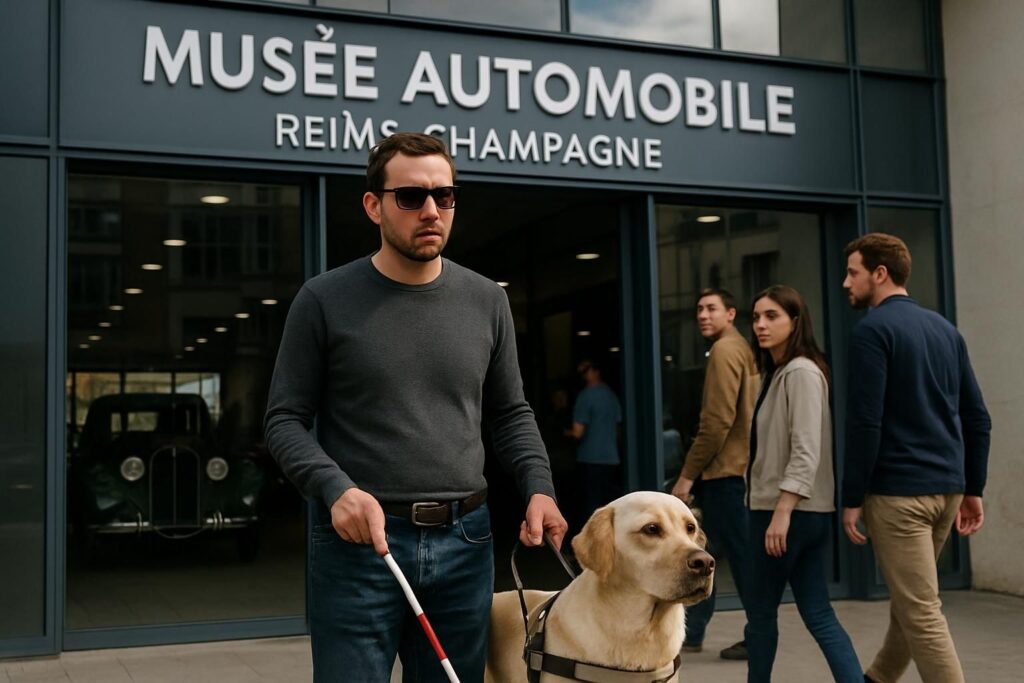
An incident that occurred at the Reims-Champagne Automobile Museum recently shocked the local community and sparked widespread outrage. A visually impaired visitor accompanied by his guide dog was refused access to this public establishment, causing an uproar around issues of accessibility and the rights of people with disabilities. This act raises once again the recurring problem of discrimination still faced by visually impaired individuals in their travel and daily life, despite legislative and societal developments. This refusal of entry, considered a blatant injustice, illustrates the persistence of a lack of awareness and adaptation in certain cultural venues.
At the heart of this episode, the question of the integration of guide dogs, these essential aids to the autonomy of visually impaired people, is once again brought to the forefront. This situation is not limited to a mere individual inconvenience, but refers to a fundamental issue of respect for rights and the fight against exclusion. The incident takes place in a broader context where public establishments must constantly reconcile heritage, public reception, and accessibility requirements. This results in a lively debate on infrastructure management and the need for genuine commitment from managers in the face of inclusion imperatives.
The legal framework surrounding access for guide dogs in public places
In France, the legislation related to the access of guide dogs in establishments open to the public is clear and protective. Since the law of February 11, 2005, for equality of rights and opportunities, places open to the public are required to welcome these assistance animals. This obligation concerns all types of establishments: transport, shops, museums, hotels, restaurants, to guarantee freedom of movement equivalent to that of able-bodied people. Refusing access to a guide dog constitutes discrimination on the grounds of disability, strictly prohibited by law.
However, despite this solid legal framework, refusals by certain establishments persist, often due to lack of information or a poor understanding of the constraints linked to the presence of a guide dog. This bias reveals an increased need for awareness and training of staff, particularly in the cultural sector which welcomes a diverse public. The legal issue also recalls the importance of possible appeals in case of non-compliance with rights, which may include complaints to the Defender of Rights or legal action.
It is essential to emphasize that the guide dog is not a mere pet: it is trained to assist its owner in navigation, avoid obstacles, signal dangers, and intervene in case of emergency. This crucial function fully justifies its free access in all places open to the public. Moreover, refusals of access not only undermine the visually impaired person by depriving them of their autonomy but also show a lack of knowledge about realities related to disability.
To better understand, here are the key points regarding rights related to guide dogs:
- Free access guaranteed by law: no establishment open to the public can refuse entry to a guide dog.
- Obligation to inform: staff must be informed about the rights of disabled people and the importance of guide dogs.
- Sanctions in case of refusal: procedures exist to challenge discrimination, including via the criminal court.
A reminder of these obligations should be systematically integrated into the reception policies of public and private structures.
Human and social consequences of the exclusion of guide dogs in museums and cultural venues
The exclusion of a visually impaired visitor because of their guide dog is not limited to a simple incident but harms dignity and equality. People with disabilities, faced with rejection in cultural spaces, see their access to culture hindered, reinforcing their social isolation. A situation all the more regrettable as it occurs in a museum, a place par excellence for the dissemination of knowledge and sharing of heritage treasures.
The Reims-Champagne Automobile Museum, known for its iconic collections and its tourist appeal, thus finds itself exposed to a controversy that undermines its image. Refusing a guide dog means denying the educational and inclusive importance that such an establishment should promote. Numerous testimonies collected from the visually impaired community underline their frustration facing repeated exclusions, despite institutional advances. This kind of injustice contributes to a feeling of ostracism and questions the real willingness of cultural institutions to fully integrate people with disabilities.
The psychological impact on visually impaired visitors is often profound. Facing refusal means experiencing a form of disabling marginalization, difficult to overcome. This may discourage other people from trying the experience, which is all the more damaging in a society committed to greater equality and respect for differences.
On the social level, the refusal of access to a museum for a person accompanied by their guide dog invites reflection on:
- The level of training of reception teams regarding disability.
- The effective implementation of accessibility policies.
- The responsibility of managers in enforcing human rights.
All these aspects demonstrate that going beyond speeches means investing in concrete actions of adaptation and awareness to avoid any new exclusion.
The challenges of universal accessibility in heritage institutions
Museums and heritage sites are at an important crossroads regarding reception and accessibility. The preservation of collections and the enhancement of heritage require specific conditions, sometimes seen as incompatible with the necessary adaptations for people with disabilities. However, innovative and pragmatic solutions exist to reconcile these objectives.
In the case of visually impaired visitors, the use of guide dogs is a first response to autonomous and secure access. Nevertheless, this should not exclude other accompanying and layout measures. Braille tables, audio guides, adapted mobile applications, or reading aid devices are complementary elements that make a visit fully accessible.
The case of the Reims-Champagne Automobile Museum also raises the question of managing coexistence between site security and inclusive reception. Indeed, the effective integration of a diverse public requires profound reflection on internal protocols, staff training, and institutional communication. The latter must clearly establish that accessibility is not an optional choice but a moral as well as legal obligation.
Some concrete examples show how cultural institutions have successfully met these challenges:
- The Musée d’Orsay in Paris offers tactile visits and adapted tours for the visually impaired.
- The Palace of Versailles has implemented bilingual audio supports with detailed descriptions to assist visually impaired visitors.
- The Louvre provides discovery workshops of its collections, including the active participation of people with visual disabilities.
These actions illustrate that perceived obstacles can be overcome by committed will and appropriate means. It is crucial that the Reims-Champagne Automobile Museum draws inspiration from these examples to renew its approach and avoid past injustices being repeated.
Mechanisms to fight discrimination related to disability: what recourse against exclusions?
Faced with an unjustified refusal of access such as that suffered at the Reims-Champagne Automobile Museum, several actions can be taken to assert the rights of people with disabilities. Victims of discrimination can first rely on official bodies like the Defender of Rights who receives complaints and conducts investigations to sanction discriminatory behaviors.
Justice remains a recourse not to be overlooked. In 2025, several similar cases were brought before the criminal court, strengthening the case law against refusals of access to guide dogs. This legal pressure contributes to raising awareness among managers of establishments and enforcing rules. It is also important to use media coverage to expose these injustices, which reinforces social and political pressure in favor of accessibility.
On a daily basis, to avoid such incidents, associations representing the visually impaired multiply information campaigns, training for reception staff, and support in administrative procedures. This collective vigilance is essential to transform mentalities and ensure a more inclusive society.
Here are the steps to follow in case of refusal of access with a guide dog:
- Immediate reminder of the law: politely inform staff that the refusal is illegal.
- Ask to speak with the manager to attempt a dialogue and resolve the problem on site.
- Collect evidence: photographs, testimonies, or recordings if possible.
- File an official complaint with the competent authorities or the Defender of Rights.
- Seek associative support to obtain advice and legal assistance.
These combined actions strengthen the fight against any form of discrimination and promote lasting change in practices.
The importance of collective commitment for better cultural accessibility in Reims-Champagne
The incident at the Reims-Champagne Automobile Museum highlights the need for unwavering commitment from all local and national actors to guarantee real accessibility to culture. Beyond legal obligations, it is necessary to establish a true culture of inclusion, where every individual, whatever their situation, can feel welcomed and respected.
The Reims region, recognized for its dynamism and exceptional heritage, has resources to drive these changes. The development of collaborative initiatives between cultural institutions, associations of people with disabilities, and local authorities is an essential lever. Moreover, capitalizing on media coverage of the case could accelerate public and political awareness.
It is also relevant to include public awareness efforts in cultural projects to deconstruct prejudices about visually impaired people and their guide dogs. This approach would foster better understanding and increased support for the people concerned. In this context, it should be reminded that inclusive reception benefits society as a whole by improving the quality of services for everyone.
Finally, it should be noted that the issue of accessibility in the cultural field intersects with other local challenges such as improving transport or housing. For example, changes in real estate prices in Champagne also impact the mobility of families affected by disability, underlining the need for a global and integrated approach.
Among possible local action paths:
- Organization of regular training sessions for museum and cultural site staff.
- Implementation of an “Accessibility and Inclusion” label for establishments in the region.
- Development of partnerships with guide dog associations.
- Promotion of cultural events specially adapted for visually impaired people.
- Communication campaigns to raise awareness about visual disability and the importance of guide dogs.
Is a guide dog really allowed in all public places?
Yes, French law requires that all places open to the public welcome guide and assistance dogs, without exception.
What to do in case of refusal of access with a guide dog?
It is advisable to remind the staff of the law, ask to speak with the manager, then file a complaint with the Defender of Rights if necessary.
How can museums improve accessibility for visually impaired visitors?
By adopting adapted tools such as tactile supports, audio tours, staff training, and welcoming guide dogs without restriction.
Are visually impaired people often confronted with exclusions in public places?
Unfortunately, despite the laws, many testimonies show that exclusions persist, indicating an urgent need for education and training.
What is the responsibility of cultural establishments regarding accessibility?
They have the legal obligation to ensure adapted access to all audiences, including people with disabilities accompanied by their guide dog.