
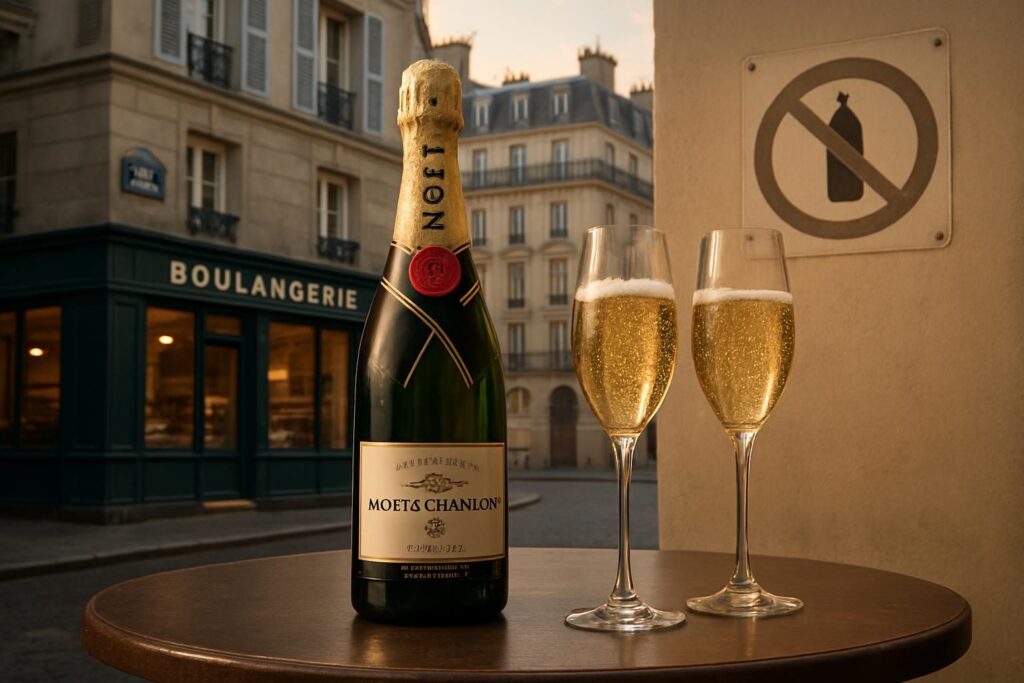
While champagne is an undeniable symbol of the French art of living, a true paradox remains surrounding its presence at one of the world’s biggest sporting events: the World Cup. Indeed, even though the Taittinger house is officially designated as the official champagne of this event, the special cuvée created for the 2026 World Cup will not be allowed to be marketed on national soil. This phenomenon, described by some as a “French paradox,” finds its roots in strict rules governing advertising for alcoholic beverages in France, particularly in the context of sports. An analysis of a conflict between tradition, legislation, and international marketing.
Despite its status as a major player in global competitions for several editions, accompanying FIFA from Brazil to Russia, passing through Qatar, Taittinger is forbidden from promoting its official cuvée in France. The bottle, proudly displaying the colors of the host countries of the 2026 World Cup, will be available in 64 countries, including remote regions such as Uzbekistan. However, it remains unavailable and prohibited from sale in the country where it is produced. This surprising exception is explained by restrictive legislation governing advertising and the links between sport and alcohol, as well as by a strong political will to protect public health.
This situation is all the more puzzling when observing the excitement and enthusiasm aroused by the tournament worldwide, where the bottle is found in VIP areas and hospitality venues, such as the highly publicized “Casa Taittinger” in Mexico City. In France, however, this visibility is not allowed, perfectly illustrating the complexity and contradictions of regulations sometimes considered too rigid by industry players.
Understanding French regulation: the Évin law and its impacts on official sports champagne
The key to this paradox lies in the Évin law, adopted in 1991 to strictly regulate advertising related to alcoholic beverages. This legislation imposes a clear separation between alcohol and sport, considering any direct or indirect promotion as a form of advertising prohibited in this area. This law is often regarded as one of the strictest in the world in terms of advertising restrictions, aiming to protect public health by limiting consumer exposure, especially youths, to images promoting alcohol consumption.
In this respect, the Taittinger house faced these rules as early as 2014 when legal action was initiated by the association Addictions France, denouncing indirect advertising linked to its partnership with the World Cup. The Paris High Court then firmly reminded the imposed limits, resulting in a freeze on advertising campaigns explicitly linking champagne and sporting events in France.
The main point of contention often centers on the FIFA logo affixed to the bottle, considered a promotional tool linking the product to the prestigious tournament. Sponsorship, which remains legal abroad, is thus perceived as prohibited indirect advertising as soon as it is visible on French territory, severely restricting the marketing and communication of this special cuvée in France.
On the other hand, it is important to note that the bottle itself, by its packaging and wrapping, does not constitute a direct advertising medium under the law, which nevertheless allows brands to offer certain products in France without violating regulations. Yet, this subtle legal distinction was not enough to lift the ban around this limited edition, which remains a symbol of global sport but is absent from French shelves.
An international partnership and its ambiguities: Taittinger’s strategy in the face of the French ban
From its first engagement for the World Cup in 2014, the Taittinger house showed a strong desire to associate its image with that of FIFA, beyond mere commercial positioning. This partnership is expressed through the creation of limited editions and exclusive devices designed to emphasize the festive spirit of champagne on a global stage, while respecting, or often enduring, national legal constraints.
For this reason, the special 2026 cuvée was mainly designed for an international audience, with marketing in 64 countries. This effort highlights a goal of conquering external markets, where restrictions are lesser or nonexistent, while complying with the contested ban in France. For example, in Mexico City, Taittinger inaugurated its own “Casa Taittinger,” open 24/7 during the competition, a convivial meeting space in the colors of the World Cup fostering exchanges between amateurs and connoisseurs.
This policy also illustrates a paradoxical functioning specific to contracts concluded with international organizations. Indeed, commitments with FIFA do not fall directly under French law, allowing the brand to capitalize on its official status on the global stage, but the French national ban drastically limits communication and promotion on the champagne’s home territory.
This situation illustrates a significant imbalance between the promotion of the champagne sector at the global level and its very restrictive framework during sporting events in France. It also reflects the evolution of luxury marketing around champagne, which relies on exclusivity and rarity, while having to cope with reinforced legislation. Some experts recall that this paradox amounts to a deliberate political choice aimed at preserving public health considering the health issues related to alcohol.
The economic and cultural consequences of the ban on the French market for official champagne
The decision not to market the 2026 World Cup cuvée from Taittinger in France has repercussions far beyond the simple regulatory framework. For such an emblematic house, being absent from a sporting event of this magnitude on its own territory constitutes a symbolic failure in enhancing the national heritage of champagne.
From an economic point of view, the French market thus sees an exclusive product reserved for export markets, losing the ability to directly benefit from the visibility and momentum linked to this global competition. In terms of brand image, this phenomenon forces the Taittinger house to concentrate its communication and distribution efforts internationally, where legislation is more flexible.
This state of affairs is reminiscent of other tensions observed in the French wine sector, where tradition sometimes clashes head-on with health regulations. Other actors in champagne, precisely in related fields such as wine tourism circuits or organizing festive events, nevertheless try to circumvent these constraints to maintain the product’s attractiveness in France. To learn more about the various contemporary dynamics of champagne, local players as well as those involved in races and champagne events demonstrate the ingenuity used to navigate this complex legal framework.
The economic question is also coupled with a cultural reflection on the image of champagne, which oscillates between a festive product and an alcoholic drink whose promotion must be responsible. This debate highlights the French caution to protect its citizens from advertising messages potentially encouraging excessive consumption, especially during sporting events widely followed by a diverse audience.
The paradox of sport, alcoholic beverages, and advertising communication: between legality and lobbying
At the heart of the French paradox lies a tension between the desire to promote a national product of excellence and that to respect a now well-established legislation. This duality questions how sport and alcohol can or should be associated. Even though international agreements link brands such as Taittinger to global competitions, the Évin law severely limits any message or visible association in France.
This gap is partly explained by preventive health policy, but also by social motivations related to the fight against alcoholism. The legal issue then becomes a battleground between associations like Addictions France, who ensure strict application of the law, and industry players wanting to fully benefit from an international positioning.
Moreover, legal experts point out that the Évin law is regularly contested in its strict interpretation, notably on the question of indirect advertising. Lawyer Benjamin Gourvez mentions sustained contentious pressure which generates a feeling of legal instability for professionals. This climate creates an environment where caution prevails, pushing brands to withdraw from the French market in certain specific segments.
- Strict ban on any direct or indirect advertising linking alcohol and sport in France.
- International partnerships not subject to French law, allowing promotion abroad.
- Gap between the festive role of champagne and its nature as a dangerous alcoholic beverage if misused.
- Maintenance of enhanced vigilance by public health associations.
- Economic impact on marketing and visibility of products in the national market.
In this complex environment, the balance between health protection and commercial freedom remains delicate, leaving the official World Cup champagne in a rather paradoxical position.
Perspectives and debates around regulation: toward a necessary evolution?
As the Évin law soon celebrates its decades, the debate intensifies about its adaptation to the contemporary era. The ban on the official World Cup champagne within national territory clearly illustrates growing tensions between tradition, public health, and globalization.
Many question the relevance of a law often seen as outdated, particularly when international wine and champagne brands must comply with strict regulations at home while having a free hand abroad. Voices are rising to advocate for revision, to allow some degree of communication while maintaining an effective protective framework.
The subject goes beyond the legal framework and fits into a sociocultural context questioning the role of alcoholic beverages in major sporting events, so essential to the international image of the champagne clientele. A European or international harmonization of rules could offer better consistency, reducing this French paradox that hinders national producers.
Meanwhile, it is useful to look at similar cases, such as Asahi beer, official partner of the 2023 Rugby World Cup, which benefits from an international contractual framework ensuring visibility abroad, without being able to fully exploit this advantage in France. This parallel highlights the political and sometimes somewhat arbitrary nature of decisions related to the regulation of alcoholic beverages in sport.
Nonetheless, the champagne sector has remained resilient, relying on other channels of valorization. To deepen the innovative strategies implemented, it is possible to consult recent initiatives and consumption trends via specialized platforms such as celebrity collaborations and champagne brands, or original campaigns around rare and limited cuvées, still outside the French framework regarding the World Cup.
Why is the official World Cup champagne not sold in France?
French regulations, notably the Évin law, impose very strict restrictions on the advertising and promotion of alcoholic beverages in relation to sport, thus banning the marketing in France of this official champagne.
What is the Évin law and how does it impact champagne marketing?
Adopted in 1991, the Évin law severely limits alcohol advertising to protect public health, notably by preventing any direct or indirect association between alcoholic beverages and sporting events.
How does Taittinger market its World Cup cuvée then?
Taittinger distributes this limited edition in many countries internationally, benefiting from more flexible regulations outside France to highlight its partnership with FIFA and reach a global audience.
Are there parallels with other alcoholic beverages?
Yes, for example Asahi beer, partner of the 2023 Rugby World Cup, enjoys a similar status where international promotion is allowed but limited in France due to the same legal constraints.
Will the Évin law be revised to allow better promotion?
Debates are underway to adapt this regulation to contemporary realities, but no major revision has yet been adopted. The challenge remains to balance public health and economic development.