
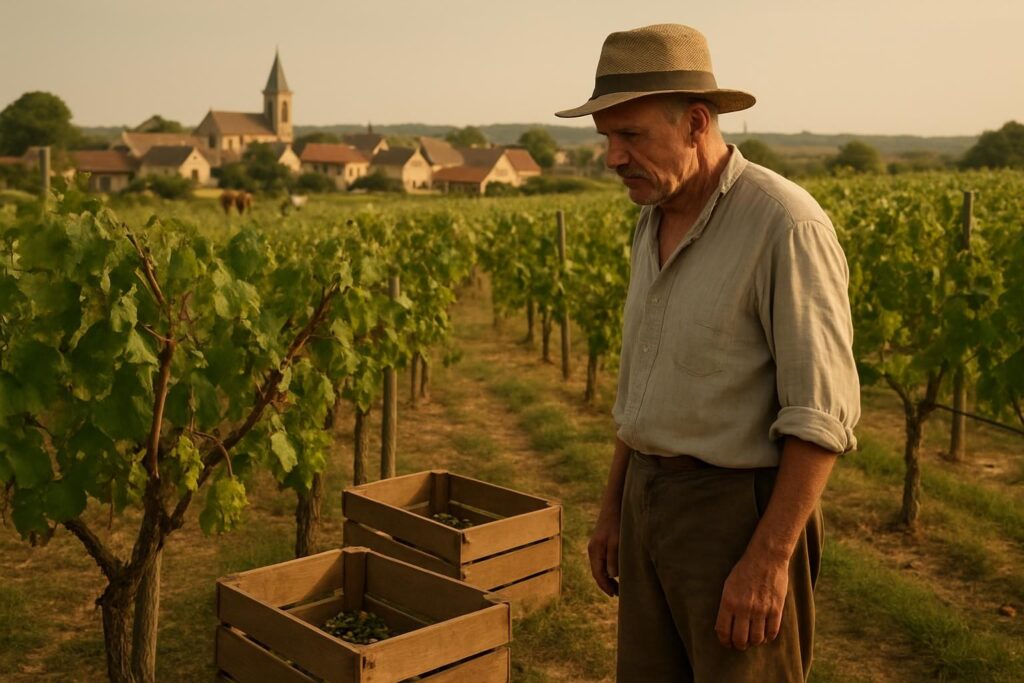
In 2026, the Champagne vineyard is marked by a grape harvest of rare weakness, reaching a historically low level never seen in more than forty years. This exceptional situation results from a combination of unfavorable climatic elements and strategic decisions collectively made by the region’s stakeholders. After several years of declining yields, the pressure on production reflects a clear desire to control quality while finely managing excess stocks, at a time when the market and natural conditions dictate their terms.
The spring of 2026 saw the Champagne vineyard suffer a particularly destructive frost episode, compromising bud development and greatly reducing production potential. This phenomenon, described in several reports as one of the sharpest in twenty-five years, accelerated the early harvest timing and weakened the size of the harvested berries. Added to this were high temperatures over much of the year, causing increased water stress, affecting the vigor of the vines and the ripeness of the grapes.
In response to this situation, producers lowered the authorized yield ceiling to 8,800 kilograms per hectare in 2026, a record threshold in the modern era apart from the disrupted year of 2020. This measure aims to discipline production, reduce excess stocks, and maintain wine quality, facing a global trend of volume tightening. This new harvest plan fits within an economic and environmental sustainability logic, emphasizing the importance for the sector to adapt to climate variations and the global commercial context.
Major climatic impacts on the grape harvest in Champagne in 2026
The 2026 harvest takes place in a particularly difficult climatic context, with direct consequences on the quantity and quality of grapes produced. During spring, the Champagne region was struck by a late frost of exceptional intensity. Unlike early frosts that sometimes affect buds at an initial stage, this episode occurred once the buds were visible, definitively compromising their development. Several experts from the Champagne vineyard warned against this type of hazard, often worsened by recent climatic variations.
The consequences of this spring frost resulted in a significant reduction of usable clusters, depriving winemakers of a large part of their annual potential. The affected area shows disparity according to terroirs, some sectors having been more spared than others, but overall, the volume reduction is clear. The very nature of the berries was altered: the harvested grapes are smaller, concentrated in sugars, thus modifying the expected organoleptic profile in the region.
Added to this difficulty is a prolonged heatwave episode that accelerated the vine cycle, leading to an exceptional precocity of the harvest. Winemakers had to pick their grapes much earlier, often fifteen days to three weeks before traditional dates, a situation rarely observed at such scale. This precocity, while sometimes allowing avoidance of berry degradation from rot or summer weather events, imposes important technical adjustments as well as organizational constraints on the ground. These early harvests in Champagne have been widely documented, underlining the need to adapt harvesting and winemaking methods.
These combined climatic conditions — destructive frost and intense heat — thus contributed to establishing an unprecedented framework for the viticulture campaign. This context forces champagne houses to reassess their strategies, particularly regarding vine management and anticipation of future production cycles. All elements converge toward an increased requirement for resilience in the face of a rapidly changing and unpredictable climate.
Strategic decisions by producers to manage a historically weak Champagne harvest
Faced with this unprecedented situation, the players in the Champagne sector adopted measures aiming to control yield and protect the value of the final product. The commercializable yield ceiling was thus lowered to 8,800 kilograms per hectare, a reduction compared to the 9,000 kilograms authorized in 2025. This decision is part of a collective and concerted approach aimed at balancing produced volumes with market demand, while avoiding dilution of quality.
This reduction in the Champagne harvest quota marks the fourth consecutive year in which the interprofessional organization has chosen to reduce yields, reflecting a strong trend toward strict production control. The objective is to bring stocks back to a more sustainable level, avoiding market saturation that could durably affect prices and the image of champagnes. Moreover, this collective approach seeks to strengthen recognition of a premium wine, made from rigorously selected grapes.
Beyond the numbers, Champagne houses and winemakers are adapting their cultivation techniques. They implement practices that improve vine health against climatic stresses, optimize pruning periods, and refine the selection of clusters at harvest. For example, some estates favor more severe thinning to concentrate the plant’s vigor on fewer grapes, thus ensuring better ripeness and juice quality.
Logistical challenges linked to this reduced and early harvest are not negligible. The mobilized teams must organize rapidly, with refined coordination between different sites, to prevent loss of raw materials. This synchronization gains importance in a context where every kilogram of grapes counts and where the precocity of the harvest imposes a sustained pace.
The year 2026 thus proves to be a turning point, where rigor in volume management becomes a lever of competitiveness, also relying on qualitative demands. It illustrates the adaptability of the Champagne vineyard in a complex environment and opens the way for reflection on the future of viticultural practices facing global climate change.
Analysis of the qualitative characteristics of the 2026 harvest in Champagne
Although the harvest is historically low in volume, the quality of the grapes presents a notable singularity. The small size of the berries, a direct corollary of frost and stress conditions, is accompanied by an increased concentration of sugars and aromas. This profoundly modifies the nature of the must and requires cellar adjustments to master the final balance of wines.
The high sugar contents observed would ultimately outline champagnes with a richer and more expressive profile, potentially amplifying aromatic complexity. However, this situation requires winemakers to double their attention on fermentation management to avoid excess alcohol or gustatory imbalances. Technical choices such as rigorous control of fermentation temperatures or the adapted use of yeasts become crucial to fully leverage the intrinsic qualities of the grape.
It is also important to emphasize that this sugar concentration is accompanied by a good level of acidity, an essential element to preserve the characteristic freshness of champagnes. This harmony between sugar and acidity, although fragile, is key to typical expression and sought gustatory balance.
At the same time, maturity variations imposed by the early harvest forced some houses to diversify their blends or resort to controlled oenological adjustments. This flexibility optimizes terroir expression while respecting the constraints linked to the exceptional conditions of 2026.
Professionals finally note a notable intensification of aromatic particularities linked to terroirs, reinforcing the typicality and distinctive character of the champagnes produced this year. This unique situation constitutes a fertile ground for reflection on the future, opening perspectives on the qualitative evolution and styles of Champagne wine in the era of climate change.
Economic consequences and market outlook for Champagne facing the reduced harvest
The context of this 2026 harvest must also be considered from an economic perspective. A lower production directly impacts market availability, which can exert upward pressure on prices, especially in a sector where quality is a key variable for product valuation. The adjustment of the yield ceiling to 8,800 kilograms per hectare thus corresponds to a desire to maintain a profitable balance, avoiding a price collapse due to an oversupply.
Stock management in Champagne, which still amounts to several tens of millions of bottles according to recent data, is an essential factor. Reducing the harvest allows these volumes to decrease over time, avoiding costs related to excessive storage and preserving the financial resources of the houses. This strategy proves crucial to durably protect profitability.
The global Champagne market is also subject to tensions related to fluctuating demand, consumption variations, and evolving consumer preferences. In this context, the voluntary limitation of wine volumes produced promotes product valorization and helps preserve Champagne’s reputation for excellence. Some producers see opportunities to strengthen export, while others focus on increased communication around the exceptional quality of the 2026 harvest.
The challenges remain nonetheless complex. The harvest tension mentioned by professionals highlights the need to balance scarcity induced by the climatic phenomenon with the expectations of distributors and consumers. The supply chain, from vine to glass, will need to demonstrate agility in the coming months. The adaptability of stakeholders will partly determine the successful management of the economic consequences of this constrained harvest.
Here are the main economic consequences of this historically low harvest :
- Probable price increase due to reduced market supply.
- Stock reduction by storing fewer reserves and promoting wine turnover.
- Increased pressure on operations to optimize every stage of viticultural production.
- Communication efforts to highlight the exceptional quality of champagnes from this harvest.
- Export market adaptation to balance scarcity with international needs.
Innovations and technical adaptations to face the 2026 harvest challenges in Champagne
The exceptional conditions encountered in 2026 have triggered a notable acceleration of technical innovations in the Champagne vineyard. Professionals show greater attention to parcel management methods, favoring solutions that enhance vine resistance and optimize water resource use. This helps limit damage related to extreme frost episodes and water stresses while promoting local specificities.
Among the explored avenues are :
- Increased use of precision viticulture, with the use of drones, sensors, and targeted analyses to better understand the microclimate of each parcel.
- More respectful cultivation practices, such as controlled cover cropping and limiting aggressive mechanical interventions, to preserve biodiversity and soil health.
- Innovative varietal selection, notably through research on clones better adapted to climate change, capable of producing more resistant and harmonious grapes.
- Winemaking adjustments incorporating more flexibility, to better exploit the unique characteristics of grapes from this harvest.
- Development of early warning systems to anticipate frost episodes and limit their effects through targeted intervention techniques.
Champagne wine companies also invest in training their teams to disseminate these new practices more quickly. They rely on a joint effort involving researchers, oenologists, and technicians to strengthen the overall resilience of the terroir. This collective effort opens encouraging prospects to ensure the vineyard’s sustainability in the face of climatic hazards and market demands.
Why is the Champagne harvest so low in 2026?
The 2026 harvest is particularly low due to a destructive late frost and an important early harvest caused by the year’s high temperatures, which affect the vigor of the grapes.
What measures have been taken to manage this low yield?
Producers lowered the authorized yield ceiling to 8,800 kilograms per hectare, a significant reduction to balance production, reduce stocks, and preserve quality.
How is the quality of the grape impacted in 2026?
Grapes are smaller with a high concentration of sugars, creating a richer wine profile but requiring technical adjustments in winemaking to maintain balance.
What are the economic impacts of this low harvest?
This reduced production leads to a likely increase in prices, a decrease in stocks, and requires market adaptation, especially for exports.
What innovations have been implemented to face climatic challenges?
Innovations include precision viticulture, varietal selection, sustainable cultivation practices, and early warning systems to anticipate climatic risks.