
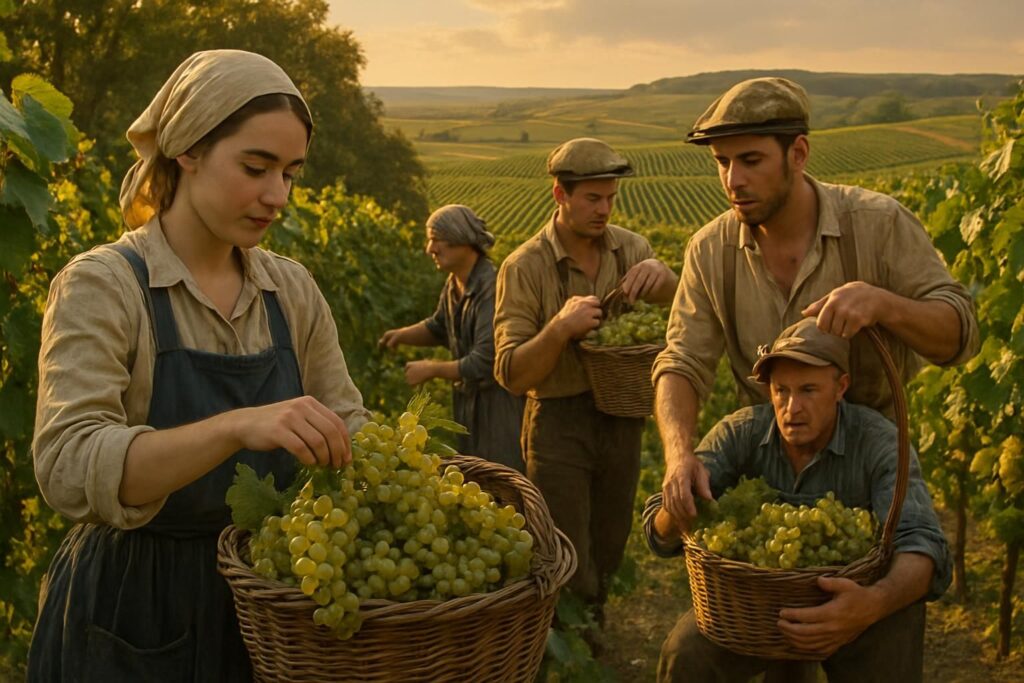
The 2026 harvest in Champagne marks a significant milestone in the region’s viticultural history. Never before had the harvests experienced such precocity, nor such intense grape ripeness, thereby imposing a new paradigm on all actors in the Champagne vineyard. From early August, the first signs of maturity prompted producers to face an extraordinary climatic context with persistent heat and a notable advancement of the growing season. This vintage disrupts established forecasts and invites a rethinking of the balances between quality, yield, and terroir expression.
Faced with these unprecedented conditions, Champagne viticulture had to mobilize all its resources to seize the precise moment when the harvest would offer optimal potential, contrasting with the usual traditional maturity classifications. Furthermore, economic issues intertwine closely with these agricultural questions: with a significant increase in potential alcohol content and sugar in the grapes, the quality of future cuvées could radically evolve, as could the markets, influenced by growing global demand, notably for export. This exceptional harvest thus raises the question of the sustainability of the Champagne model in the face of climate disruptions.
Exceptional Harvest Precocity: Adaptability Imposed by the Climate
The 2026 harvest in Champagne began with unprecedented precocity. The official start of the harvest on August 21 reflects a shift of nearly twelve days compared to the average of the last ten years, a historic record confirmed by regional agricultural services. This phenomenon is primarily explained by high temperatures combined with sunny days that accelerated grape maturation, especially in the vineyard’s most exposed areas. This exceptional weather context results from several climatic factors: recurring heatwaves since spring, episodes of marked drought, and water stress, which transformed the vine’s vegetative cycle.
Precocity forces estates to drastically adjust their organization. Staff mobilization intensifies to ensure a rapid harvest at optimal maturity, notably avoiding berry degradation due to risks of rot or overripening. Cultural practices have also evolved to accompany this acceleration, refining ripening observatories such as frequent sugar and acidity bath checks. Moreover, this advancement of the calendar comes with major logistical repercussions: harvesting equipment must be quickly deployed, and coordination among the various regional actors becomes essential to face this unprecedented challenge.
This extreme situation highlights the importance of agile viticulture, capable of adapting to a terroir in profound change. These very early harvests disrupt traditional benchmarks, especially concerning classifications based on historical criteria, and impose constant dialogue between winegrowers, oenologists, and institutions. More than ever, Champagne must combine know-how and innovation to preserve the remarkable quality that makes it renowned while integrating new climatic constraints.
Quality and Ripeness of Grapes: A Delicate Balance to Preserve
The exceptional nature of the 2026 harvest is marked by an unusually high maturity level in the Champagne vineyard. The grapes show sugar levels potentially exceeding 13% alcohol, a threshold rarely reached in this region and which challenges the standards of the cuvées. This phenomenon, resulting from a long period of drought alternating with storm episodes, deeply modifies the biochemical composition of the berries. The sugar concentration often comes with a drop in acidity, affecting the aromatic profile, texture, and aging capacity of upcoming champagnes.
Maintaining a harmonious balance between sugar and acidity is essential to guarantee the quality of Champagne wines, both for classic cuvées and exceptional vintages. The fine management of the harvest thus relies on continuous observation of physicochemical parameters and complex technical decisions during sorting in the parcels. For example, some bunches, particularly exposed or overripened, can be excluded to preserve the freshness of the blends.
The relationship between grape maturity and terroir is also strengthened, demonstrating that each parcel, its soils, and microclimates influence the final quality. This exceptional harvest offers producers the opportunity to further enhance their crus by exploiting the diversity of Champagne terroirs to create unique cuvées. The oenological stakes are therefore significant: blending development, fermentation control, and dosage evaluation must be adapted to this new grape profile, which is more concentrated and powerful.
For more information on the challenges posed by the nature of the grapes at this time, see the article Harvest 2026: why some champagnes could exceed 13% alcohol.
Vineyard Organization and Logistics: Facing a Major Collective Challenge
The advanced schedule of this harvest demands flawless coordination throughout the Champagne logistics chain. Operators, cooperatives, merchants, and seasonal workers had to organize themselves to meet the speed of execution required by the 2026 harvest. On some estates, it was necessary to strengthen the harvest teams by hiring additional seasonal workers to avoid delaying picking, which could have compromised grape quality.
Simultaneously, the technical preparation of harvesting tools and pressing installations was anticipated at an unprecedented scale. The speed of operations must not come at the expense of the delicacy required in handling grapes, a guarantee of optimal quality for future cuvées. This challenge mobilizes both human skills and agronomic and technological innovations.
Furthermore, the management of grape flows to pressing centers requires smooth and efficient logistics, ensuring fruit freshness and limiting deterioration risks. Some vineyards have even developed collaborative management systems for teams and equipment to optimize transfers between parcels and reduce downtime.
The issue is thus twofold: combining speed and excellence to meet global demand while preserving the identity unique to each Champagne terroir. These constraints highlight the adaptability of a vineyard driven by centuries-old tradition and a constant will to innovate.
Economic Impact and Market Outlook for Champagne
In a demanding market context, the 2026 harvest in Champagne takes place while global demand continues to grow moderately, with a clear dynamism internationally. Shipments as of June 2026 show a slight increase, around 1.2%, mainly driven by export sales, while domestic consumption remains more cautious. This situation places producers in the position of managing their volumes without sacrificing quality to remain competitive in a sector where the premium image plays a key role.
The harvest volume is a central parameter in this equation. While exceptional withdrawals require regulatory adjustments, Champagne must balance quantity and excellence to avoid overproduction that would dilute the brand. In 2026, yield adjustments followed this logic to harmonize supply and demand, taking into account the specificities of this exceptional vintage.
The impressive quality of the grapes should enhance the value of the cuvées, but the increased sugar concentration requires consideration of dosage and the styles of champagnes offered. This shift could stimulate new oenological experiments and, by extension, influence the usual classifications and evaluation criteria of Champagne wines.
This harvest thus offers an opportunity for the Champagne vineyard to consolidate its positioning in a sophisticated market, whose technical and gustatory expectations evolve alongside environmental conditions. More information on the economic implications of the harvest is available in this specialized article.
New Expectations in Viticulture and Terroir Adaptations
This exceptional harvest also reveals the profound transformations affecting Champagne viticulture. To adapt to the unprecedented climatic context and the harvest’s particularities, vineyard actors are implementing innovative strategies. Yield adjustments, rootstock choices, irrigation management, and new cultural practices aim to protect the vine while preserving the uniqueness of the terroirs. The plant thus lies at the heart of a renewed reflection on its resilience to climate change.
Vine management techniques diversify to maintain quality, for example through more thorough work on leaf shading to modulate berry temperature or soil maintenance to improve water retention. Close collaboration between oenologists and winegrowers becomes more crucial to support these evolutions and ensure that each step, from the vine to the bottle, perfectly reflects the expression of the terroir.
These adaptations also influence the nature of future cuvées, with a tendency to highlight aromatic depth and freshness despite grape overripeness. Moreover, water stress management and drought episodes, key issues of this harvest, encourage rethinking practices to strengthen vineyard sustainability.
- Revision of pruning schedules and green pruning to adapt to precocity
- Development of real-time grape maturity monitoring methods
- Introduction of sustainable viticulture practices to limit water consumption
- Increased use of drought- and disease-resistant rootstocks
- Strengthened collaboration between estates to share know-how and technical innovations
These perspectives are part of a collective effort aimed at maintaining Champagne’s excellence and global recognition in a context of constant change. The Champagne terroir remains a central and adaptable actor, capable of meeting challenges and producing cuvées that continue to surprise with their personality and quality.
Why is the 2026 harvest considered an exceptional vintage?
The 2026 harvest stands out due to historic precocity, exceptionally high grape maturity levels, and increased mobilization of winegrowers to preserve quality in an unprecedented climatic context.
What impact will an alcohol content above 13% have on champagnes?
An alcohol content above 13% alters the taste profile of champagnes, enhancing their aromatic power and body, while requiring adjustments in dosage to maintain balance and freshness.
How does harvest precocity affect logistics?
Precocity imposes accelerated organization, reinforced recruitment of harvesters, and optimal coordination of grape flows to ensure quality up to processing.
What are the main viticulture adaptations in response to climate change?
Winegrowers adjust their practices by modifying pruning calendars, prioritizing adapted rootstocks, improving water management, and developing precise maturity monitoring methods.
Does the 2026 harvest call traditional classifications into question?
This exceptional harvest questions the relevance of historical classifications based on old criteria, inviting a reassessment of quality standards in light of new climatic and technical realities.