
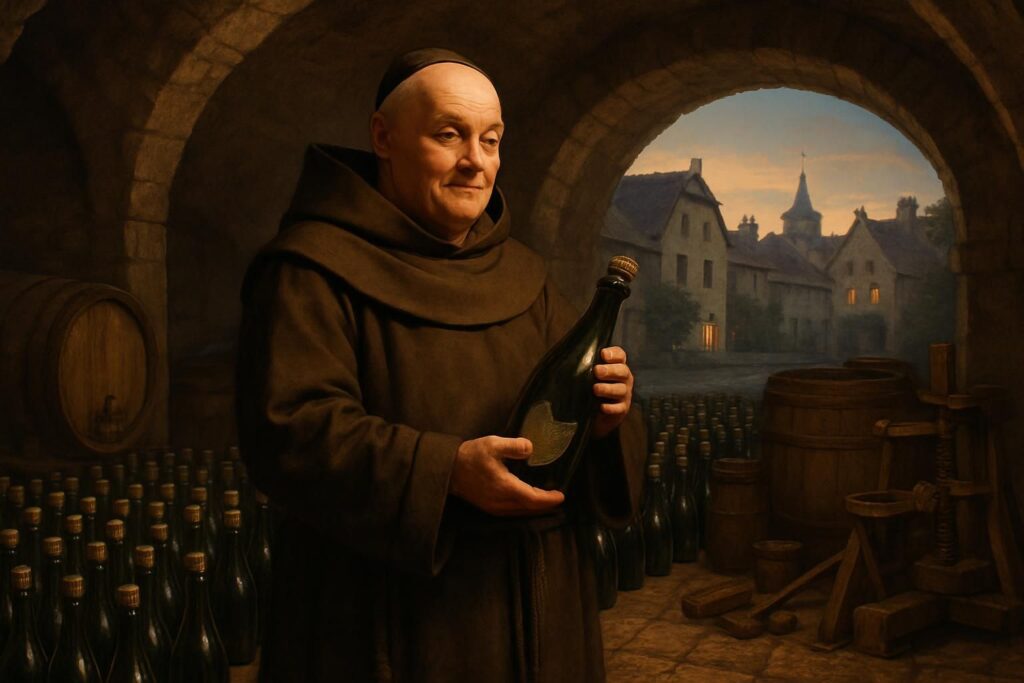
Dom Pérignon is an iconic figure in the world of winemaking and more specifically in Champagne. Born in Sainte-Ménehould in the heart of the Argonne, Pierre Pérignon, who would become a Benedictine monk, profoundly marked the history of Champagne in the 17th century. This region, renowned for its clay and calcareous-siliceous soils, gives its grapes a unique character, essential in the making of the cuvées that still today are exported worldwide. From his entry into the Saint-Pierre Abbey of Hautvillers, Dom Pérignon set himself the mission of mastering winemaking and constantly improving the quality of sparkling wine that would soon be called champagne.
The story of Dom Pérignon goes beyond the simple feat of secondary fermentation. He embodies a technical but also commercial revolution, laying the foundations for the modern trade of heady wines. His name evokes effervescence, the precision of blends, and the search for the best gustatory balance that characterize the legendary cuvée bearing his name. The inventor originally from Sainte-Ménehould managed to combine monastic know-how and innovation to enhance a beverage that today embodies French luxury and tradition. This article invites you to discover the multiple facets of this visionary Benedictine monk, his winemaking techniques as well as the lasting impact he had on the production of champagne.
Dom Pierre Pérignon: the Benedictine monk from Sainte-Ménehould who marked the history of Champagne
Pierre Pérignon was born in December 1638 in the small town of Sainte-Ménehould. This village located on the border of Champagne was then a land of winemaking traditions with modest but dynamic operations. Very early, young Pierre decided on a religious life and joined the Saint-Pierre Abbey of Hautvillers in 1668 as cellarer — responsible for managing the material goods of the abbey, which at that time revolved heavily around wine production.
His role was not limited to simple administration; he invested himself in winemaking at a time when the process was still embryonic and uncertain. The wine was then especially fragile, notably because of the secondary fermentation, often uncontrolled, which caused bottles to explode or spoiled the quality of the final product. Dom Pérignon gradually introduced revolutionary techniques, such as the meticulous blending of grape varieties from different plots, which ensured a remarkable harmony and consistency in the cuvée.
The vineyards of Sainte-Ménehould and its surroundings, mainly consisting of Pinot Noir, Pinot Meunier but also Chardonnay, were thus elevated thanks to his expertise. His secret also lay in the rigorous selection of grapes and control of fermentation. Moreover, he worked to improve the bottles, using stronger containers, a necessity to contain the natural effervescence of the wine.
Besides these innovations, Dom Pérignon bequeathed to posterity a philosophy based on quality, terroir, and the permanence of taste that still distinguish champagne today, and particularly the house bearing his name. To learn more about the region and its markets, read this article on the flea markets in Champagne-Ardenne, a place where the history of champagne is deeply rooted in the local terroir.
The technical innovations that shaped modern champagne
The Champagne method, also called the “traditional method,” was still in development in the 17th century. Dom Pérignon was not the inventor of secondary fermentation, but he perfected this process by improving bottle sealing and mastering yeast selection. His goal was to produce a sparkling wine, fine and elegant, capable of competing with the best European wines.
He is often credited with the invention of champagne, but historically, it is rather his role as a visionary and craftsman of quality that shaped the reputation of the sparkling wine. He is also responsible for standardizing the wine, realizing that blending different grape varieties was the key to achieving consistency, especially between Pinot Noir, Pinot Meunier and Chardonnay, the three emblematic grapes of the region.
The thickened glass bottle he popularized is an essential element in preserving effervescence. At a time when the glass industry was still fledgling, he imposed strict standards that major houses would later follow. His work was also noted in cultural practices, with particular care given to harvesting, de-stemming, and pressing grapes to limit defects.
Beyond techniques, Dom Pérignon established a true culture around champagne, which became a prestigious product. In this respect, his contribution is also commercial and marketing-related, laying the foundations of trade that would sustain the region for several centuries.
The role of Sainte-Ménehould in the birth and rise of champagne
The commune of Sainte-Ménehould is often forgotten in the history of champagne, yet this is where it all began for Dom Pérignon. This Champagne cradle has a pivotal importance in the history of local viticulture. In the 17th century, this Norman region situated on the edges of Champagne provided the grapes mainly destined for the Abbey of Hautvillers. Its cool climate and clay-limestone soils offer ideal conditions for the grape varieties that give champagnes their finesse and complexity.
This locality did not merely give birth to a Benedictine monk. It fostered the emergence of an innovative spirit, combined with a monastic tradition of rigor and observation. The story of Dom Pérignon is set within a specific geo-historical framework where every detail matters to reveal the wine’s identity. In 2026, several oenological studies support this correlation between terroir and quality. The precision of the techniques implemented by Dom Pérignon in Sainte-Ménehould partly explains the global reputation of the product.
The region is today vibrant and offers visitors or enthusiasts of the drink a rich journey between history and tasting. Several major events, such as the 2028 Tour de France in Reims-Champagne, will highlight this unique heritage in 2026. This further emphasizes the undeniable link between terroir and haute gastronomy, where a bottle of champagne accompanies key moments in sport and culture.
Champagne winemakers continue to honor the memory of Dom Pérignon through artisanal expertise and a perpetual quest for excellence. Sainte-Ménehould therefore stands as the starting point of an effervescence much greater than the simple bubble of the drink.
Dom Pérignon and winemaking: an indelible technical heritage
The winemaking practiced by Dom Pérignon went far beyond the standards of his time. His rigorous methods laid the foundation for what would become the modern Champagne method. He thus applied meticulous care to every step, from grape selection to rigorous bottling. This subtlety in the management of yeasts and secondary fermentation is the foundation of the mastered effervescence.
Beyond production itself, he introduced several innovations such as juice clarification and the use of reinforced bottles. This led to a drastic reduction in the risk of bottle explosion, a major problem in sparkling wine production at that time. Thanks to these technical advances, he was the first to guarantee uniform cuvées of remarkable quality year after year.
Dom Pérignon also codified good practices around the harvest, emphasizing the optimal timing of picking to preserve aromatic quality. These precise adjustments now allow the production of prestigious cuvées meeting very high standards of excellence. His philosophy rests on the subtle marriage between tradition and innovation, a duality that continues to fuel the creation of new bottles in the champagne universe.
In 2026, Dom Pérignon’s work serves as a reference for cellar masters and oenologists, highlighting how relevant his technical contributions remain. To better understand these ancestral and contemporary know-how, the site Prix Champagne Secrets offers a fine and detailed analysis of prices and modern techniques inherited from ancient traditions.
The Dom Pérignon cuvée: synthesis of history and perfection
The house of Dom Pérignon, today synonymous with prestige and refinement, provides a perfect example of how historical heritage can be translated into tangible quality. Each vintage is crafted to respect the founding principles that the Benedictine monk had established, with an obsession for perfect balance between freshness, aromas, and texture.
The Dom Pérignon cuvée embodies the know-how and consummate art of winemaking in the Champagne region. The blends combine the best of several terroirs, integrating the emblematic grape varieties carefully selected over centuries. This meticulous choice of ingredients contributes to creating an exceptional bottle, driven by a fine and persistent effervescence that makes champagne world-renowned.
For example, regular tastings allow adjusting the proportion of grape varieties and ageing on the lees, enhancing the depth and complexity of the cuvées. This rigorous process is a direct homage to the tradition initiated by Dom Pérignon, but enriched by modern oenological science.
The house of Dom Pérignon also represents a cultural showcase of French expertise. Commercial success, a philosophy of excellence, and the ability to innovate while respecting heritage lie at the heart of its international fame. To learn more about the complexity of prices and selections, also consult this article on the secrets of sugar in champagne.
Who was Dom Pérignon and why is he important for champagne?
Dom Pérignon was a Benedictine monk born in Sainte-Ménehould in the 17th century, who revolutionized sparkling wine production by establishing techniques to improve the quality and consistency of champagne.
Did Dom Pérignon really invent champagne?
While legend attributes the invention of champagne to him, it is rather a significant improvement of the winemaking process and the traditional Champagne method, making sparkling wine more stable and refined.
What influence does Sainte-Ménehould have on champagne production?
Sainte-Ménehould is the birthplace of Dom Pérignon and a key wine region whose terroir contributes to the aromatic richness and characteristic finesse of champagnes from its vineyards.
What does the Champagne method developed by Dom Pérignon consist of?
This method mainly involves mastering a second fermentation in the bottle to produce fine effervescence, while ensuring the wine’s quality and stability through precise blending and the use of reinforced bottles.
How does the Dom Pérignon cuvée respect the monk’s heritage?
Each cuvée is crafted with great attention to terroir, grape selection, and blending of varieties, thus perpetuating the quest for excellence initiated by Dom Pérignon.