
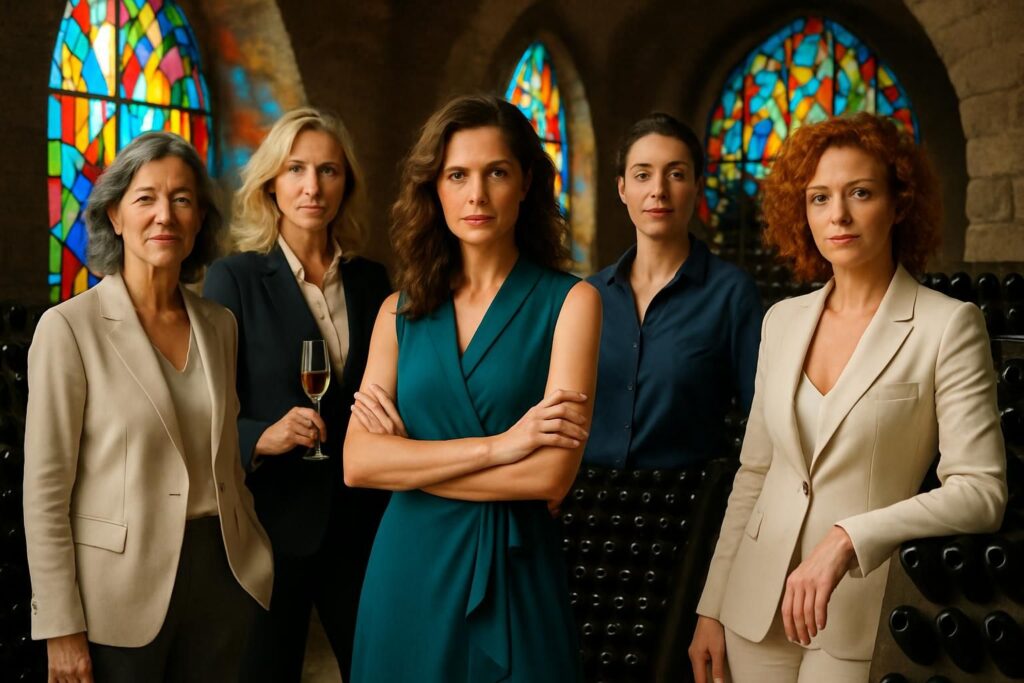
The Champagne region, world-renowned for its rolling landscapes and prestigious vineyards, is also a territory where women shine brightly in professions often considered masculine. From the cool, mysterious depths of the Canard-Duchêne cellars to the multicolored brilliance of the stained glass windows at the Simon-Marq workshop, five exceptional women perfectly illustrate the richness of a heritage combining tradition, innovation, and passion. Their journeys bear witness to meticulous know-how and a precious legacy perpetuated in 2026, between oenology, craft, and artistic creation. This journey invites you to discover the Champagne region from a new perspective, where every gesture and every light work to enhance a unique terroir.
From the vineyard to watchmaking, passing through gastronomy and glass arts, these female figures embody the vitality of a region that continues to reinvent itself. The Canard-Duchêne House, for example, embodies this alliance between history and modernity, now led by a visionary female cellar master. At the same time, in Reims, the Simon-Marq workshop, a respected master of stained glass, shines under the direction of a woman whose creativity sublimates light through glass. Contemporary initiatives like Maison Alcée add another dimension to this dynamic, blending watchmaking crafts with sensory experience. Driven by strong ambitions, these women are redefining not only their professions but also the image of Champagne and its territory.
The Cellar Master of Canard-Duchêne: Mastery and Sensitivity at the Heart of Champagne
Since 1868, the Canard-Duchêne House has shone at the heart of Champagne, with its vast 6 km-long cellars where nearly 10 million bottles rest. Today, the continuity of this heritage rests on the shoulders of an exceptional woman, Cynthia Fossier, who embodies the tenth generation of cellar master and the first woman to hold this position since Léonie Duchêne, co-founder of the House. Arriving in 2019 as deputy, she became cellar master in 2025, bringing a fresh perspective to this prestigious house while respecting the fundamentals of taste: fruitiness, balance, and freshness.
Cynthia Fossier initially oriented herself towards the sciences before specializing in oenology, obtaining her National Diploma in Oenology. Her path demonstrates rigor and passion, an essential duo in a field where precision and intuition combine. Coming from the Ardennes, she earned her place in a profession long dominated by prejudices, notably the superstition that women would disrupt fermentation. Today, this cliché is outdated, and the field is gradually opening up to women thanks to profiles like hers.
In her daily work, Cynthia works closely with a mainly female team, perpetuating meticulous know-how in blending 3 to 4 million bottles from 30 hectares of vineyards primarily cultivating pinot noir, pinot meunier, and chardonnay. Each year, the development of blends is a true art, combining experimentation and respect for traditions. Her sensitivity brings a feminine touch, a softness and delicacy that transform the blend into a real gustatory alchemy.
For enthusiasts wishing to dive into the world of cellars, Champagne cellar tours offer an authentic encounter with this living heritage. The Canard-Duchêne house, in particular, offers a unique immersion into its universe, where each bottle carries the memory of precise gestures and a long family history. Thanks to Cynthia Fossier and her team, Champagne maintains its brilliance while firmly anchoring itself in the present.
Maison Alcée: Artisan Watchmaking Serving Time and Champagne Heritage
In the heart of Reims, Maison Alcée embodies a rare and precious artisanal know-how: that of watchmaking. Founded in 2020 by Alcée Montfort, an engineer by training and passionate about manual creation, this company offers an innovative approach to transmitting the craft. Faced with the real fear of the disappearance of certain traditional crafts, Alcée chose to revive watchmaking by allowing customers themselves to assemble their own timepiece.
This bold project relies on a meticulous selection of 233 components, provided with all the necessary tools in an assembly kit. This concept, at the crossroads of scientific technique and the philosophy of time, invites a true dialogue between the artisan and the user. Through this exercise, each participant immerses themselves in a dual experience: technical and contemplative, simultaneously materializing a strong link with a tradition of transmission.
This initiative is particularly captivating because it renews the very approach to local artisanal heritage. In an industry still very much masculine, Alcée Montfort stands out by her boldness and her will to keep alive a high-precision and excellence craftsmanship. Her international career, which took her from major watchmaking houses like Hermès, Cartier, Richemont, then Tag Heuer, to creating her own brand, explains her technical mastery and keen sense of quality.
By reconciling innovation and tradition, Maison Alcée thus creates an unexpected bridge with Champagne, just like the women shaping these worlds. The notion of “time” that drives this watchmaking echoes that which marks the vinification and aging of precious bubbles. Through this synergy, craftsmanship asserts itself as a fundamental element of Champagne heritage.
The Stained Glass Windows of the Simon-Marq Workshop: Light and Creativity Serving Champagne Heritage
Light plays a fundamental role in the Champagne region, both in the sun-drenched vineyards and in the masterful art of stained glass. Located in the Sacred Heart Church in Reims, now desacralized, the Simon-Marq workshop has been a major actor of glass heritage since 1640. It is notably in this workshop that workshop leader Anne-Catherine Perreau practices her art with impressive mastery.
Since her adolescence, this passionate artist has been fascinated by the play of light on stained glass, those colored fragments revealing moving images depending on the time of day and the sun’s intensity. Her path, marked by studies in applied arts and specializations in glass painting, led her to work internationally, especially in York, England, before returning to Champagne to join this high place of glass art.
Her role, beyond technical mastery, is that of a conductor. Anne-Catherine coordinates artisans and collaborates with contemporary artists like Claire Tabouret, notably participating in the creation of new stained glass windows of Notre-Dame Cathedral in Paris, a project closely followed by heritage observers. In Reims, her creations combine ancestral know-how and modernity, bringing new light to monuments rich with history.
In this profession where fragile glass becomes artwork, each stained glass window reflects not only technical mastery but also a vibrant cultural testimony. The Simon-Marq workshop, with Anne-Catherine at its head, thus imposes itself as an essential pillar in the valorization of Champagne heritage. This mastery of light, fragile yet powerful, resonates with that found through Champagne – two arts that enhance the essence of a remarkable terroir.
The art of stained glass and that of Champagne thus converge in this region where light continually inspires, revealing a history as rich as it is alive. For those wishing to explore further this unique link between craftsmanship and heritage, several art and life experiences can be discovered in the Champagne region, such as those offered in cultural and artistic tours around Champagne.
Star Chef Nawal Rezagui: Mixed Flavors and Gastronomic Innovation in Champagne
Beyond wine, the Champagne region also stands out for its culinary boldness carried by women who reinvent gastronomy. Nawal Rezagui, chef of the restaurant L’Alcôve in Vinay, is a perfect example. Originally from Morocco and initially trained in industrial computing, she chose a career change that led her to the pinnacle of gastronomic excellence: receiving a Michelin star at the beginning of 2026.
Her path, marked by diverse experiences in France, Germany, and also on the island of Yeu, forges a cuisine where Moroccan, French, and Japanese influences blend. Through rigorous mastery and unfailing creativity, she offers dishes that tell stories, such as her iodine flan with caviar and smoked haddock or her quail seared with binchotan accompanied by beetroot and rich jus. Each bite is a journey blending tradition and boldness.
This mixing of genres and techniques not only values the richness of the Champagne terroir but also fits into a broader approach of transmission and cultural blending. Her success is all the more remarkable as she becomes the first Moroccan female starred chef. Nawal Rezagui proves that talent, combined with an innovative vision, can transform codes without denying culinary heritage.
At the heart of this gastronomic dynamism, recognition by the Michelin Guide reflects a will to promote a demanding and sensitive culinary art. The region’s chefs, and especially the women, contribute thus to making Champagne shine beyond its viticultural borders, inviting discovery of subtle pairings between dishes and bubbles. This alliance is a true multisensory celebration of Champagne.
Artistic and Cultural Transmission at ESAD Reims with Céline Savoye
In the world of design and artistic creation, Céline Savoye plays an essential role in Champagne. Director of the Higher School of Art and Design (ESAD) of Reims, she embodies the desire to transmit and evolve the regional creative heritage. Trained in design at the Beaux-Arts of Saint-Étienne, she worked in several prestigious cultural institutions, including the Palace of Versailles, before dedicating herself to this establishment which educates 255 students in culinary design and other artistic disciplines in 2026.
Her vision goes beyond simple technical training: it involves questioning the relationship to the living, notably through culinary design, a specialty where food is approached as a raw material, on the same level as wood or metal. Students thus learn to conceive projects combining aesthetics, functionality, and meaning, preparing a new generation of artists capable of seizing contemporary challenges.
Since September 2023, Céline Savoye has been leading a major project: the construction of new premises for ESAD. This infrastructure, more open to the city, aims to improve student living conditions while strengthening interactions between the school and its environment. Her commitment underlines the importance of education as a vector of continuity and innovation in a heritage both alive and renewed.
The school, through the quality of its teaching and its openness, thus participates in strengthening the attractiveness of the Champagne region, at the crossroads of art, design, culture, and of course, the inspiring light unique to this territory. It also illustrates a facet of Champagne often overlooked, beyond the bubbles and cellars.
- Elegance and know-how: Women embody Champagne excellence through crafts and expertise professions.
- Transmission and innovation: Each path testifies to the will to perpetuate a heritage while offering a contemporary vision.
- Living heritage: Gestures and creations reveal a multifaceted Champagne, between centuries-old tradition and assumed modernity.
- Alliance of the arts: From stained glass to watchmaking, through gastronomy, light and time are common themes.
- Female engagement: These exemplary paths highlight the rise of women in historically masculine fields.
What is the importance of women in the history of Champagne?
Historically, women have always played an essential role, often in the shadows, notably with figures like Léonie Duchêne, founder of Canard-Duchêne. Today, they are increasingly asserting themselves in the professions of oenology, craftsmanship, and creation linked to Champagne.
How does Maison Canard-Duchêne perpetuate its heritage today?
Thanks to a cellar master like Cynthia Fossier, who combines scientific rigor and artistic sensitivity, the house maintains its classic blends while adding a personal and innovative touch.
What characteristics define the stained glass windows of the Simon-Marq workshop?
The workshop stands out by ancestral mastery of glass and collaborations with contemporary artists, producing works combining tradition and modernity, under the direction of Anne-Catherine Perreau.
What is the concept of Maison Alcée?
Maison Alcée offers its clients the opportunity to make their own watch from a complete kit with parts and tools, allowing an educational and artistic immersion into the watchmaking craft.
What role does ESAD Reims play in enhancing Champagne heritage?
ESAD trains young creators in culinary and artistic design, thus preparing an innovative generation that values the living and food in a new light, contributing to the cultural dynamism of the region.