
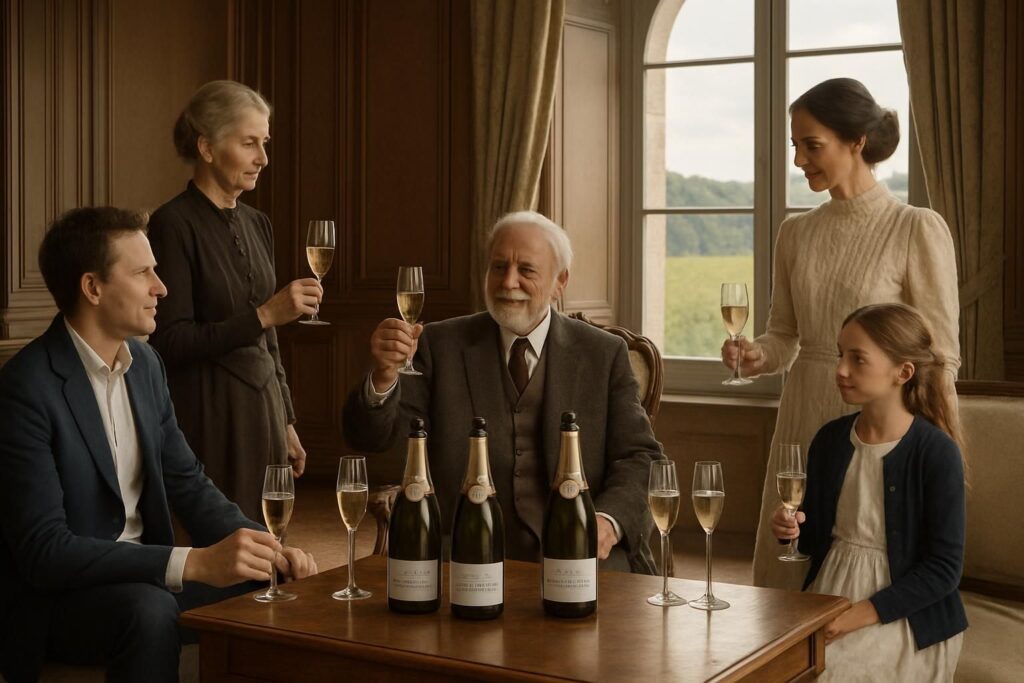
In the heart of Champagne, Château Roederer stands as a true witness to an age-old tradition where time intertwines with family excellence. For over two centuries, this iconic house has rigorously preserved the heritage of its founders while innovating to perfect the art of champagne. More than just a winemaking house, Roederer embodies a family story rich with challenges and victories, where each generation has left its mark on the prestige of French luxury. This rare continuity in the sparkling world of champagne demonstrates a perfect balance between respect for heritage and the boldness necessary for the evolution of tastes.
Château Roederer, renowned for its ability to span decades without ever losing elegance or finesse, stands out for its precise and meticulous blending, the result of expertise handed down from hand to hand. Each bottle thus tells a story where nature, the vine, and man unite to offer an exceptional moment. This independent family house manages to combine tradition and modernity, thereby revealing the soul of a champagne that defies time and generations.
The family heritage at the heart of Château Roederer’s continuity
The remarkable longevity of the Roederer house is primarily due to the strength of its family heritage. Since its founding in 1776 in Reims, the family has maintained control and independence of the house, which is now a rarity in the world of great champagne houses. This transmission from generation to generation has never been limited to mere ownership; it involves a deep commitment in vineyard management, strategic choices, and above all, the quality of the final product.
The notion of heritage is not limited to historical capital or a famous name. It embodies the constant desire to refine know-how, adopt the most relevant technologies without denaturing ancestral methods. For example, the Roederer house was a pioneer in mastering malolactic fermentations in stainless steel tanks to preserve the aromatic purity of its grapes while ensuring optimal preservation.
Each generation has contributed its stone to the building, with major figures like Frédéric Rouzaud, the current CEO, who always strives to maintain the balance between tradition and the demand for modernity. In 2026, this balance is more than ever an asset in the face of rising quality requirements and climate challenges. Maintaining the family identity remains the foundation on which Roederer’s worldwide reputation rests.
Ultimately, the family history of Château Roederer is not a fixed narrative but continuously adapts to define a unique style, combining tradition and innovation, a luxury accessible through its excellence and not through prestige alone.
An exceptional terroir and mastered viticulture for exemplary winemaking
For Château Roederer, the quality of the champagne fundamentally relies on the excellence of its terroir and the rigorous mastery of viticulture. Located in the top crus of the Champagne region, the house benefits from a privileged environment that gives the grapes an irreplaceable complexity and purity of character.
The unique nature of the soil, composed mainly of chalk, offers excellent drainage capacity and a natural regulation of humidity, which promotes the vigor and health of the vines over the long term. Viticultural practices are thus precisely adapted to the terroir’s particularities and environmental imperatives, notably in relation to the major issue represented by drought in recent harvests.
A list of mastered techniques during winemaking at Roederer:
- Manual selective sorting of clusters to keep only grapes of impeccable quality.
- Winemaking in temperature-controlled stainless steel tanks to perfectly control fermentations.
- Use of barrels for certain rare vintages, providing complexity and aromatic richness.
- Blends prepared with rigor, allowing the unique balance between traditional grape varieties: pinot noir, chardonnay, and pinot meunier, to be expressed.
- Long aging on lees, sometimes extended beyond ten years, to ensure exceptional finesse and elegance.
This expertise is reflected in champagnes of great consistency and finesse, bearing a recognizable aromatic signature above all others. Moreover, this exemplary winemaking is part of a sustainable approach, a guarantee of continuity and respect towards future generations.
Blending and elegance: the art of champagne at Maison Roederer
At Château Roederer, the art of blending is at the heart of the creative process, regarded as a refined and demanding discipline where precision is paramount. The house skillfully plays with the precise proportions of different grape varieties to create cuvées that meet both traditional expectations and the desires for modernity of enthusiasts.
The most famous cuvée, Cristal, perfectly embodies this quest for balance. It is made from a meticulous blend of pinot noir and chardonnay from vineyards selected with the utmost rigor. The result is a champagne of rare elegance, capable of aging for decades without ever losing its liveliness or refinement.
The key criteria guiding the blenders at Roederer are:
- Freshness and aromatic purity, guaranteeing the signature champagne style.
- Intensity and depth of fruity and floral aromas.
- Balance between power and finesse on the palate.
- A long and silky finish, a vector of pleasure and gustatory complexity.
Thanks to this methodology, the house succeeds in unveiling a champagne that speaks to the heart of connoisseurs as well as novices, an essential classic filled with history and symbols. This mastery is a key element that makes Château Roederer an essential player in the realm of accessible luxury champagne.
Successive generations: guardians of timeless expertise
When talking about Château Roederer, it is impossible not to highlight the importance of the men and women who have succeeded one another to perpetuate this living heritage. Intergenerational transmission is not just a transfer of responsibilities; it also guarantees the preservation of specific expertise, allied with the passion that animates each family member.
The challenges faced by each generation have forged a house resolutely turned towards the future while respecting a tradition where time has no hold. Whether it is managing viticultural crises, global market evolutions, or climate challenges, each descendant has adapted practices and strategic directions without ever betraying the essence of Château Roederer.
For example, since 1975, the leadership taken by the Rouzaud family has injected new energy, amplifying the house’s international presence while strengthening attachment to the terroirs. The family has diversified its interests in other prestigious houses, but the heart of the champagne heritage remains intact. These actions reflect a family vision that aims to place champagne in the long term and rarity.
This fidelity to the family principle is one of the reasons why, even today, Château Roederer continues to shine as a beacon in the world of champagne, between authenticity and prestige.
The family monopoly facing modern challenges of viticulture and luxury
In a sector where mergers and acquisitions are commonplace, the fact that Château Roederer remains an independent family business is a notable exception. This imposes a doubled responsibility and requirement, which the house fully assumes to affirm its positioning in a highly competitive champagne market.
Luxury is no longer solely synonymous with opulence but today aims to offer a rich, authentic, and sustainable experience. Château Roederer has thus developed an integrated approach, combining technical innovation and biodiversity preservation. This includes commitment to viticultural practices adapted to climate change, responsible resource management, and the enhancement of the Champagne territory.
Notable actions of the house in 2026 include:
- Deployment of precise digital monitoring systems to optimize yields while respecting quality.
- Transition to organic and biodynamic viticulture on several parcels.
- Investments in local cooperations to stimulate the regional economy around champagne.
- Strengthening of ecological and eco-designed packaging practices.
- Opening of new exclusive experiences at the Château to showcase this art of wine and luxury.
This strategy aims to make Roederer champagne shine as an emblem of luxury, accessible yet demanding, defying time and inviting a tasting always richer and more conscious.
What is the importance of the terroir for the quality of Roederer champagne?
The terroir, notably the chalky soils of the best champagne crus, provides the grapes with exceptional quality, balancing freshness and aromatic complexity, essential to the finesse of Roederer champagnes.
How does Maison Roederer manage to reconcile tradition and modernity?
A cascade of know-how passed down from generation to generation, integration of cutting-edge technologies in winemaking, and strict respect for ancestral methods allow Roederer to combine tradition and innovation.
What are Château Roederer’s sustainable commitments?
Roederer adopts organic and biodynamic viticultural practices, optimizes its yields thanks to digital technology, and engages in biodiversity protection and responsible resource management.
What makes the Cristal cuvée so unique?
The precise blend of pinot noir and chardonnay from carefully selected vineyards, prolonged aging, and rigorous winemaking give Cristal remarkable elegance, finesse, and longevity.
Why does Château Roederer remain a family business?
The Rouzaud family ensures the house’s independence and perpetuates rigorous management centered on quality, thus guaranteeing exceptional continuity in champagne production.