
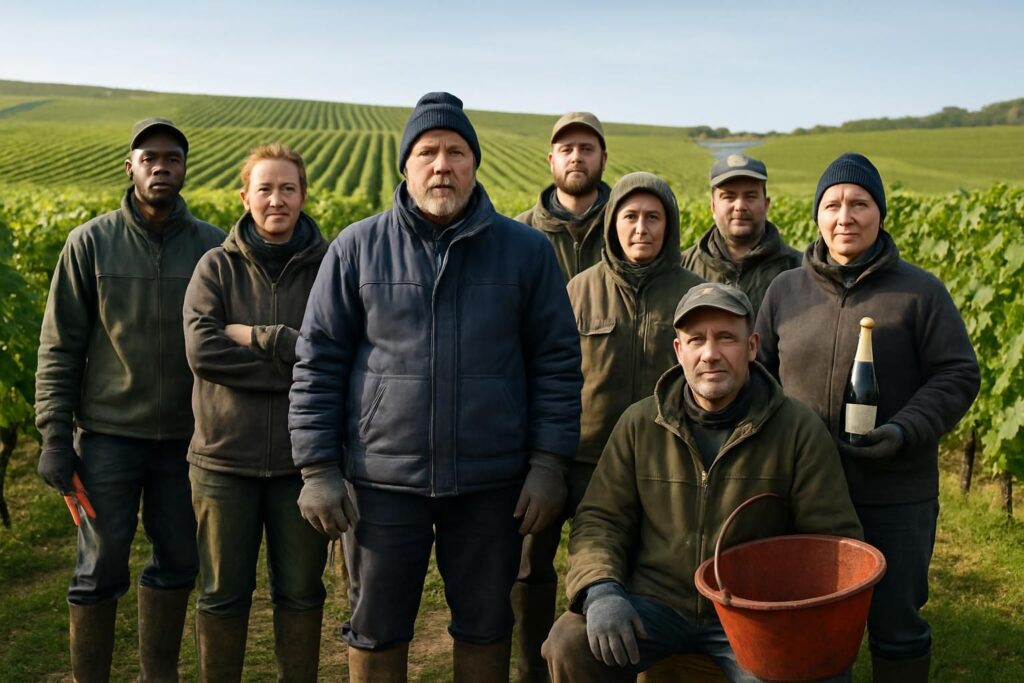
The champagne sector, a flagship of the French wine economy, is currently at the heart of an intense debate regarding the collective agreement that governs labor relations. Employees, known for vigorously defending their social gains, have refocused national attention on one of the pillars of their rights. In response to a recent decision by the Union des Maisons de Champagne (UMC) aiming not to renew an important provision starting in 2027, industry professionals are expressing their concerns. This measure would notably affect the calculation of year-end bonuses, thus significantly changing compensation conditions in an already strained economic context.
Several hundred protesters gathered in Épernay in the Marne, in a movement organized by the CGT Champagne, demonstrating how much the protest mobilizes employees. They denounce an attempt to weaken the collective agreement, which they consider one of the most advantageous in France, even Europe. This mobilization reflects a clear desire to preserve fragile balance between work, recognition, and social protections in an industry renowned worldwide.
While the UMC justifies its decision by a desire to avoid legal disputes and offers compensation through other measures, the unions remain defensive, calling for stronger actions if management positions persist. The debate raises fundamental issues about the role of collective agreements in protecting employee rights in a sector as prestigious as the champagne sector in France.
The Specifics of the Collective Agreement in the Champagne Sector in France and Europe
The collective agreement covering the champagne sector represents a unique regulatory framework, combining wine-growing tradition and contemporary work requirements. It is indeed an essential component that governs relations between employers and employees at the heart of the delimited Champagne wine-growing area, a very specific geographical zone where production is protected. This agreement has precise rules concerning salaries, bonuses, working time, but also specific benefits not found in other similar sectors in France or across Europe.
For several years, salary scales in this sector have been among the highest in France. The year-end bonus system, including a thirteenth month often increased and a fourteenth month sometimes paid under conditions, reflects the desire to recognize the difficulty and seasonality of wine-making work. The consideration of certain absences, such as back-to-school and blood donation, has so far helped soften the calculation of these bonuses, ensuring a stable and appreciated income by employees.
Beyond salaries, this collective agreement also includes innovative measures to promote professional equality between women and men, in order to comply with French legal obligations while fostering sustainable social cohesion. Social protections are often more favorable than the minimum provided by the labor code, making the sector an example sometimes inspiring other European wine-growing regions.
In summary, this agreement is frequently cited as “one of the best in France, even Europe,” not only for its salary conditions but also for the quality of social dialogue established between employees and employers. It guarantees a fair balance between the rights and obligations of both parties, which helps maintain the reputation and quality of French champagne on international markets.
The Stakes of the Union des Maisons de Champagne’s Decision for Employees
The recent measure announced by the UMC, aiming not to renew the consideration of certain absences in the calculation of year-end bonuses starting in 2027, is causing strong dissatisfaction among employees. This provision, in effect since 2019, excluded deductions for absences related to back-to-school and blood donation, thus offering a form of additional protection on compensation. The announced suppression implies that these absences will now be penalized in the calculation, which may lead to a significant reduction of bonuses, without modification of the basic salary.
To understand the real impact, it is crucial to note that these bonuses often represent an essential complement to employees’ income, especially in a sector where seasonality and physical constraints are marked, notably during the grape harvest. For example, a worker in charge of the harvest or a wine production operator could see their bonus reduced based on absences that are nonetheless legitimate and recognized in other sectors.
The UMC justifies this decision by the need to preserve the spirit of the collective agreement, specifying that strikes, which reduce productivity, should not be exempt from their financial impact on additional compensation. Certain legal actions brought by employees who used this provision to assert their rights during strike periods reportedly contributed to this reversal, according to the employer organization.
In response, employees, notably supported by CGT Champagne, denounce what they see as a maneuver aiming to restrict the right to strike by making it financially more costly. Philippe Cothenet, deputy general secretary of the CGT, calls this initiative a “direct attack on the social status of employees,” emphasizing that this measure could gradually weaken the entire collective agreement, already one of the most protective nationwide.
Consequences on Mobilization and Social Climate
The UMC’s decision has caused a notable rise in tension within champagne companies. Nearly 650 employees, according to organizers, gathered in Épernay to demonstrate their opposition. The union representation rallies its members around well-rooted demands, notably a 3% salary increase proposed as a response to the rise in the minimum wage and living costs. The threat of new strikes, especially during the sensitive harvest period, testifies to employees’ determination to preserve their working conditions and acquired rights.
At the same time, CFDT Champagne has also called for a strike, highlighting the scale of concerns across unions in the sector. This rare union unity in certain contexts reflects the perceived seriousness of the situation. The mobilization takes place within a legitimate framework, emphasizing the defense of work as a central value, while the champagne sector remains one of the flagships of the French economy.
Compensatory Measures Proposed by the Union des Maisons de Champagne
In response to the protests, the Union des Maisons de Champagne expresses its intention to maintain dialogue with unions to find common ground. To compensate for the end of the exemption on absences related to back-to-school and blood donation in the calculation of bonuses, the UMC has suggested introducing or strengthening other measures, such as exceptional bonuses or benefits in kind, likely to mitigate the financial impact for employees.
This approach highlights an attempt to reconcile rigorous management requirements and recognition of social needs. For example, it is envisaged that targeted bonuses may be paid based on seniority, work performed during the harvest periods, or compliance with other performance criteria. A meeting is scheduled soon, offering an opportunity for employee representatives to negotiate these compensatory measures.
However, unions remain cautious, emphasizing the need to avoid degradation of fundamental rights in the name of economic flexibility. They primarily call for structural salary increases rather than one-off or temporary measures, reflecting a model of sustainable protection. In this perspective, the proposal for a 3% salary increase, corresponding to inflation and social demands, illustrates a key issue.
This situation reflects a classic debate between economic demands of companies and employees’ aspirations for fair recognition of their work. It also exemplifies a case where the defense of a specific collective agreement has symbolic and practical importance within the socio-economic dynamics of the Champagne region.
Why the Defense of This Collective Agreement Is Essential for the Champagne Sector
The collective agreement of the champagne sector is not limited to a simple administrative framework. It constitutes a true social foundation for thousands of employees who contribute to the worldwide reputation of champagne. By effectively protecting workers’ rights, this agreement helps guarantee a stable, attractive, and fair framework essential for the pursuit of quality and excellence in production.
Among its advantages, one can highlight:
- High salary scales: often higher than those observed in other French or European wine-growing regions, they ensure a comfortable standard of living.
- Motivating bonuses: an indispensable complement to the base salary, they reward commitment and versatility.
- Protective social measures: additional leave, professional equality, protection against discrimination, harmonious conditions.
- Active social dialogue: employee and union participation in negotiations ensures constant adaptability of the working environment.
- Recognition of hardship: work in the vineyards and cellars requires particular attention, taken into account in the agreement.
These elements partly explain why the champagne collective agreement is considered one of the best in France, even Europe. Its preservation is a strategic issue not only for employees but also for the entire sector, as it contributes to the sustainability of a prestigious industry, emblematic of French know-how.
Moreover, the domino effect could be significant in other wine-growing branches. A partial or total questioning of the advantages of this agreement, even under the guise of punctual reforms, could inspire legislative or conventional changes endangering the social gains of wine-working workers throughout France.
Furthermore, as the sector faces increasing challenges related to climatic conditions, international competition, and changing consumer expectations, it is crucial to maintain a peaceful social climate. Respecting employee rights and valuing work in the Champagne region are therefore essential to preserve champagne’s excellence globally. This context highlights how active defense of the collective agreement remains paramount.
Future Prospects for Employees in the Champagne Sector
Faced with current challenges, the future of employees in the champagne sector largely depends on decisions to be made in upcoming negotiations. The planned meetings between the UMC and unions open a crucial phase to shape the working framework for coming years, both in protecting rights and adapting to economic needs.
Demands such as salary increases to offset the rise in minimum wage and living costs show a clear desire for fairness. More broadly, the sustainability of a solid collective agreement appears essential to attract and retain talent crucial to the champagne production chain.
The recent mobilization, which resulted in demonstrations and a threatened strike schedule during the harvest, reflects strong employee commitment to defending their rights. This fight goes beyond mere economic benefits: it is part of a broader demand around respect for work in an exceptional sector.
Finally, it is useful to emphasize the European dimension of the sector, with massive exports requiring a stable and motivated workforce. Any weakening of social conditions could undermine champagne’s competitiveness internationally, which professionals wish to avoid. Recent events highlight a tension between modernizing rules and preserving social heritage.
For more information on the dynamism and news of this unique region, consult specialized resources such as the must-visit addresses for tourism in Champagne or local initiatives that shine a spotlight on this industry. This allows full understanding of the importance of a collective agreement that protects both the interests of employees and those of the entire Champagne wine sector.
What is a collective agreement in the champagne sector?
It is a specific agreement framing the working conditions, remuneration, and social protection of employees working in companies linked to the production and commercialization of champagne, mainly in the delimited Champagne region.
Why is the champagne collective agreement considered among the best in France?
It offers advantageous salary scales, generous bonuses, solid social protections, and an active social dialogue, which clearly distinguishes it from agreements in other sectors in France and even Europe.
What are the effects of the suppression of certain absences in the calculation of bonuses?
The suppression contributes to reducing the amount of bonuses for absences not counted as actual working time, including justified absences such as back-to-school or blood donation, which directly impacts employees’ additional remuneration.
How do employees react to the changes proposed by the UMC?
Employees, supported by their unions such as CGT and CFDT, express strong disagreement, organizing mobilizations and threatening strikes to defend their rights and demand salary improvements.
What are the stakes for the future of the champagne sector?
Maintaining a protective collective agreement is essential to ensure social stability, attract talent, preserve production quality, and defend champagne’s competitiveness on international markets.