
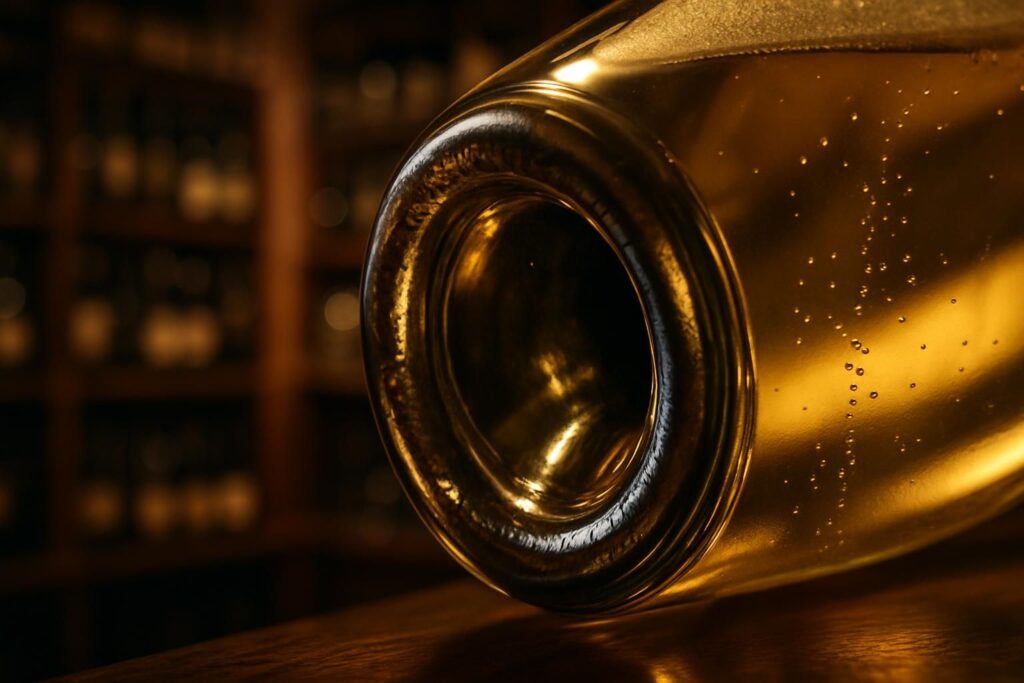
Each bottle of champagne reveals a surprising detail as soon as it is turned over: a deep hollow at the bottom, resembling a small inverted crater. This feature, often perceived as a simple aesthetic choice or a whim of the glassmaker, actually hides a crucial manufacturing secret. This hollow, which professionals call the “punt” or “kick-up,” is the result of a subtle balance between art and physics, as it plays an essential role in the bottle’s resistance to the internal pressure generated by the natural effervescence of champagne. This mystery, long ignored, now sheds light on the complex interaction between design, safety, and functionality in the bottling of sparkling wines, a know-how that historic houses continue to perfect to offer stability and elegance.
Beyond the visual aspect, this indentation conceals major technical issues, particularly in pressure management. Indeed, a bottle of champagne withstands an exceptional constraint: generally around 6 bars, almost double the pressure of a car tire. This constant pressure exerts considerable force on the glass walls, especially at the bottom. Without this concave shape, the bottle would risk deforming or worse, exploding under the effect of carbon dioxide gases. The primary function of the hollow is therefore to distribute this pressure evenly, making the bottle safer and stronger during storage and transport.
This feature is also found in other sparkling beverages, such as cava or prosecco, and even some highly carbonated craft beers. This common point reveals the perpetual union between aesthetics and technique in the design of pressure containers. There are also practical uses, little known to the general public, related to this detail, notably in the art of sommelier service. The following sections will analyze these multiple functions that go far beyond appearance, enriching the understanding of this mysterious hollow, which we might soon look at with a completely new perspective.
Why the hollow at the bottom of champagne bottles is an ingenious response to internal pressure
The presence of a hollow at the bottom of champagne bottles is not only an aesthetic decision but a crucial technical necessity related to the physical characteristics of effervescence. Champagne, with its double mousse formation, generates inside the bottle an average pressure of 6 bars, which equates to an intense force exerted on the entire container. This internal pressure could easily weaken a classic flat-bottom bottle, which is more prone to deform or suddenly give way.
The hollow, also called the “punt,” redistributes this pressure uniformly thanks to its concave shape. More than just a visual effect, it is an adaptation inspired by ancient architectural principles such as the arch or the dome. These rounded forms are historically known for supporting heavy loads by diverting pressure onto curved surfaces rather than concentrating it at a weak point. Thus, the bottle becomes a structure capable of resisting temperature variations, shocks during transport, or handling during service.
For example, imagine a bottle placed in a cellar subject to small temperature changes. The internal pressure can temporarily increase, putting the glass to a severe test. Without a hollow, the flat bottom would bulge outward, creating a risk of bursting. This indentation is therefore an invisible shield which, even in 2026, remains essential to the design of champagne bottles, such as those mentioned in recent trends of the 2025 production. This technical feature demonstrates that container design is less a matter of appearance than a necessity of safety and durability.
The engineering behind this hollow also influences the perceived quality of the champagne. A well-defined and symmetrical hollow bottom is often associated with a solid bottle, crafted to withstand multiple manipulations, while bottoms that are too flat or poorly formed suggest a more economical packaging, intended for immediate consumption. Thus, the “punt,” although invisible at first sight, becomes a quality marker linked to contractual rigor in glass manufacturing, an aspect meticulously evaluated in the great champagne estates.
The little-known role of the hollow in sommelier service and functional design
Beyond its mechanical function, the hollow at the bottom of champagne bottles is an indispensable tool in the art of service. Professional sommeliers use it to improve grip and control during pouring, a technique sometimes called the “sommelier grip.” By inserting the thumb into this hollow, they stabilize the bottle while allowing fluid one-handed handling. This trick enables maintaining balance even with bottles weighing several kilos and to modulate the pouring angle precisely, thus limiting the risks of overflow or loss of bubbles.
This serving technique, still taught in French hospitality schools in 2026, highlights the interconnection between functional design and professionalism. A bottle whose bottom is perfectly hollowed not only facilitates service but also enhances safety during handling, particularly during high-end tastings where maintaining the wine and its effervescence is crucial.
Moreover, this hollow is also a symbol of authenticity and tradition in the world of champagne. Since its origins, it embodies the rigor and artisanal know-how that champagne houses strive to preserve. This aesthetic detail has endured through the ages, establishing itself not only for its practical virtues but as an identification marker. By contrast, classic soft drink bottles, like sodas, have a bottom that is little or not hollowed, illustrating less compromise between functionality and manufacturing cost.
The added value of the hollow also extends to its visual impact during presentation. During a tasting, the deep and elegant aspect of the bottom subtly illuminates the bottle on the table, reinforcing the prestigious image and the perception of effervescence. This harmonious union between form and function perfectly characterizes the accessible luxury and technical sophistication of champagne.
International comparison: the hollow bottom, a universal design for sparkling wines
While the hollow at the bottom of champagne bottles is well known in France, it is actually a universal feature for all carbonated beverages subjected to similar pressures. Spanish cava and Italian prosecco, cousins of champagne by their mousse formation method, also adopt this hollow bottom for the same technical reasons. This uniformity reflects a common understanding of the physics applied to bottling across different terroirs and know-how.
Beyond wines made from traditional vinification, some highly carbonated craft beers, notably in the United States and Belgium, have been adopting this approach for several decades. For example, Belgian Trappist beers, famous for their natural effervescence, now use bottles with bottoms almost rivaling that of champagne. This phenomenon shows a progressive adaptation of manufacturing methods and increased appreciation of technical principles of strength in packaging.
On the other hand, for still wines, that is, non-sparkling, the bottom remains almost always flat, the internal pressure being almost zero. This clearly illustrates that this detail does not serve a decorative purpose, but an indispensable physical function to maintain the integrity of the glass against the constraints of effervescence.
It is interesting to note that this characteristic also influences logistical and commercial choices. In 2026, historic champagne houses continue to invest in extremely strict controls concerning the glass thickness around the punt, ensuring optimal stability during transport and worldwide shipments of their crus. Every detail of the design is thus thought out to meet the high safety and presentation requirements of today.
Manufacturing and quality control: the precision behind every champagne bottle with a hollow bottom
The manufacture of bottles with a hollow bottom requires particular expertise and rigorous control orchestrated by glassmakers and champagne houses. The glass thickness around the “punt” is a critical parameter as it must ensure both robustness and lightness. Too thin, the bottom risks giving way under pressure; too thick, it unnecessarily weighs down the bottle and raises production costs.
During the manufacturing process, each bottle goes through several control stages where symmetry, hollowness uniformity, and glass quality are checked. These technical criteria are essential to guarantee that each container withstands the pressure generated by the wine’s effervescence. It is also a point analyzed during quality audits, notably in pioneering structures such as the major houses mentioned in the sector with continuous innovations in security matters.
Moreover, the finesse of this design is inseparable from tradition. The artisan’s gesture, passed down from generation to generation, remains the guarantor of a perfectly functional bottle. Paradoxically, this technical element is an aesthetic signature: the hollow bottom is also a symbol of prestige for connoisseurs. It reflects a constant pursuit of excellence and the mastery of physical constraints often invisible at first glance.
While this touch may seem anecdotal to some consumers, it truly embodies the successful marriage of science, art, and passion that defines the world of champagne today. Thus, the famous hollow at the bottom of the bottle is much more than a simple visual detail: it is a manufacturing feat, a guarantee of safety, and a mark of quality in every sparkling flute.
The essential reasons why the hollow shape of champagne bottles is both aesthetic and functional
The hollow bottom of champagne bottles concentrates several unique advantages that make it an essential element for both professionals and amateurs. This subtle combination of functionality and aesthetics can be summarized as follows:
- Increased resistance to pressure: The hollow distributes internal forces, preventing the risk of bursting under effervescence pressure.
- Optimized stability and grip: It facilitates handling, especially during service, thanks to the sommelier’s grip.
- Quality marker: A deep and well-formed hollow reflects rigorous manufacturing and a robust bottle.
- Visual impact: The hollow enhances the elegant silhouette of the bottle and highlights its presentation in cellars or tastings.
- Worldwide technical uniformity: Adopted by many sparkling wines and effervescent beverages, this design combines tradition and modernity in packaging.
More than just a visible detail only when the bottle is inverted, this stylized hollow is a true technical secret that contributes to the longevity and beauty of champagne. It embodies, in 2026 as it has for centuries, the inseparable marriage between ingenuity, know-how, and excellence. Thus, at every opening, enthusiasts enjoy not only a refined beverage but also the fruit of traditional innovation.
Why do champagne bottles have a hollow at the bottom?
The hollow at the bottom of champagne bottles serves to distribute the strong internal pressure produced by effervescence evenly, ensuring the bottle’s resistance and safety.
Does this hollow have a use for champagne service?
Yes, sommeliers use this hollow to stabilize the bottle during pouring, thus facilitating grip and control of the flow with one hand.
Do other drinks use this type of hollow bottom?
Yes, cava, prosecco, as well as some highly carbonated craft beers adopt bottles with similar hollow bottoms for the same pressure and safety reasons.
Does a hollow bottom mean the bottle is of better quality?
Generally, a deep and well-centered hollow reflects careful manufacturing and a more robust bottle, a sign of quality in production.