
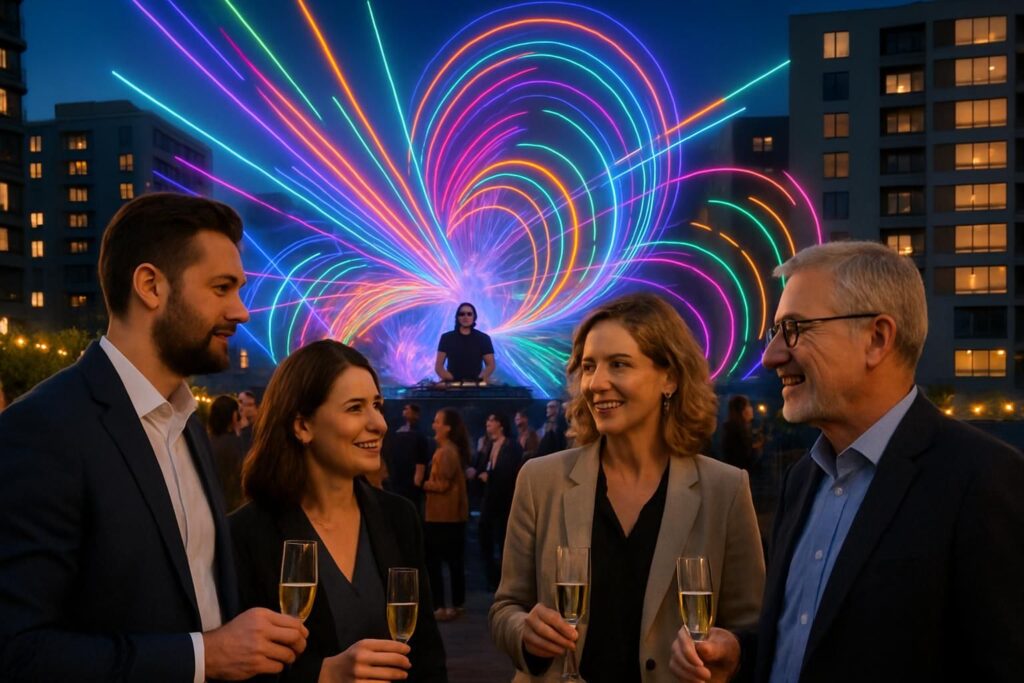
In a context where urban management and ecological transition are becoming priority issues, the Champagne region adapts its local policies to meet current challenges. Elected officials have recently implemented a tax on unoccupied housing, a measure designed to curb real estate vacancy that plagues certain municipalities and exacerbates the shortage of available housing. At the same time, to energize cultural life and strengthen social ties, an unprecedented electro night was organized, combining artistic innovation and civic responsibility.
This dual initiative illustrates the determination of regional leaders to combine incentive taxation and cultural animation in order to better manage urban planning while generating strong enthusiasm among younger generations. The objective is clear: to put deserted real estate back on the market, while injecting fresh momentum into local life through cultural events that create cohesion. This approach is also part of an urban ecology logic, where every action of the territory is designed to reduce environmental impact and improve the quality of life of inhabitants.
The tax on unoccupied housing: a strong lever against real estate vacancy in Champagne
In Champagne, the implementation of a tax on unoccupied housing translated as the Tax on Housing Vacancy (TVLH), marks a significant step in the fight against the waste of real estate resources. This targeted taxation mainly aims at owners who deliberately leave their properties empty for a prolonged period, which increases pressure on the housing market and complicates access to affordable housing.
Specifically, this tax applies to housing considered vacant for more than a year, especially in municipalities where the housing market is tight. For the latter, the challenge is twofold: to encourage putting otherwise unused properties back on the market and to generate additional financial resources intended to finance more inclusive housing policies. In this respect, the distribution of the tax revenue between municipalities and intercommunalities offers an unprecedented lever to coordinate urban planning, territorial development, and social policy.
At the local level, some Champagne municipalities have chosen to go beyond simple tax recovery, integrating these revenues into innovative urban renewal programs, promoting the energy renovation of vacant buildings to better meet ecological requirements. These initiatives help reduce the carbon footprint of the real estate stock by putting back into service housing adapted to current standards.
A notable example is the city of Reims which, from the introduction of this tax, carried out a rigorous census of vacant housing, particularly targeting buildings in historic neighborhoods. Dialogue with owners has often made it possible to launch partnership renovation operations, thus giving a second life to often neglected properties. This exemplary policy shows that local taxation can be a genuine tool of urban ecology and effective real estate regulation.
Beyond economic and environmental aspects, this tax also acts as a brake against real estate speculation in a context where demand far exceeds supply. Artificial vacancy helps maintain high prices, penalizing modest and vulnerable households. By forcing owners to make a choice: rent or pay, it fosters a more fluid and accessible market aligned with the real needs of residents.
Local authorities also ensure support for this measure through information and assistance mechanisms to encourage responsible renting, sometimes including renovation aids or rental guarantees. The momentum engaged in Champagne could well become a model for other regions confronted with the same scourge of real estate vacancy.
Cultural animation in Champagne: an electro night at the heart of local policy
As part of this dynamic local policy, Champagne elected officials organized a unique event: an electro night distinguished by its bold programming and ecological dimension. This initiative, conceived as a genuine vector of cultural animation, embodies a desire to unite entertainment and social and environmental engagement, thus responding to a growing demand from the population for innovative and responsible events.
This electro night was chosen for its ability to attract a young and diverse audience, often distant from traditional citizen participation mechanisms. The goal was to offer an immersive experience where music, light, and space combine with strong messages on the necessity of urban planning respectful of the planet. Every aspect of the organization was designed to limit the carbon footprint: use of renewable energies, responsible waste management, and use of sustainable materials for the installations.
The musical program, orchestrated by DJs of local and international renown, included exclusive sets blending electro and soundscapes inspired by the Champagne terroirs and their landscapes. This artistic fusion perfectly illustrates how culture can be a tool for awareness and gathering in the service of public policy. In addition, the evening was punctuated by interventions on the theme of sustainable housing, inviting participants to reflect on the links between urban lifestyle, ecology, and territorial planning.
This innovative approach is also a fine example of eco-animation, where festivities are not separated from the principles of sustainable development. A space dedicated to discovering local initiatives in green urbanism was set up, highlighting projects for the redevelopment of neighborhoods affected by the tax on unoccupied housing.
This event testifies to the creativity deployed by Champagne elected officials to combine taxation and culture. It thus illustrates that urban ecology is not limited to planning or regulation but can also be expressed through unifying cultural animation, fostering dialogue among citizens from all backgrounds around common challenges.
By combining these dimensions, Champagne sets an exemplary framework aimed at inspiring other territories seeking to reconcile economic dynamism, social cohesion, and respect for the environment, in a spirit of collective appropriation of urban issues.
Local taxation in Champagne: coordination between vacancy tax and urban planning policies
The tax on unoccupied housing in Champagne fits into a broader logic of integrated urban planning, where local policy and taxation work together to achieve sustainable balance. Local authorities are now equipped with powerful tools that enable them to combine real estate market regulation with environmental and social objectives.
This reform, stemming from recent finance law, grants elected officials enhanced autonomy, particularly regarding the ability to adapt the tax scale according to local realities. Thus, municipalities can set up differentiated schemes, taking into account the particularities of their real estate stock and the specific challenges of their areas, especially rural or peri-urban zones where vacancy often corresponds to a different issue.
Competition between tense and less solicited areas is now better addressed, with a more targeted and effective approach to urban planning policies. This flexibility avoids the rigidity effects too often attributed to uniform schemes, while strengthening local intervention capabilities on the ground.
In this context, urban development programs incorporate new approaches. They encourage energy rehabilitation, social housing construction, and diversification of offers with particular attention to young families and precarious populations often excluded from the traditional market. These actions are partly financed by revenues generated by the taxation of vacant housing, creating a virtuous circle conducive to neighborhood revitalization.
A major issue is also that of transparency and dialogue with inhabitants. This aspect has been strengthened by the establishment of local consultative committees involving citizens, owners, and real estate professionals in monitoring the policies implemented. These bodies make it possible to adjust objectives based on initial results and expressed expectations, thus fostering a climate of trust and adherence to a global approach.
Furthermore, emphasis is placed on the complementarity between taxation on unoccupied housing and support measures for homeownership, such as energy renovation aids or subsidies for sustainable rental. This innovative combination reflects a subtle balance between fiscal constraint and incentives aimed at making the Champagne real estate stock more accessible and environmentally respectful.
Impact and perspectives of taxation on vacant housing in Champagne facing the housing crisis
Faced with the housing crisis affecting many territories in France, the tax on unoccupied housing adopted in Champagne represents a pragmatic and innovative response, oriented towards greater social justice and better urban resource management. Its initial results, although still to be confirmed in the long term, are encouraging and testify to the relevance of an adapted territorial approach.
The Champagne context, with its economic and demographic specificities, shows clearly that prolonged housing vacancy constitutes an obstacle to the harmonious development of cities and villages. By making mere ownership of unused properties fiscally costly, the measure encourages owners to adopt a strategy more aligned with local needs. Several owners have chosen to sell or renovate with a view to putting back on the market, creating beneficial effects on the available supply, particularly in historic centers and peripheral neighborhoods.
In the medium term, fiscal policy also helps limit the inflation of real estate prices, which hinders access to housing for modest-income households. This last point proves crucial in a context where demographic pressure and growing urbanization exacerbate tensions on the housing sector. The effort to fight vacancy appears as a tool of urban regulation enabling better distribution of properties.
Moreover, the expected increase in revenues from this tax will be reinvested in projects committed to urban ecology, both through the promotion of energy renovation and the development of green spaces and soft transportation. This perspective expresses a clearly stated ambition to combine economic efficiency, social cohesion, and environmental preservation.
For local actors, owners, real estate professionals, or social organizations, this reform thus opens a new era where taxation is no longer considered solely as a coercive instrument but also as a lever for positive transformation of the urban fabric. Champagne thus shows that, thanks to a voluntary and concerted local policy, it is possible to respond to contemporary housing challenges while fostering innovative and responsible momentum.
List of the main expected benefits of the tax on vacant housing in Champagne :
- Reduction of neglected housing
- Increase in the available supply on the real estate market
- Decrease in local real estate speculation
- Funding of ecological renovation projects
- Stimulation of social integration through accessible housing
- Promotion of sustainable and respectful urban planning
Cultural and social innovations in Champagne: a successful fusion between taxation and urban animation
Beyond fiscal measures, Champagne confirms its avant-garde role in terms of cultural animation and social commitment, as evidenced by the success of the unprecedented electro night. This type of event, conceived and organized by elected officials, goes beyond the mere festive framework to become a tool for collective awareness, placing music and culture at the heart of urban planning and local policy strategies.
This innovative approach also relies on a participatory method, where residents are invited to co-create strong moments that make the territory’s challenges visible, particularly the fight against vacancy and the promotion of sustainable housing. Interactions between artists, technicians, and the public thus enrich debates around development policies and strengthen the sense of community belonging.
To maximize the impact of these events, organizers integrate an important educational component, offering workshops, conferences, and information booths on topics related to responsible urban planning and urban ecology. This educational orientation increases the scope of cultural animation, creating a dialogue space between generations and diverse social backgrounds.
Concretely, urban animation in Champagne now functions as a vector for citizens’ appropriation of housing issues. It helps transform the perception of daily actions related to territorial management, promoting respectful behaviors and inviting collective mobilization. Thus, local taxation is not limited to sanctioning but becomes a true engine of change, supported by a dynamic and inclusive cultural life.
Champagne elected officials have thus succeeded in federating a network of varied actors: local associations, cultural institutions, economic players, and residents, all invested in this convergence between taxation and animation. This success attests to a new model where every public action is accompanied by a strong human and cultural dimension for sustainable and innovative territorial management.
Who is concerned by the tax on unoccupied housing in Champagne?
Any owner of a dwelling left vacant for more than one year in a municipality subject to this tax is liable, especially in tense zones where housing demand is strong.
What objectives do elected officials aim for with this tax?
Elected officials aim to reduce real estate vacancy, increase the supply of available housing, curb speculation, and finance sustainable urban planning projects.
How does the electro night contribute to local policy?
It constitutes an innovative cultural animation that raises awareness about urban ecology and strengthens social cohesion around housing and city issues.
Is the tax applied everywhere in Champagne?
It is mainly mandatory in tense zones, but some municipalities outside tense zones can also choose to apply it by deliberation.
What are the perspectives for vacant housing thanks to this tax?
The tax encourages putting properties back on the market, promotes energy renovation, and improves the regulation of the local real estate market.