
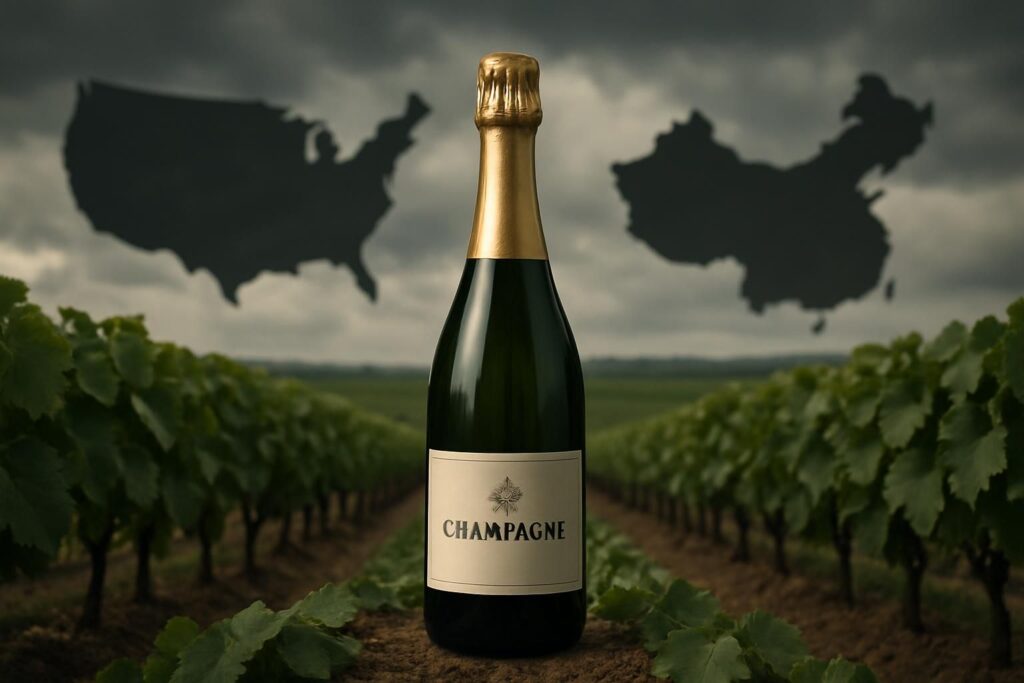
Universal symbol of celebration and refinement, champagne embodies a unique know-how rooted in an exceptional terroir. Yet, this viticultural jewel faces a silent but persistent threat: the lack of protection of its appellation in two major nations. While French legislation has guaranteed its status as a controlled designation of origin (AOC) since 1936, ensuring strictly delimited production within the Champagne region, this specificity remains vulnerable abroad, notably in the United States and Russia. The Comité Champagne, at the forefront of the legal defense of this heritage, works tirelessly to counter the illicit uses of the name “Champagne”, which compromise not only the reputation but also the international trade of the product. The stakes go beyond a simple legal matter: it is the very integrity of the production and the global perception of this prestigious appellation that are at risk in this complex battle with significant economic and cultural proportions.
Since the official recognition of the Champagne AOC 90 years ago, the protection of the name Champagne remains a constant struggle. While Europe has strengthened this protection at the dawn of the new decade, notably through regulation 2024/1143 on protected designations of origin, some great powers still resist stringent regulation. Through various modes of exploitation, ranging from counterfeits to parasitic uses such as in diverted cosmetic or food products, the threat weighs on the controlled origin, a fundamental principle guaranteeing the quality and authenticity of wines from the Champagne terroir. This challenge raises many questions about the future of champagne, at the heart of French viticultural tradition and regarding its global prominence.
A protected and codified appellation, but exposed to major international risks
The Champagne appellation is one of the oldest and most prestigious French controlled designations of origin, created in 1936 under the aegis of the INAO. It requires that only wines produced, harvested, and processed in this delimited region of France’s Grand Est can bear this name. This geographical protection is based on strict regulation defining the terroir, production process, and quality of sparkling wines.
However, despite this solid legal framework in France and Europe, this accuracy is not universal. Two nations, Russia and the United States, still maintain vague legislations, which open the door to abusive exploitations of the appellation. In these countries, some producers use the term “Champagne” to designate sparkling wines produced locally, with no connection to the geographical area of origin. This situation creates unfair competition and confuses consumers about the true authenticity of the product.
The Comité Champagne plays a crucial role in this system, conducting intense judicial battles against counterfeits and parasitic use internationally. For example, in 2023 in Belgium, the slogan “The Champagne of beers” on Miller High Life cans led to the seizure and destruction of more than 2,000 units by customs for abusive use of the appellation. This emblematic case underlines the vigilance required against these proliferating practices, notably on the Internet, where more than 51,000 disputed ads were detected in 2025, a quarter of which were for China alone.
To ensure the sustainability of the appellation, several key points should be noted:
- The strict geographical delimitation of Champagne, centered on Marne, Aube, Aisne, and part of Seine-et-Marne, which conditions the right to use the name.
- The rigorous regulation governing production, from grape harvest to bottle aging, guaranteeing unique quality.
- The necessity of increased international cooperation to standardize recognition and protection of the term “Champagne” in global trade.
- The constant work of the Comité Champagne to detect, pursue, and stop counterfeits and abusive exploitations.
Despite these efforts, the lack of harmonized legislation in certain major markets weakens the protection of this singular appellation. This observation opens the way to reflection on the diplomatic and legal means to deploy to strengthen champagne’s defense worldwide.
The economic and commercial stakes of an appellation at risk
Beyond a controlled designation of origin, champagne represents a strategic pillar for the French viticultural economy and its international influence. In 2025, nearly 266 million bottles were produced, of which more than 152 million were exported. The United States is the leading export market with 26.46 million bottles delivered, despite a 15% tax on these wines. Belgium, the fifth market, follows with 7.8 million imported bottles, up 2.6%.
The position of champagne on the international market thus closely depends on consumer confidence in the authenticity and quality guaranteed by the appellation. As soon as a risk of weakening this confidence arises due to poor protection of the label, trade can suffer seriously. The proliferation of products marketed with abusive use of the term “Champagne” abroad disturbs not only perception but also the competitiveness of genuine Champagne wines.
These issues also influence marketing strategies and investment plans within the Champagne sector. The industry now must devote considerable resources to legal monitoring, which represents a significant cost. Furthermore, the impact on product value is not negligible: rarity and quality sustain prestige, yet dilution of the appellation could lead to price drops and a risk of commodification.
To illustrate these stakes, the case of the “Champagne” perfume launched by Yves Saint Laurent in the 1990s reminds us that the use of the name is not limited to beverages. On a larger scale today, cosmetic or food brands, like the “Champagne” shampoo by Andrélon in the Netherlands or “Cham-Dog” in Great Britain, exploit this renown for commercial purposes, further blurring the lines between authentic production and marketing drift.
The consequences of this dilution of the Champagne name can be listed as follows:
- Loss of consumer trust in products falsely labeled as “Champagne.”
- Decrease in pricing power for authentic producers, impacting profitability.
- Strengthening of legal and customs barriers to defend the appellation in certain countries.
- Potential reduction of genuinely labeled export volumes due to unfair competition.
- Weakening of champagne’s image worldwide.
The defense of the Champagne appellation, a guarantee of quality and excellence, therefore emerges as a crucial issue to protect this viticultural heritage and its international trade.
Legal protection against abuses: strategies and limits in major markets
The legal protection of the Champagne appellation rests on several pillars: French national law, European regulations, international agreements, and the concrete action of the Comité Champagne. The INAO formally guarantees that the title “Champagne” is only allowed for wines produced in the specific region according to regulated methods, thus ensuring rigorous geographical indication.
At the international level, articles 26 and 27 of regulation 2024/1143 further clarify the protection of protected designations of origin, but their application is not uniform everywhere. Some countries, notably Russia and the United States, have not yet implemented sufficiently restrictive legislation to prevent abusive use.
These legal gaps represent a weakness exploited by foreign producers marketing sparkling wines labeled “Champagne” without any connection to the French terroir. The Comité Champagne relentlessly pursues these cases thanks to a reinforced legal team, with over 1,000 cases ongoing in 2025, handled by only three specialized lawyers. Despite enhanced surveillance strategies, especially on online platforms where disputed ads are numerous, the task remains herculean.
A revealing example is that of Miller High Life beer cans, which in 2023 were withdrawn from the Belgian market following a procedure launched by customs. Similar actions are underway in other jurisdictions, with sometimes encouraging but never completely decisive results.
Faced with these challenges, several avenues are being explored:
- Strengthening bilateral and multilateral agreements aiming to recognize and protect the Champagne appellation.
- Increased collaboration between French authorities and local administrations in the countries concerned to better enforce regulations.
- Deployment of technological online monitoring tools to rapidly identify and block counterfeits.
- Awareness campaigns targeting foreign consumers to inform them about the meaning of the controlled designation of origin.
Despite all these initiatives, protection remains a long-term struggle. Legal recognition is not always sufficient to eradicate violations, raising the question of a worldwide harmonization of the regulatory framework. Meanwhile, the Comité Champagne continues to focus efforts in these high-risk territories, aware that each won battle is a victory for the entire sector.
The role of terroir and geographical indication in the legitimacy of the Champagne appellation
The terroir represents the living heart of the Champagne appellation. It defines not only a delimited geographical area but also a set of natural and human factors shaping the unique quality of the product. This distinctive character fully justifies the existence of a controlled designation of origin, guaranteed by the INAO.
The Champagne terroir mainly covers Marne, Aube, Aisne, and part of Seine-et-Marne, divided into several crus with distinct characteristics. It is the interaction between the climate, limestone soils, and traditional winemaking methods that impart this incomparable finesse and effervescence.
The geographical indication thus plays a fundamental role as a distinctive sign, certifying the authenticity and origin of champagne. This certification is the legal basis protecting production against misappropriated denominations abroad. Without it, the prestige and reputation built over centuries would be weakened.
More concretely, the notion of geographical indication allows:
- Limiting the use of the name “Champagne” to only wines produced in the delimited territory according to precise quality and method criteria.
- Establishing a geographical and cultural link between production and its place of origin, thus strengthening the identity of the wines.
- Ensuring consumers a tangible guarantee on the origin and nature of the product.
- Preserving the ancestral know-how inherent to the specific production process in this region.
This terroir protection fits into a broader dynamic of sustainable development and preservation of viticultural heritage. By enhancing the connection between soil, climate, and human handiwork, Champagne stands out from sparkling wines produced elsewhere, often indirect competitors, notably Prosecco whose economic momentum was analyzed in a recent study.
The importance of terroir and geographical indication in valorizing champagne must be at the core of communication and awareness strategies, especially in international markets where protection remains fragile.
Actions and prospects: strengthening champagne protection in major at-risk nations
In this battle to protect the Champagne appellation, several levers are mobilized by the Comité Champagne, its partners, and local authorities. Their common goal is to establish a stricter and more effective protection framework, notably in the American and Russian markets.
The legal strategy consists of a multi-level approach, combining diplomatic pressure, legal disputes, and monitoring actions. The Comité intensifies its interventions while fostering collaboration with specialized law firms, such as Nicolas Clarembeaux who highlights the importance of these collective efforts for defending geographical indications.
Simultaneously, consumer awareness in these countries is a key focus. Educating the public on the real meaning of the controlled designation of origin helps to reduce confusion and increase demand for authentic champagne. This foundational work must be part of a lasting and multifaceted dynamic.
The Champagne sector also invests in digital tools to strengthen online monitoring. Early detection of fraudulent offers, the use of traceability technologies, and cooperation with e-commerce platforms are crucial elements to counter abuses.
The growth of exports to Belgium, which recorded a 2.6% increase in 2025, illustrates the vitality of markets where protection is better ensured. These successes demonstrate that rigorous policies can bear fruit while strengthening the appellation’s value.
To summarize, the priority actions to reinforce champagne protection in these at-risk nations are:
- The negotiation of strengthened trade agreements including specific clauses on the Champagne AOC.
- Development of close cooperation between French, American, and Russian judicial authorities.
- Support for international communication campaigns via adapted platforms.
- Investment in technology for rapid detection of online infringements.
- Strengthening legal resources, notably in terms of team and capacity to handle the growing volume of cases.
These measures, adopted with consistency and rigor, are crucial to guaranteeing the sustainability of an appellation that is not only a mark of excellence but also a unique economic and cultural driver.
More information on regional initiatives and champagne protection is available, notably through a page dedicated to special Champagne offers and news on local sector events in various regions.
What defines the Champagne appellation?
The Champagne appellation is defined by a strict framework requiring that only wines produced, harvested, and processed in a geographically delimited region according to precise standards can bear this name.
Why is champagne protection weaker in the United States and Russia?
These countries have not adopted legal protections as stringent as those in force in Europe, allowing abusive use of the appellation for sparkling wines produced locally.
What are the risks linked to counterfeiting the Champagne appellation?
Counterfeits weaken consumer confidence, reduce the commercial value of true champagne, and harm the image of this product of excellence.
How does the Comité Champagne protect the appellation internationally?
Through an active legal strategy, constant monitoring of online and offline markets, as well as awareness campaigns and international partnerships.
What initiatives exist to raise consumer awareness about champagne authenticity?
Educational and informative campaigns are conducted in different countries to explain the meaning of the appellation and the specificity of the Champagne terroir.