
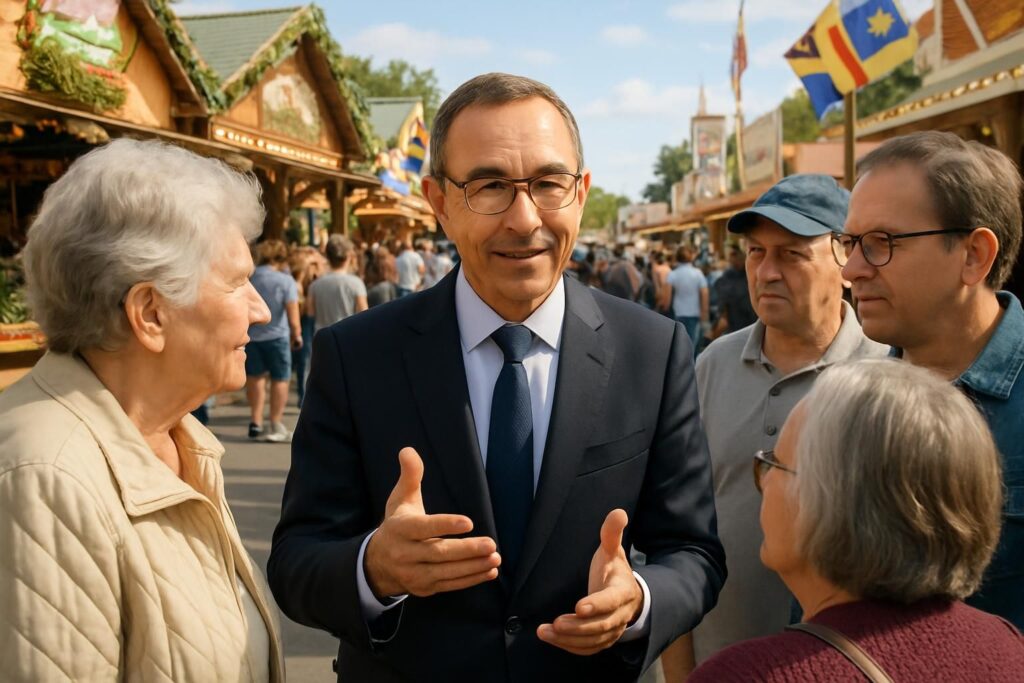
As the presidential elections approach, the Châlons-en-Champagne Fair plays a key role in the French political scene. This agricultural and public fair attracts numerous political actors each year eager to address the heart of the rural country, a symbolic gateway to voters’ concerns. In 2026, amidst crucial electoral stakes, Bruno Retailleau, president of the Republicans, attended this event to assert his commitment and clarify the growing questions surrounding his candidacy.
While polls still reflect some hesitation around his position, Retailleau relies on closeness with his audience to answer questions of trust and demonstrate the necessity of his presence in the electoral campaign. Facing a fragmented political landscape and a divided right, his speech delivered in the heart of the Marne aims to galvanize an often overlooked electorate, made up of workers, artisans, and laborers sensitive to the values of work, security, and national sovereignty. This particular context, in full pre-electoral momentum, lends a special significance to this visit, which goes far beyond a simple media trip to become a true major political meeting.
The political stakes of the Châlons-en-Champagne Fair for Bruno Retailleau and his candidacy
The Châlons-en-Champagne Fair, recognized for its symbolic weight in the French political sphere, proves to be a key moment for any candidate wishing to reassure and mobilize the rural electorate. For Bruno Retailleau, this 2026 edition represents a strategic opportunity to dispel the uncertainties surrounding his candidacy, while some of his detractors call for withdrawal in favor of other figures of the right or center.
In rural areas, public opinion is marked by a feeling of abandonment and mistrust towards traditional political elites. Retailleau intends here to overcome these barriers by focusing on a message centered on the value of work – a major theme he develops in his speeches. He knows full well that this electorate, often made up of artisans, farmers, and small entrepreneurs, is not only sensitive to promises but demands genuine proximity and a clear vision for the future.
The challenge is twofold: first, to convince the undecided and, secondly, to prevent a transfer of votes to the far right, notably to the RN, whose portion of voters seek a right-wing candidate capable of firmly defending the nation against the excesses they denounce on the left. In this spirit, Retailleau does not hesitate to point out certain political movements deemed “dangerous” or “destabilizing” by advancing decisive ideas on security and sovereignty, while maintaining a responsible and constructive stance.
Finally, through this strong presence, Retailleau seeks to strengthen his presidential stature. The weight of the Châlons-en-Champagne Fair in national media coverage is undeniable. Through this obligatory stop, he asserts that he has nothing to fear from internal competition on the right, not rejecting the very idea of a primary, but showing an intact determination to see this electoral campaign through to the end.
Bruno Retailleau’s speech: a call for work, security, and national sovereignty
The speech delivered by Bruno Retailleau at the Châlons-en-Champagne Fair proclaimed his core values and the main lines of his political project, in a context where the electoral campaign seeks to rebalance the debates against the multiple candidates running. The central theme, that of work, structured his various speeches, resonating particularly with the hat makers, winemakers, and artisans present, who symbolize an economic fabric often weakened by successive crises.
Retailleau emphasized the need to strengthen internal security, a theme that has become a real lever for winning votes, especially in rural and peri-urban areas. He vigorously condemned what he calls political niches where “profiteers” thrive, insisting that firm measures be taken against delinquency and breaches of public order. This assertive stance aims to reassure a worried electorate, often torn between far-right voting and that of a more moderate center-right.
Beyond security, national sovereignty constitutes another essential point of his intervention. Retailleau became the spokesperson for a France capable of defending its economic and cultural interests against globalization deemed too aggressive and foreign interference. This line, combined with a reminder of economic patriotism, aims to structure a program seeking consensus within a frequently fragmented right.
To make his message more accessible and credible, he draws on concrete examples, notably in the large Champagne sector, emblematic of French excellence and the necessity to protect local know-how in international competition. This reference to the Champagne region, at the heart of the fair, reinforces his territorial anchoring as an argument of trust.
Public reactions at the Châlons-en-Champagne Fair: between support and criticism
Bruno Retailleau’s visit to the Châlons-en-Champagne Fair sparked a mix of enthusiasm and questions coming from a diverse audience. Composed mainly of rural voters, this public is known for its capacity to weigh durably on political balances, notably thanks to often strong mobilization during local and national ballots.
Many artisans, shopkeepers, and farmers present expressed real support for Retailleau’s candidacy, notably because he embodies for them the pursuit of a social and economic project focused on recovery and France’s competitiveness. Some clearly expressed their concern at the idea of withdrawal, even mentioning a temptation to turn to the National Rally if their right-wing candidate were to disappear from the race.
However, even within this base, critical voices emerged, highlighting a lack of visibility in the main political lines or a fear of dividing the right-wing vote. These questions fuel an already lively debate on the relevance of a broader gathering of right and center forces, a recurring theme in political ranks but also in agricultural and industrial circles.
On the opposite side, journalists and political observers noted that this traditional meeting shows a form of mutation in the relationship between candidates and their rural electorate. Closeness, certainly sought by Bruno Retailleau, is now a demand that politicians must permanently satisfy. The rural world, far from monolithic, asserts its expectations and demands, complicating campaign strategies.
The Châlons-en-Champagne Fair: an essential springboard for Bruno Retailleau’s electoral campaign
Beyond the exchange with citizens, the Châlons-en-Champagne Fair offers an ideal ground to give strategic visibility to Bruno Retailleau’s electoral campaign. For a right-wing candidate trying to stand out in a fragmented context, this gathering constitutes a major media showcase, namely the key to restoring an upward dynamic in voting intentions.
This meeting also represents an unparalleled platform of expression to assert strong positions at the heart of a deep France, in sectors such as agriculture, regional industry, and artisanal trades. It is also an event where political speeches can address a varied public, mixing local elected officials, entrepreneurs, families, and civil society actors, each carrying different expectations but converging towards common challenges.
The fallout with specialized press, such as articles on municipal dynamics or debates on the electoral future of the region, give such a visit an increasingly heavy dimension in the electoral strategy. This presence in Châlons-en-Champagne also propels Retailleau to the center of discussions regarding the right’s future, marked by an intense competition with several other potential candidates. This deadline forces the candidate to confirm his course and to reduce the shadow areas remaining over his project.
Moreover, the Fair helps structure active mobilization locally, by creating ties with associative and professional networks, ready to become as many relays on the ground during the campaign. Consolidating support, indispensable, therefore passes through repeated meetings in such events, which feed trust and popular adherence.
The next challenges for Bruno Retailleau after the Châlons-en-Champagne Fair
The visit to the Châlons-en-Champagne Fair does not close Bruno Retailleau’s electoral campaign but marks an important step in consolidating his image and project with the electorate. While visibility has gained intensity, many challenges remain to turn this momentum into concrete electoral results.
Among the priorities is broadening the electoral base, especially towards young professionals and urbanites, who demand innovative solutions in employment and ecological transition. He also has to face internal competition on the right, where several candidates vie to capture a similar audience, avoiding dividing an already fragmented electorate.
Another point of attention is maintaining a coherent discourse in the face of rising identity and economic tensions, to which he must propose a balanced response, not yielding to extremes while being seen as firmly committed. This requires meticulous work on content and the timing of public interventions.
Finally, the structuring of the campaign network at the local level, with the support of elected officials and influential actors, must intensify. This involves strengthening contacts in key territories, mentioned in analyses such as those on elections in the Champagne region, in order to build a true electoral machine backing the candidacy.
- Mobilize the rural electorate while broadening appeal to the youth
- Consolidate program coherence facing diverse expectations
- Strengthen the local network to ensure effective territorial coverage
- Maintain targeted communication on work, security, and sovereignty
- Overcome internal competition within the right
The path to the ballot remains full of pitfalls, but the strategy adopted around the Châlons-en-Champagne Fair illustrates a clear will from Bruno Retailleau to turn questions into driving forces for his campaign.
Why is the Châlons-en-Champagne Fair such an important political meeting?
The Châlons-en-Champagne Fair is a key moment for politicians, notably because it gives access to a rural electorate that is often decisive and demanding proximity and concrete responses to local and national issues.
What are the main messages of Bruno Retailleau during his visit to the Fair?
Retailleau highlighted work, security, and national sovereignty as pillars of his political project, emphasizing the need to protect the country’s economic and social interests while improving internal security.
What uncertainties still surround Bruno Retailleau’s candidacy?
Despite his affirmed commitment, questions remain regarding the electoral impact of his candidacy against internal competition on the right and the risk of vote splitting, as well as the ability to reach urban and young audiences.
How does the Châlons-en-Champagne Fair help strengthen the electoral campaign?
This event allows Bruno Retailleau to increase visibility, build a solid local network, and deliver a direct message to rural voters, while feeding the momentum of his campaign during a crucial phase.
What is the weight of the rural electorate for the presidential elections?
The rural electorate represents a significant portion of the electoral body and often plays a decisive role in electoral results, notably through strong mobilization during local and national polls.