
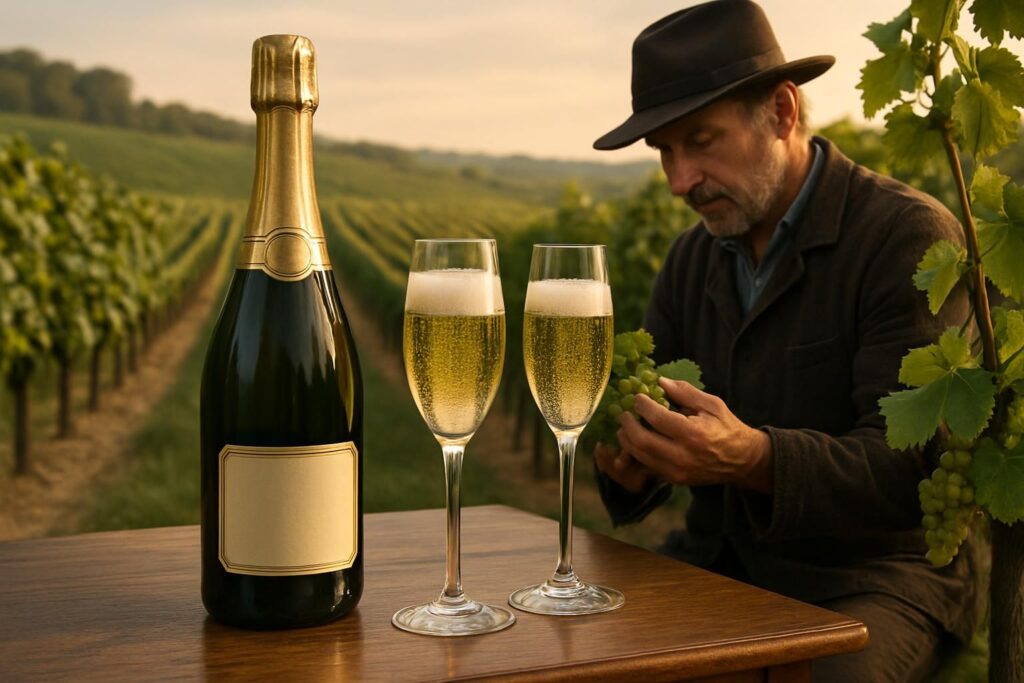
Recognized worldwide, the Champagne Appellation embodies much more than just a name on a label; it reflects an exceptional heritage combining a unique terroir, ancestral know-how, and the art of winemaking. In 2026, Champagne continues to shine as an exceptional wine blending tradition and innovation, facing the challenges of a changing climate. From the finesse of its bubbles to the complexity of its aromas, each bottle is the result of a delicate balance between technical precision and genuine passion. Exploring the Champagne lands means plunging into a mosaic of chalky landscapes where Pinot Noir, Meunier, and Chardonnay tell the millenary story of an exceptional vineyard.
Champagne wine, a universal symbol of celebration and elegance, continues to seduce with its strong identity. Behind its apparent lightness, it reveals a rich aromatic palette, stemming from a meticulous Champagne method. This unique process involves a second fermentation in the bottle that gives the famous effervescence and allows the wine to develop unparalleled complexity. Facing contemporary challenges, Champagne producers demonstrate an art of adaptation, enhancing each year a terroir affected by global warming without ever losing its nobility.
The Champagne terroir: a natural setting for an exceptional wine
The terroir is the cornerstone of the Champagne Appellation, defining the uniqueness of the wines produced. Located in the northeast of France, this vineyard covers three major sub-regions: the Montagne de Reims, the Côte des Blancs, and the Vallée de la Marne. Each has specific geological and climatic characteristics, contributing to the aromatic richness and complexity of champagnes.
This territory is dominated by a chalky soil, a fundamental element in the expression of the wine. Very porous, this soil allows excellent drainage while retaining the essential moisture during dry periods. Thanks to this capacity for absorption and heat restitution, vine roots benefit from a stable microclimate, favoring the gradual ripening of the grapes. This particularity imparts a remarkable minerality to the wines, a typical signature of champagnes from this region.
Climatic conditions bring the necessary freshness to maintain acidity in the grape, a guarantee of a balanced and lively wine. Mild and humid winters alternate with bright but temperate summers, ideal conditions for developing fine and delicate aromas. The diversity of vineyard exposures – sometimes on slopes, sometimes on plains – also allows the production of various cuvées offering an extended aromatic palette.
This geographical diversity gives the Champagne vineyard a unique richness fully expressed in the blends. Both white wines and rosé champagnes take advantage of this mosaic of soils and climates to offer nuanced flavor profiles, from sharp freshness to generous roundness. This terroir is a living canvas on which each producer paints, with rigorous expertise, the soul of their Champagne.
Example of climate impact on Champagne production
In recent years, the region has experienced significant climatic changes, exposing the vineyard to hotter summers and increased drought, as analyzed in several recent studies. These changes result in unusual ripeness levels and sometimes very early harvests. This new situation pushes winemakers to rethink their agronomic approach to preserve the quality and identity of the wines. Adaptation to these hazards demonstrates all the ingenuity and know-how characterizing Champagne production.
Noble grape varieties: cornerstone of the Champagne Appellation
The richness of Champagne wine lies primarily in the subtle balance between three emblematic grape varieties: Pinot Noir, Pinot Meunier, and Chardonnay. Each brings an essential dimension which, through their blend, creates the harmony unique to the region.
Pinot Noir, the dominant red grape variety, gives Champagne its structure and aromatic power. Its fruity notes, ranging from cherry to raspberry, provide depth and intensity that serve as the base for many blends. It is also through this grape that the light color and ample texture develop in the wine.
Pinot Meunier, for its part, is known for its generous fruitiness and ability to bring suppleness and roundness. Favored for its adaptation to cooler and more humid climatic conditions, it plays a key role in the diversity of organoleptic profiles. Its presence in the blend guarantees a wine more accessible in its youth while retaining a nice freshness.
Chardonnay, the only white grape variety authorized in the region, offers finesse and elegance. It is the source of the famous blanc de blancs champagnes, renowned for their freshness, purity, and longevity. This grape also brings floral and citrus nuances, enriching the aromatic palette. Its sensitivity to chalky soil highlights the natural minerality of the terroir, a distinctive trait of Champagne.
- The balance of grape varieties allows a diversity of styles ranging from extra brut to demi-sec, meeting varied consumer expectations.
- The complementarity between fruitiness, power, and finesse is a complex art mastered by winemakers who favor a thoughtful blend.
- The rigorous selection of clusters during harvest ensures that only the best grapes enter into the composition of champagnes.
This grape-terroir-method trio becomes the foundation of the Champagne Appellation, guiding producers in their quest for excellence. While tradition imposes these choices, the creativity of Champagne houses brings each year new interpretations and innovations.
The Champagne method: ancestral know-how and technical rigor
The Champagne Appellation owes its world reputation to the Champagne method, a winemaking process developed with near-scientific rigor and passed down from generation to generation. Established in the 18th century, this technique revolutionized the production of sparkling wines and remains today at the heart of Champagne’s quality and identity.
After the first alcoholic fermentation, conducted as in a traditional wine, the real magic begins with the second fermentation in the bottle, called the “prise de mousse.” This crucial step involves hermetically sealing the bottle and then adding a tirage liqueur, a mixture of sugar and yeast, triggering a new fermentation. This fermentation traps carbon dioxide, giving rise to the famous effervescence characteristic of Champagne.
This is followed by several meticulous phases: aging on lees which enriches texture and aromas, riddling to gather sediments in the neck, then disgorgement to remove these deposits. Finally, dosage, the final operation where an expedition liqueur, dosed in sugar according to the desired style (extra brut, brut, sec, or demi-sec), is added to perfect the wine’s balance. This precise work is an art form, a true signature of Champagne professionalism.
The Champagne method is also a battle against time. Some vintage champagnes can age for several years or even decades in cellars, evolving in their flavors and complexity. This controlled aging, always in bottle, allows the development of an exceptionally fine aromatic profile often cited as the ultimate reflection of Champagne know-how.
In today’s context, where every detail counts, mastering this method requires rigorous organization of vineyards and cellars, capable of ensuring consistency and excellence, hallmarks of the appellation whose reputation is well-established. The Champagne method thus embodies a subtle balance between art and technique, a living tribute to regional winemaking tradition.
The art of blending and the unique style of champagnes
At the heart of the Champagne Appellation, blending represents a strategic step that fully reveals the genius of cellar masters. By skillfully combining grape varieties, vintages, and terroirs, they create unique cuvées capable of expressing the full diversity and richness of Champagne wines.
The main objective is to achieve a perfect balance between freshness, power, finesse, and aromatic complexity. For example, one house may primarily favor Pinot Noir to produce a Champagne with robust and spicy notes, while another may prioritize Chardonnay for its elegant blanc de blancs, imbued with minerality and vibrant acidity. These choices reflect the producer’s personality, the quality of the harvests, but also market expectations.
Aging also plays a role in shaping the wine’s style. In some cases, it imparts more roundness and evolved tertiary aromas such as brioche, hazelnut, or honey, signatures of prolonged aging on lees. Thus, Champagne transcends its festive image to embody a gastronomic wine, capable of subtly accompanying refined dishes.
- Multi-varietal blending: a technique that achieves balanced complexity and compensates for year-to-year variations.
- Vintage champagnes: made from grapes of a single exceptional year, an authentic reflection of the terroir and climate of that harvest.
- Variety of styles: from extra brut to sweet champagnes, each dosage targets precise flavor profiles allowing a wide tasting range.
This subtle and rigorous alchemy illustrates the artistic mastery and passion that inhabit Champagne production. Through these nuances, the Champagne Appellation confirms its unrivaled place among exceptional wines.
Champagne in 2026: traditions and challenges in a changing world
As the international market evolves, the Champagne sector is engaged in a renewal dynamic while honoring its deep roots. The vineyard, confronted with the consequences of climate change, adapts its agricultural and oenological practices to preserve the unparalleled quality of the wines. Early harvests and changes in alcohol levels, analyzed in recent studies such as those relayed by specialized experts, testify to a French wine industry in full mutation.
On the actors’ side, the new generation now consists of young passionate talents, such as Clémentine Reyboubet, a visionary cellar master embodying a new generation eager to combine tradition and modernity. This new dynamic energizes the entire sector, facilitating better communication about the values of the Champagne Appellation and innovation in production and marketing methods.
To meet market expectations while remaining faithful to authenticity, Champagne houses multiply initiatives. Some promote organic and biodynamic work to strengthen the vineyard’s sustainability. Others invest in affordable ranges to broaden the client base without sacrificing quality, as recently explored in selections of champagnes priced below 10 euros.
In this context, deep knowledge of the terroir, mastery of the Champagne method, and understanding of the global market become essential levers to enhance the exceptional wine that is Champagne. This approach ensures the region a place of choice at the heart of the world’s great wines and a promising future.
What distinguishes the Champagne Appellation from other sparkling wines?
The Champagne Appellation is the only one in the world to possess a protected terroir, exclusive know-how including the Champagne method, and a strict specification guaranteeing the quality and identity of its sparkling wines.
Which grape varieties are authorized in Champagne production?
Only three grape varieties are authorized: Pinot Noir, Pinot Meunier, and Chardonnay. Each contributes to the complexity and balance of the wine.
Why is the second fermentation essential in Champagne winemaking?
This step called prise de mousse creates the characteristic effervescence of the wine and allows the development of the complex aromas specific to Champagne.
How does climate change affect the taste of Champagne in 2026?
Hotter summers cause early harvests and increase alcohol content, altering the aromatic profile. Winemakers adapt their practices to maintain balance and quality.
Can quality champagnes be found at affordable prices?
Yes, several houses offer cuvées of excellent quality at affordable prices, notably those highlighted during wine fairs or presented in selections like the E.Leclerc selection.