
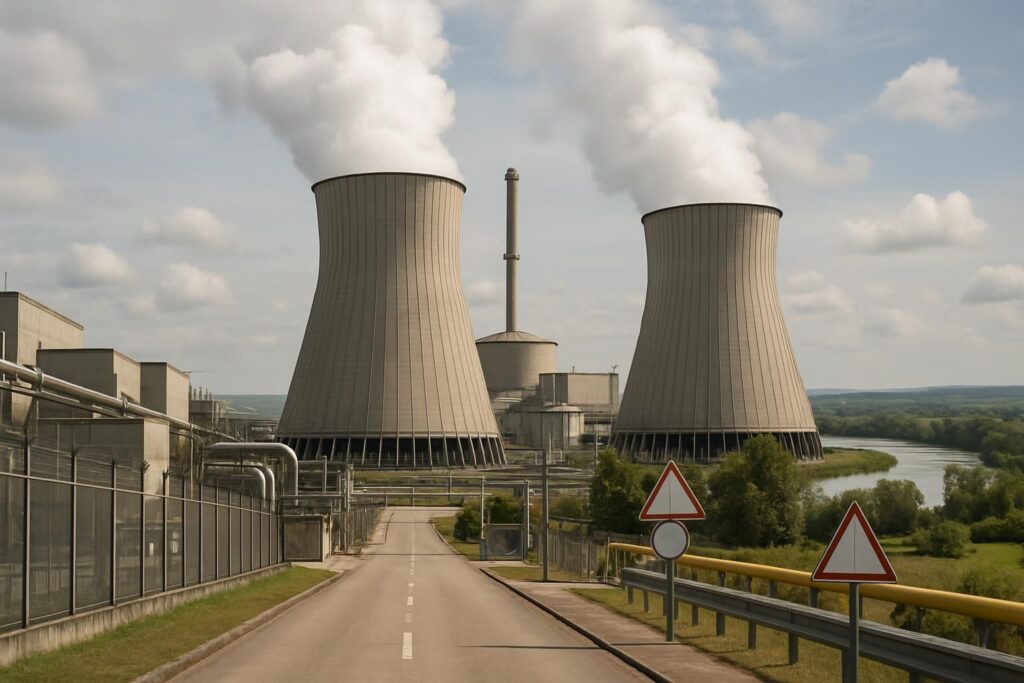
At the heart of Aube, a department renowned for its prestigious vineyards, leather craftsmanship, and agri-food industry, lies a little-known but vitally important facility for France: the Nogent-sur-Seine nuclear power plant. More than just an energy infrastructure, this site symbolizes an alliance between regional tradition and technological modernity. About a hundred kilometers from Paris, this plant plays a strategic role in the national electricity supply, combining production power with rigorous attention to nuclear safety. Far from the usual spotlight of Champagne and leather goods, Aube thus also asserts itself as a discreet but indispensable pillar of the French nuclear industry.
Built in the 1980s, the Nogent-sur-Seine plant consists of two pressurized water reactors of 1,300 megawatts each, which alone provide nearly 5% of French nuclear production. This decarbonized energy is essential to meet electricity demand, especially in the Paris region, which accounts for one-third of the country’s consumption. In 2025, the site produced 18.5 terawatt-hours, a significant volume supplying homes and economic activities, while contributing to reducing dependence on fossil fuels.
The Nogent-sur-Seine Nuclear Power Plant: A Structuring Economic Engine for Aube
Beyond its energy role, the Nogent-sur-Seine plant occupies a central place in the local economy, with a direct impact on employment and regional businesses. About 700 employees work within this facility, supplemented by the workforce of numerous service companies operating on site. These collaborations generate significant economic spin-offs, often comparable to those of Aube’s flagship industries, such as champagne houses and the agro-industry.
In 2025, contracts with local suppliers exceeded 17 million euros, demonstrating the plant’s deep integration into the territorial economy. In a context where some traditional sectors like champagne face economic difficulties, this support represents a reliable anchor point for regional activity. The nuclear industry of Nogent thus ensures a certain stability, constituting a lasting pillar against the volatility of agricultural markets.
It should be noted that the employment generated is not limited to the site itself. Indeed, a significant portion of services and deliverables is outsourced to the local industrial fabric, which nourishes a whole artisanal, technical, and commercial ecosystem. This anchoring creates a virtuous dynamic, where local know-how benefits from nuclear industrial activity, strengthening the economic resilience of Aube.
List of the main economic impacts of the Nogent-sur-Seine plant:
- Direct employment: about 700 EDF employees.
- Indirect employment: numerous local contractors and subcontractors.
- Local markets: over 17 million euros in 2025 for regional suppliers.
- Economic stability: a reliable counterpart against agro-industry volatility.
- Skills support: development of industrial and technical expertise.
Technology and Safety: The Foundations of Electricity Production at Nogent-sur-Seine
The Nogent-sur-Seine nuclear power plant operates pressurized water reactors (PWRs), designed in the 1980s but regularly modernized to ensure performance and safety. Each unit generates 1,300 megawatts, supplying a vast region with low-carbon electricity. This technology relies on a closed cycle of pressurized water, separating the steam used to drive the turbines from the radioactive primary circuit.
Operation involves rigorous control and continuous maintenance, notably through scheduled shutdowns intended to reload fuel, check equipment, and incorporate technical improvements. The next ten-year inspections, planned for 2029 and 2030, are major milestones involving several years of preparation and large-scale works, with significant employment prospects for the region.
Nuclear safety is at the heart of concerns. In 2026, the plant applies the highest standards, overseen by the Nuclear Safety and Radioprotection Authority (ASNR). These measures address both technical requirements and environmental imperatives. They guarantee operation without major risk, while minimizing impacts on surrounding biodiversity and the water quality of the Seine.
Additionally, the plant is committed to continuous improvement: real-time monitoring of critical parameters, ongoing staff training, and cooperation with external organizations ensure exemplary robustness. This safety framework also contributes to the confidence of the local residents, often sensitive to nuclear facilities.
In summary, the keys to technological success lie in:
- Continuous modernization of reactors to optimize production.
- Rigorous maintenance during ten-year inspections and planned shutdowns.
- Enhanced monitoring of safety systems and permanent quality control.
- Strict compliance with national and European nuclear safety standards.
- Environmental commitment with measures to protect the Seine and ecosystems.
Territorial Integration and Environmental Challenges at Nogent-sur-Seine
The installation of the nuclear plant in an agricultural and wine-producing region like Aube raises challenges of integration and local acceptability. Dialogue with local authorities, associations, and residents is essential to ensure harmonious coexistence between nuclear industry and traditional activities.
The plant fits within a sustainable development approach, combining decarbonized electricity production and protection of natural resources. Thermal discharge into the Seine is controlled so as not to disturb aquatic ecosystems. Regular environmental monitoring programs measure the impact of discharges and implement corrective actions if necessary.
Moreover, public awareness of nuclear energy and safety issues is an indispensable part of this integration. Educational visits and exchanges with schools or associations facilitate better knowledge of the site and the technologies employed, thus reducing fears and misinformation.
Local research also supports these efforts, with projects aimed at enhancing synergies between nuclear industry, environmental protection, and regional economic development. The plant thus acts as a responsible actor, aware of societal expectations and ecological priorities.
The following key points concerning territorial integration can be highlighted:
- Permanent dialogue with elected officials, residents, and associations.
- Rigorous management of thermal discharges and regular environmental controls.
- Awareness programs and educational visits to improve transparency.
- Research projects on industry-environment interactions.
- Promotion of sustainable nuclear energy compatible with Aube’s natural assets.
Evolution Perspectives: Nogent Power Plant Between Stability and Innovation
As France positions itself as a world leader in nuclear energy, the Nogent-sur-Seine plant prepares its future with confidence. In 2026, the question of extending the reactors’ lifetime is at the heart of concerns, as well as the emergence of new generation reactors, such as EPR2s, with which Aube could be associated in the coming decades.
These prospects are accompanied by a commitment to the energy transition, where nuclear stands out as a reliable energy source with low greenhouse gas emissions. Nogent-sur-Seine’s strategic position makes it a key site for stable production alongside the development of renewables, which, although growing, still face challenges of regularity and capacity.
Projects to improve the performance of existing installations continue, including optimizing fuel cycles, energy saving in buildings, and digital integration for data management. These innovations will strengthen the plant’s competitiveness, safety, and sustainability.
Finally, cooperation with local and national partners allows the creation of a modern industrial ecosystem oriented toward technological innovation and talent training. This dynamic guarantees the site’s longevity in a rapidly changing global energy context.
The main axes of planned evolution are:
- Secure extension of the current reactors’ lifetime.
- Possible integration of new generation EPR2 reactors.
- Optimization of performance and reduction of consumption.
- Development of an innovative partnership with industrial and academic players.
- Strengthening Nogent’s role in French electricity production.
Human Dimension and Continuous Training: At the Heart of Nuclear Safety at Nogent-sur-Seine
The nuclear industry relies not only on state-of-the-art equipment but also on human excellence. At Nogent-sur-Seine, training and team expertise are essential to ensuring nuclear safety and production quality. Technical competence, vigilance, and a safety culture are the pillars for the operator and contractors working on site.
Employees continuously benefit from training adapted to technological evolutions, new regulations, and emergency scenarios. These programs include simulation exercises, internal audits, and the integration of feedback to improve practices. Rigor and preparation for all contingencies guarantee full control of complex operations.
Beyond the technical aspect, the human dimension is also expressed in transparent communication with the local population. The Nogent teams regularly participate in forums, information sessions, and meetings to respond to questions and establish a climate of trust. This proactive approach contributes to better social acceptance and constructive dialogue about the nuclear industry.
The essential points illustrating this human dimension are:
- Continuous training and skill development of employees.
- Regular simulations and emergency preparedness.
- Safety culture integrated in all site activities.
- Transparent dialogue with the population and stakeholders.
- Valorization of local talents to support the regional economy.
How many reactors make up the Nogent-sur-Seine nuclear power plant?
The plant is equipped with two pressurized water reactors of 1,300 megawatts each, brought into service between 1987 and 1988.
What is the plant’s average annual electricity production?
In 2025, the plant produced approximately 18.5 terawatt-hours of electricity, covering nearly 5% of French nuclear production.
How does the plant contribute to the local economy of Aube?
The plant employs about 700 people directly and creates many indirect jobs through local service companies, generating over 17 million euros in contracts for the region.
What measures are taken to ensure nuclear safety?
The plant complies with strict standards overseen by the Nuclear Safety Authority (ASN), with constant monitoring, ten-year inspections, and ongoing staff training.
What are the future projects for the Nogent-sur-Seine plant?
The plant plans to extend the life of its reactors, possibly integrate new-generation EPR2 reactors, and optimize its performance to support France’s energy transition.