
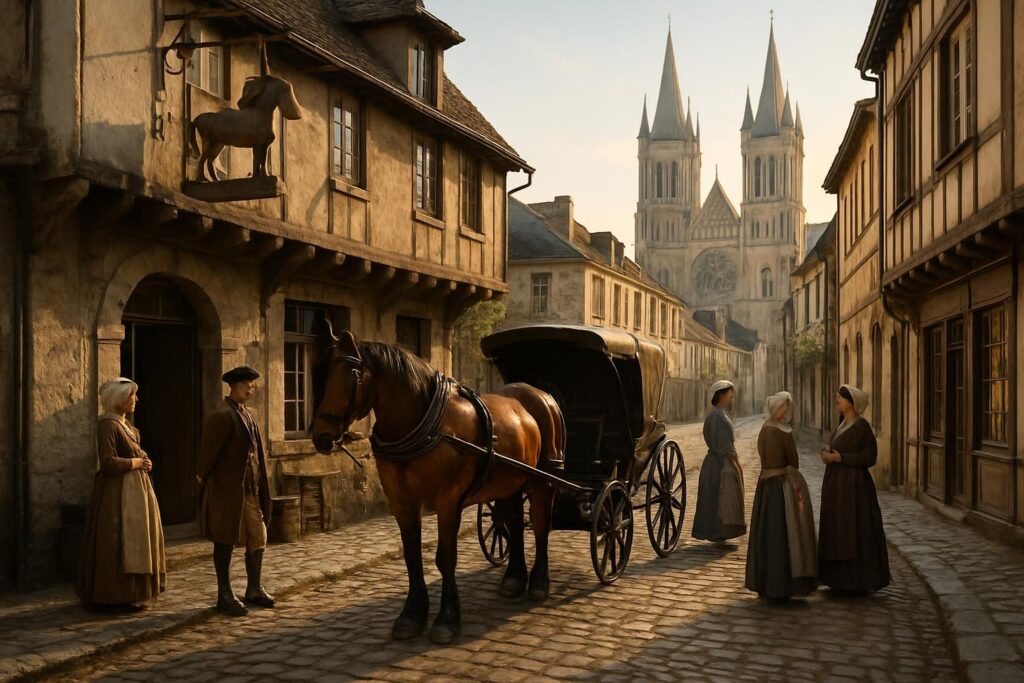
At the heart of Châlons-en-Champagne, rue du Cheval intrigues as much by its name as by its history. For while this denomination seems to stir the imagination, its origins delve deeply into the urban fabric and traditions of past centuries. Rue du Cheval, both a discreet artery and a witness to a bygone era, reveals to those willing to linger a rich toponymy, imbued both with the rurality of Champagne and ancient practices related to breeding and trade. Through its layout, its environment with evocative names, and the stories that accompany it in local archives, this street constitutes a true testimony to the heritage and culture of Châlons. Exploring the surprising origins of this street is therefore to probe the collective memory of a city where the street name goes beyond a simple geographical marker to become an identity and historical marker.
Origin of the street name: rue du Cheval through the centuries
The name of rue du Cheval in Châlons-en-Champagne does not fall from the sky nor from a contemporary whim. It is the result of a long historical process, where oral tradition, toponymy, and urban changes intertwine. From the Middle Ages, streets were often named after their function or the activities that took place there. Here, the mention of the horse would directly refer to a commercial or artisanal activity related to breeding, the blacksmithing of the animal, or the transit of draft animals.
Over the course of the archives, several hypotheses are proposed. The most plausible links the street to the presence of stables and farriers who occupied the area until the 18th century. These horse professionals were essential in a society where locomotion and agriculture largely depended on these animals. Rue du Cheval thus became an indispensable space in daily life, a place where merchants, breeders, and artisans gathered, thereby reinforcing social ties around this activity.
Other etymological leads evoke an old signboard, that of a postal relay or an inn with an evocative name, “Au Cheval d’Or” or “Au Cheval Blanc”, whose sign could have been transposed to the official name of the street. This practice is common in French urban toponymy, where important businesses or establishments end up lending their name to the streets. Rue du Cheval would thus illustrate a form of cultural anchoring, reflecting the lifestyles and services that animated the city.
It is also essential to take local geography into account: situated not far from strategic crossroads and close to other streets with names related to animals or trades, rue du Cheval fits into a network delimiting districts with specific vocations. This urban articulation bears witness to the progressive formation of Châlons-en-Champagne, reflected in a toponymy full of meaning for inhabitants and enthusiasts of local history.
The influence of equestrian heritage in the local toponymy of Châlons-en-Champagne
The role of the horse in the history and culture of Châlons-en-Champagne goes far beyond a simple mention in a street name. This region, between plains and hills, long lived to the rhythm of breeding, transport, and war, where horses occupied a central place. Rue du Cheval fits into this cultural and economic trajectory found in other urban layouts and Châlons traditions.
The horse, whether ridden or harnessed, was at the heart of many activities. It was used both in agriculture to plow fields and in local defense or the transport of goods. Châlons-en-Champagne, as a city of historical importance, hosted several breeding centers for these animals. It is therefore not surprising that equestrian culture permeates the toponymy.
This presence is expressed by other street or square names nearby, referring to trades around the horse (farrier, wheelwright) or symbols linked to these animals (Haras Square for example). The intangible heritage of these designations reflects the symbolic and economic importance of the horse for the local community. This allows one to measure the influence these animals had on the daily life of the inhabitants and to understand that rue du Cheval is much more than a simple appellation: it is a living part of Châlons tradition and culture.
In this context, rue du Cheval also acts as a witness to evolutions, from the central place occupied by these districts dedicated to artisans and merchants to the recent transformation linked to urbanization and modernization. Despite the changes of the 21st century, notably in 2026, the name retains an emotional charge and a certain authenticity that contribute to the local identity.
Rue du Cheval and collective memory: the method for tracing the origins of a street name
Tracing the history of a street name, such as rue du Cheval, requires relying on numerous sources: notarial archives, old maps, municipal documents, but also oral or topographical testimonies. The scientific approach of toponymy thus combines history, geography, and sociology, offering a precise reading of the underlying urban life.
In the case of rue du Cheval, municipal deliberations from previous centuries show that the street was well identified through recurring mentions, although under different appellations before the name stabilized. The cartographic work, initiated as early as the 17th century and continued by 19th-century cadastral maps, notably made it possible to observe the physical evolution of the street as well as its change of status in the city.
Local archives also reveal stories of families involved in the animal trade, confirming the old vocation of the street linked to horses. These pieces of information give substance to the toponymy by linking it to a concrete historical reality, thus avoiding the risk of pure speculation.
Finally, collective memory plays an essential role in this research. Whether through stories handed down over generations or mentions in tourist guides or guided tours, rue du Cheval continues to bring to life a rich past where every stone and every name holds a fragment of local history. This cultural transmission is a pillar for the preservation of heritage, helping to make tangible roots sometimes forgotten.
The links between tradition and urban evolutions visible in rue du Cheval
Rue du Cheval is also a perfect example to observe how ancient traditions influence contemporary urban developments. While the street retains an old name, its surroundings have undergone many transformations, notably as part of the current redevelopments in Châlons-en-Champagne.
The old artisanal buildings have given way to modern constructions, but the historical denomination serves as a heritage landmark. These changes raise the question of preserving toponymy and its role in safeguarding collective memory in the face of urban transformations. Through rue du Cheval, one observes how a simple name can become a tangible link between past and present, inviting both inhabitants and visitors to reconnect with a strong regional identity.
Residents themselves play a role in conserving history by participating in associative initiatives or heritage visits that highlight the city’s toponymy. Thus, the tradition of naming places according to their activity or specificity endures, ensuring cultural continuity despite the rapid pace of real estate and urban transformations.
This dual dynamic also illustrates the ability of cities like Châlons-en-Champagne to combine heritage and modernity through their street names, inviting respect for heritage while contributing to a better understanding of local roots.
Toponymy as a reflection of the culture and identity of Châlons through rue du Cheval
The name of rue du Cheval is not a mere relic of the past, it is also a cultural and identity marker. Toponymy constitutes a living language that conveys the history of a community. In Châlons-en-Champagne, where tradition and modernity intertwine, understanding the meaning of street names like this one is to open oneself to a dense historical and cultural dimension.
From this perspective, rue du Cheval appears as an element of intangible heritage, participating in urban storytelling and constructing a sense of belonging. Local culture, shaped by centuries of agricultural, equestrian, and commercial history, is fully expressed through this appellation. It helps keep alive a connection with the old trades and ways of life that marked the Champagne region.
Beyond the purely linguistic aspect, the street name serves to recall and reinforce the Châlons roots. It encourages residents to situate themselves in time and space, while inviting discovery by visitors who stroll through the city’s alleys. This interaction between heritage, culture, and local identity gives to toponymy a strong power, both in collective memory and in tourism development.
Finally, rue du Cheval symbolizes a characteristic trait of Châlons culture: attachment to its rural traditions while adapting to the demands of a contemporary society. Toponymy thus proves to be a true bridge between eras, embodying a form of harmony between past and future that continues to be written in the daily lives of inhabitants.
- The importance of toponymy for understanding local history.
- The links between equestrian culture and urban life in Châlons-en-Champagne.
- The methods for tracing the origins of street names and their heritage value.
- The coexistence of ancient traditions and contemporary urban developments.
- Toponymy as a living reflection of the identity and culture of Châlons.
Why is rue du Cheval named as such?
Rue du Cheval takes its name from a historical activity related to the horse, probably associated with stables, farriers, or a postal relay. This name recalls the importance of the horse in the economic and social life of Châlons-en-Champagne.
How does toponymy reflect local history?
Toponymy transcribes the evolution of activities, trades, and significant events of a city. It serves as a tangible trace of the past and helps better understand the culture and identity of the inhabitants.
What are other street names linked to the horse in Châlons-en-Champagne?
Around rue du Cheval, other streets bear names related to the horse or its trades, such as place du Haras or rue du Maréchal, testifying to a rich and shared equestrian heritage.
How does collective memory help preserve the street name?
Oral stories, archives, and local heritage promotion initiatives keep the history of street names alive, strengthening the bond between inhabitants and their city.
What is the cultural significance of rue du Cheval today?
Today, rue du Cheval is a symbol of Châlons’s intangible heritage, embodying the balance between rural tradition and urban modernity, and serving as a strong identity landmark for the local population.