
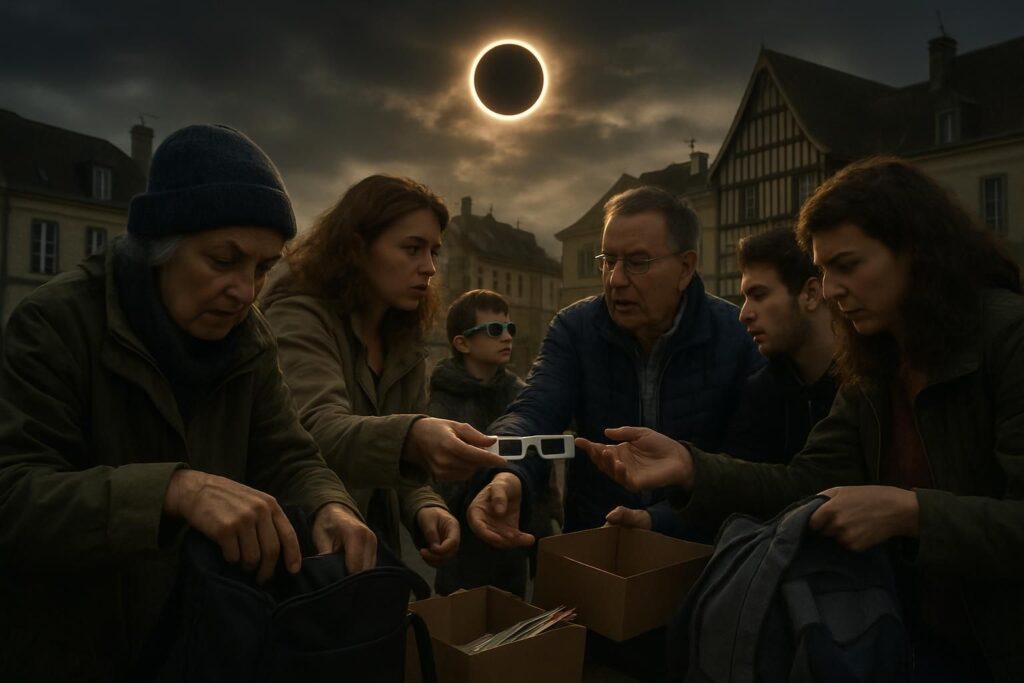
When a major solar eclipse looms on the horizon, the collective fascination with this celestial phenomenon often disrupts local habits, as was the case in Châlons-en-Champagne. Preparing to observe this astronomical marvel quickly became a race against time to procure glasses specifically designed to safely admire the spectacle. The demand, far exceeding the supply, transformed a simple quest into a real challenge, balancing safety constraints, local shortages, and expert advice to avoid endangering one’s vision. This excitement, typical of rare astronomical events, mobilizes not only enthusiasts but also professionals and institutions keen to ensure an accessible and secure experience.
Châlons-en-Champagne, known for its rich winemaking heritage in the heart of the Champagne region, saw its shops rapidly overwhelmed. Faced with an unexpected influx, specialized and general retail stores were quickly out of stock. This situation highlights the need for better collective anticipation as well as clear information regarding the essential equipment for observing a solar eclipse, notably certified glasses. Beyond the logistical challenge, it also represents an awareness of vision protection against a phenomenon that can cause irreversible damage. At the same time, alternative solutions and local initiatives have emerged to facilitate group observation, while respecting the strictest safety rules.
Solar eclipse and visual safety: why certified glasses are indispensable in Châlons-en-Champagne
The solar eclipse fascinates and yet demands special attention due to the serious risks it poses to eye health if one is not properly equipped. The intense light emitted by the Sun, even partially obscured, contains ultraviolet (UV) rays as well as infrared rays, capable of causing permanent retinal damage. Thus, it is essential to use glasses specially designed and certified ISO 12312-2 to ensure optimal protection. Without this, even the slightest direct or prolonged gaze risks irreversibly damaging vision.
In Châlons-en-Champagne, as elsewhere in France, the general public is advised by health authorities and the Astronomical Society of France about these requirements. The latter warns against regular sunglasses, whether category 3 or 4, which do not filter radiation sufficiently. Only certified filters can block 100% of UV and reduce brightness to a safe level for direct observation of the Sun during the entire eclipse.
This point of caution is all the more crucial since unsafe observation can cause temporary blindness or retinal burns. Approaching August 12, the expected date of the next partial eclipse visible in the region, local authorities are multiplying awareness campaigns. They direct people to purchase from reliable sales points and remind them of the importance of checking the conformity of glasses with CE marking and the ISO standard. These simple actions ensure a safe experience, essential for fully enjoying the spectacle of this solar eclipse, a natural phenomenon also rich in lessons in astronomy and space sciences.
In Châlons-en-Champagne, stores out of stock: a shortage revealing the challenges of anticipation during the solar eclipse
The announced success of the solar eclipse triggered a rush toward shops offering protective glasses in Châlons-en-Champagne. This exceptional influx led many establishments to manage a local shortage unprecedented in scale, a phenomenon also recorded in other French cities. Several reasons explain this situation: initially low stocks, sudden surge in demand, and, it must be emphasized, still imperfect communication about the necessity and method of acquiring certified glasses.
Local merchants, sometimes unprepared for this influx, often underestimated demand, believing it would be a modest peak. As a result, from the first weeks preceding the eclipse, shelves became empty. The most foresighted who bought very early thus found themselves protected, but many other residents and visitors embarked on a true obstacle course to find suitable glasses. This situation generated frustration and worry, as it is impossible to do without this device without compromising eye safety.
Faced with this observation, local authorities and associations considered alternative solutions such as setting up free distribution points in coordination with official suppliers, hoping to regulate demand more effectively. At the same time, advice to avoid counterfeit glasses intensified, emphasizing that some products circulating on the market do not guarantee sufficient protection, sometimes sold at exorbitant prices or online without rigorous control.
This experience highlights a wider national issue of preparation for astronomical events, illustrating both the needs for logistics and education. The city of Châlons-en-Champagne is thus invited to promote better collective anticipation to avoid similar situations during future eclipses, notably through the use of local associative networks and partnerships with schools and cultural institutions to raise awareness among younger generations.
Safe observation methods and alternatives to certified glasses in Châlons-en-Champagne
While ISO 12312-2 certified glasses remain the recommended solution for observing a solar eclipse safely, several alternatives also allow enjoying the spectacle, especially in case of shortage. These methods, often educational, offer the opportunity to organize collective observation sessions, especially in public spaces or during astronomical events proposed by local clubs.
Among the most accessible techniques is pinhole projection: a simple device where the Sun’s shadow is projected through a small hole onto a white surface, allowing one to see its shape without looking directly at the Sun. This technique requires no expensive equipment and can be used in all schools and civic activities.
Telescopes equipped with specific solar filters or astronomy instruments with certified models also constitute reliable means for detailed observation. In Châlons-en-Champagne, several astronomy associations organize public sessions during the eclipse, providing professional supervision and ensuring participant safety.
Furthermore, it is essential to remind that usual glasses, even very dark ones, should never be used in this context. The risks to eye health are real. Respecting this instruction remains the first reflex to adopt. If certified glasses cannot be obtained and there is no access to collective events or devices, the exclusive use of these indirect observation methods is the best alternative.
Moreover, the link between the necessary eye protection for the eclipse and the local culture resonates with the world of Champagne and regional heritage. All the attention given to this quest for glasses to observe the eclipse also helps to showcase skills and legacies, as discovered in the following link on the history of the Treasure of the Sun King or anecdotes scattered throughout the region.
Organizing a collective observation in Châlons-en-Champagne: energizing the community around astronomy
Faced with difficulties in equipping themselves individually, the collective mobilization around the solar eclipse in Châlons-en-Champagne amazes with its unprecedented initiatives. Organizing supervised group observation sessions not only provides enhanced safety but also enriches the experience with scientific explanations, historical context, and discussions about the importance of these phenomena in our understanding of the universe.
These events, often initiated by astronomy clubs, schools, or city halls, also help to cope with the shortage by sharing equipment. Certified glasses are thus used in rotation, or participants benefit from shared instruments, increasing accessibility to an extraordinary natural spectacle. These gatherings also contribute to spreading good practices for observing the Sun.
Besides strengthening local cohesion, these collective observations create a favorable setting for intergenerational exchanges, between experts and amateurs, enthusiasts or simple curious. They stimulate interest in science, particularly among young people who can discover astronomy through an event well anchored in their daily Châlons life. It is an additional educational opportunity that extends manifestations such as those linked to the Olympic Games or regional cultural events, scattered across numerous local news.
Finally, this collective dynamic paves the way for greater vigilance for upcoming eclipses, improving local preparation and information. A challenge met that shows that the eclipse, a universal celestial phenomenon, can become a unifying vector and a lever for culture and social sharing at the communal level.
Lessons to learn to prepare for the next solar eclipse in Châlons-en-Champagne
The recent experience shows that logistics related to safely observing a solar eclipse in Châlons-en-Champagne must be taken seriously. The exceptional demand revealed organizational flaws but also a real opportunity for improvement. It is about anticipating more, not only the supply of certified glasses but also public information and the establishment of accessible collective organization.
To better prepare in the coming years, several avenues have been identified:
- Strengthen local communication on the ocular risks linked to unprotected Sun observation and on the certification criteria of glasses;
- Establish lasting partnerships between local authorities, merchants, and astronomy associations to guarantee a sufficient and secure supply;
- Diversify observation solutions to offer educational alternatives via projection devices or supervised sessions;
- Encourage training and awareness in schools and during civic events to educate the young about good practices and passion for astronomy;
- Create a network of volunteer observers to support the population and thus ensure relevant monitoring of equipment needs and assistance on the day J.
Through this approach, Châlons-en-Champagne will position itself as a model for the optimal organization of local astronomical events, energizing both scientific knowledge and the social fabric. These efforts fit into a broader dynamic of valuing regional, cultural, and scientific riches, integrating the impact of phenomena such as the solar eclipse on territories and their inhabitants.
Why use only certified glasses to observe a solar eclipse?
ISO 12312-2 certified glasses ensure complete filtration of ultraviolet and infrared rays, preventing irreversible retinal damage. Regular glasses do not guarantee this protection.
How to recognize a pair of glasses compliant for the eclipse?
Certified glasses bear the CE marking and the ISO 12312-2 standard. They must be purchased from authorized dealers, notably physical stores or via local authorities during distributions.
What alternatives exist if I cannot find certified glasses?
Indirect methods like pinhole projection or observation through a telescope equipped with specific solar filters provide secure observation without risk.
Is it safe to use regular sunglasses during the solar eclipse?
No, sunglasses, even very dark ones, do not filter harmful rays sufficiently and can cause serious retinal damage.
Where can I participate in a collective observation of the eclipse in Châlons-en-Champagne?
Many local astronomy associations and clubs organize public events, often announced by the city hall or schools. Check local platforms and information bulletins.