
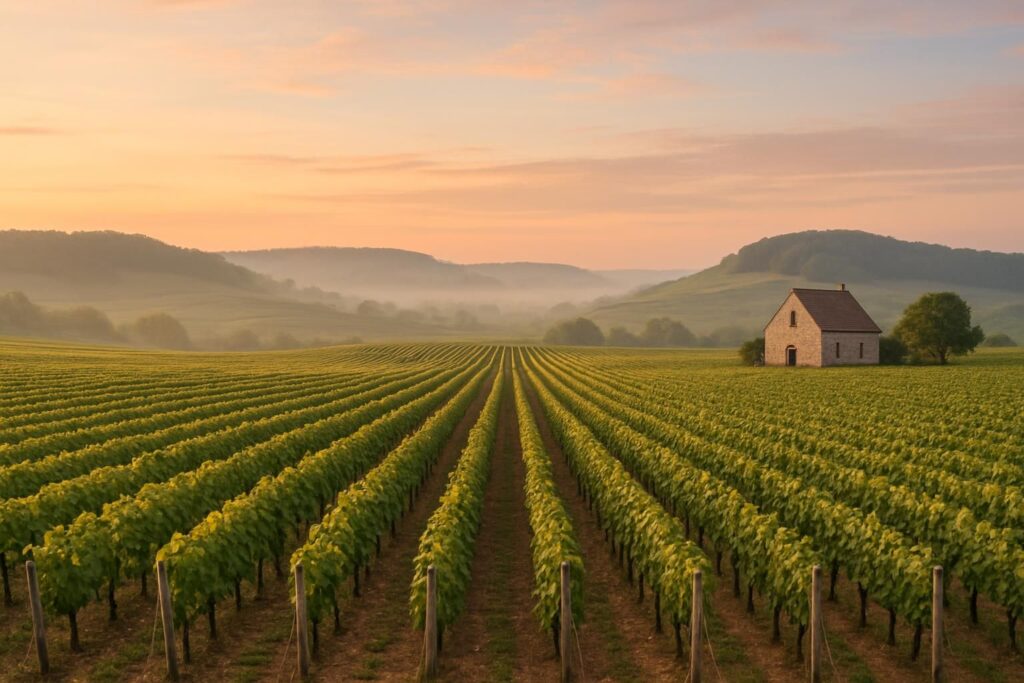
At the heart of the Champagne vineyard, the Aube stands out as a major player in sparkling wine, embodying the “second cradle” of champagne, after the Marne. Far from the clichés dominated by Reims and Épernay, this department conceals a unique terroir, the Côte des Bar, vast and authentic, where family traditions and sophisticated know-how come together. This territory with a rich and little-known heritage invites a deep discovery, both for oenology enthusiasts and lovers of wine tourism. The Aube offers a preserved natural setting, a network of picturesque villages, and exceptional tasting experiences that contribute to the growing reputation of this bold wine region. From the limited media coverage of its vineyards to its current economic challenges, this region raises key questions about the future of champagne, its adaptation to climatic constraints, and the balance between tradition and innovation in the sector.
The Aube and the Côte des Bar: a fundamental and authentic terroir of champagne
The Aube, with its 8,100 hectares of vineyards classified under appellation, represents an essential part of the Champagne vineyard. The Côte des Bar, which stretches here, forms a unique terroir characterized by limestone and clay-limestone soils, gentle topography, and a moderate continental climate. These particular conditions favor the cultivation of pinot noir, the predominant grape variety in this region, and give sparkling wine a distinct aromatic signature, fruitier and often more powerful than that of northern terroirs.
From an agronomic point of view, the variety and quality of the soils allow for balanced grapes, suitable for classic cuvées but also for crémant, less known but booming in this territory. These vines, often managed on family farms, actively contribute to the local economic wealth and play a major role in the export of champagne. The relationship between the Aube and the major houses traditionally located around Reims and Épernay is also strategic: they largely depend on Aube grapes to maintain their export volumes, which amounted to 5.8 billion euros in 2025.
In practice, the Côte des Bar particularly benefits from an oenological dynamism with increased attention to the quality of grapes and winemaking processes. Many winemakers combine respect for the terroir with technical innovation to meet climate challenges, notably by reducing commercial yields. In 2026, the quota was lowered to 8,800 kilos per hectare to ensure better quality, even if some plots see much lower harvests. This context leads to a profound reflection on the future balance of the Champagne sector, where the Aube plays an irreplaceable role.
The development of wine tourism in this region is also a lever for enhancing the territory, offering visitors cultural, gastronomic, and oenological experiences unique in a rural setting. Not limited to simple cellar tastings, this dynamic now includes hiking trails, visits to emblematic villages, and events around sparkling wine, giving rise to sustainable and responsible tourism.
Economy and family establishment: the discreet strength of Aube viticulture
While Champagne is often associated with the major houses established between Reims and Épernay, the Aube stands out for the crucial importance of its family-run estates. These wine estates, often human-sized, cultivate the Champagne tradition relying on know-how passed down from generation to generation. These southern winemakers contribute significantly to the supply of pinot noir to the more famous houses, demonstrating a genuine regional network based on cooperation and complementarity.
Contrary to the technological and industrial concentration prevailing in the Marne, the wine economy in the Aube is characterized by adaptability and a very marked territorial anchoring. The diversity of estates, ranging from small artisanal domains to more structured houses, guarantees some resilience against climatic or economic hazards. However, the marketable yields in 2026 reflect the impact of climate change, with some producers estimating that they will not be able to reach half of the allowed quota.
This situation directly impacts the market with cascading effects on production and prices. More importantly, it fuels a recurring debate about the solidity of a sector thought of as “indivisible,” where the grapes of one region fundamentally depend on those of others. This interdependence is particularly visible in the ability of major houses to maintain their export volumes which, despite fluctuations, reached nearly 5.8 billion euros in 2025.
Moreover, this economic reality is also confronted with the real estate dynamic. The price of vineyard land in the region remains competitive compared to northern departments, but demand is increasing, especially around villages benefiting from significant tourist appeal. This rise, encouraged by wine tourism, prompts owners to rethink their land management in the medium term to ensure the sustainability and enhancement of their heritage.
This vineyard organization offers many advantages, particularly in terms of product quality and authenticity, but also raises modernization and economic balance issues that are essential to master in order to maintain champagne’s international renown.
Discovering oenology in the Aube: unique tasting and training experiences
The viticultural wealth of the Aube is not limited to production; it also translates into a developed and diversified oenological offering that attracts a growing number of amateurs and professionals each year. Many cellars offer visiting circuits including tasting workshops, allowing a grasp of the subtleties of sparkling wines grown in the Aube area.
The 2026 context offers a renewed perspective on tasting thanks to the highlighting of rare grape varieties and specific cuvées. Some estates, aware of the potential of their terroir, develop ranges including crémant, offering a wide variety of styles and textures. These oenological initiatives contribute to a better understanding of the region’s gustatory particularities and enhance the original compositions of champagne.
Internships and training courses offered by renowned oenologists enrich the experience, proposing a rigorous pedagogical approach combining technical knowledge and sensory pleasure. These courses are often designed to meet the expectations of wine tourists as well as professionals seeking improvement.
The market for affordable champagnes is also highlighted in this region, where producers manage to reconcile quality and price ratio, thus promoting democratization of access to this prestigious wine. The first tasting, often improvised during a visit, quickly gives way to an immersive experience combining exploration of local history, discovery of winemaking methods, and exchanges with passionate winemakers.
This wine tourism also includes events such as fairs, thematic activities, and meetings around sparkling wine. These events are opportunities to strengthen the bond between producer and consumer, while enhancing the notoriety of the Aube in Champagne at a national and international scale.
Culture, heritage, and tourism in the Aube: a setting for champagne
The Aube is not limited to its vineyard: the cultural and historical richness of this region increases its attractiveness. Crossed by the Seine, this destination is full of medieval witnesses, with remarkable churches and villages featuring typical architecture, notably timber-framed houses that tell local history. Art and history lovers find a fertile ground to complement their oenological journey.
The department has succeeded in enhancing its heritage through cultural events and themed routes, integrating immersive experiences and temporary exhibitions. This highlighting of the past strengthens the view of the Aube as a land of exception, to be discovered beyond its champagne bottles. The city of Troyes, a medieval gem, perfectly embodies this duality of a region between historical tradition and tourism modernity.
The majestic lakes of the Forêt d’Orient offer a natural breath, allowing the combination of outdoor activities and cultural getaways. The combination of these assets transforms the Aube into an ideal destination for slow and qualitative tourism, respectful of the rhythms of the terroir and the seasons.
Moreover, the local gastronomy, associated with the wine heritage, offers a blend of flavors that seduce the most demanding visitors. Circuits combining vineyard discovery, tasting, and regional food exploration reinforce this positioning. In 2026, this dynamic is largely supported by local actors, who work together to promote their riches.
Climate challenges and the future of champagne in the Aube: adaptations and perspectives
Faced with the numerous environmental challenges encountered by viticulture, the Aube has positioned itself as a key territory to observe champagne’s evolutions and test new adaptation strategies. The tightening of the marketable yield for the 2026 harvest, set at 8,800 kilos per hectare, reflects this desire to favor quality and sustainability in the face of climate hazards. Some producers fear, however, that they will only be able to harvest half of this quota, exposing the fragility of the current viticultural model.
This situation underlines the need for better organization in the sharing of roles within the sector. The Marne continues to set the commercial pace, while the Aube must absorb the impact of climate fluctuations, notably on the ripening of pinot noirs. This mutual dependence questions the future of a sector conceived as an indivisible whole, which may have to reinvent itself to guarantee its sustainability.
Oenological research is underway in the region, aiming to select grape varieties adapted to climate change, improve cultural practices, and strengthen vineyard resilience. Technological innovation, combined with the richness of local heritage, represents a double opportunity for the Aube to maintain its position as a key player.
This transition period also energizes exchanges between wine professionals, institutions, and consumers, called upon to share a common, more conscious and responsible vision. The Aube thus illustrates a vital laboratory where ancestral traditions and contemporary demands come together. This complexity symbolizes one of the major challenges for the future of champagne, with at stake a wine still sparkling, but also more authentic and sustainable.
Why is the Aube called the second cradle of champagne?
The Aube is home to the Côte des Bar, a major terroir of the Champagne vineyard that produces a significant share of the pinot noir necessary for champagne production. This traditional wine region, rich in family know-how, plays a vital role for the entire sector, alongside the Marne.
What are the oenological advantages of the Côte des Bar in the Aube?
The terroir of the Côte des Bar offers a diversity of limestone soils and a climate adapted to pinot noir cultivation, which gives the champagne from this region a unique aromatic personality, fruitier and more structured.
How is wine tourism developing in the Aube?
Wine tourism in the Aube relies on discovery routes through the vineyards, tasting cellars, cultural events, as well as educational activities. This immersive approach helps to enhance the terroir while boosting the local economy.
What are the main difficulties faced by Aube viticulture?
Climatic conditions greatly affect yields, forcing producers to reduce their quotas, with significant economic consequences. Managing uncertainties and the need to innovate to preserve quality are at the heart of debates.
What innovations allow the Aube to face climate change?
Winemakers in the Aube are experimenting with the selection of suitable grape varieties, improving cultural practices, and integrating advanced technologies to maintain the quality and sustainability of the vineyard despite climate variations.